CRE POLICY NEWS
Anne Arundel County Pauses New Data Centers and Repeals Their Tax Break
The Anne Arundel County Council in Maryland voted 7 to 0 on October 5, 2026 to pass Bill 63-26, according to the county’s bill page. The amended text stops the county from accepting new data center applications until January 31, 2028 at the latest. It also repeals a 2022 code section that reduced the personal property tax assessment on qualified data center equipment for 15 years.
Direct answer
Direct answer to Anne Arundel County data center moratorium
Coverage called this a moratorium. The first operative section is a tax repeal: a 15-year assessment reduction, 100 percent for five years and 50 percent for the next ten, comes out of the county code, and the bill has no transition language for a center already receiving it. The pause starts 45 days after the bill becomes law, and plan applications filed before then may proceed. On any Anne Arundel site, check the filing date and the tax assumption first.
What the County Council passed on October 5
Anne Arundel County’s bill page records that Bill 63-26 was introduced on July 20, 2026, amended on September 21 and passed on October 5, with all seven councilmembers voting yes. The bill began as something else. As introduced by Councilmember Nathan Volke, it would have removed data storage centers from every zoning district that allows them. The amended bill the county posted strikes that text line by line and replaces it with three things: the repeal of county code section 4-3-104, a temporary stop on new applications, and a work group. The stop runs for what the bill calls the Effective Period, from the bill’s effective date to the earlier of January 31, 2028 or the effective date of legislation, based on the work group’s recommendations, that comprehensively regulates data storage centers.
During that period, Section 3 says the county shall not accept any new applications of any type for any proposed development of a data storage center. Three groups may proceed: preliminary plan, site development plan, sketch plan, modification and final plan applications filed before the period begins; applications associated with those plans; and future phases of any existing data storage center on adjacent or adjoining properties. Section 4 binds the council itself: it shall not introduce, consider, hear or pass data center legislation during the period, except for an acute emergency, to form the work group, or to act on the work group’s recommendations. The work group has one appointee per councilmember, four appointed by the County Executive and confirmed by the council, and designees from five county offices and agencies. By PSV’s count that computes to 11 appointed members and five ex officio. Its report is due no later than ten months after the effective date. The bill takes effect 45 days from the date it becomes law.
Why the tax repeal matters more than the pause
Section 1 is one sentence: section 4-3-104 of the county code is repealed. The county’s Bill 13-22, passed February 22, 2022, shows what that section does. Qualified data center personal property, in a qualified data center with at least $10 million of total investment and at least 10 qualified positions, may receive a 15-year reduction in assessment for county personal property tax: 100 percent for the first five taxable years and 50 percent for years six through 15. The section takes its definitions of a qualified data center and of qualified data center personal property from the state tax code, which PSV did not read for this brief. The section requires an application or a renewal by April 15 before each taxable year. Bill 63-26 repeals it outright. The text has no clause for a center already inside its 15 years, and whether a repealed section can still be renewed is a question for tax counsel and the county Office of Finance. PSV does not know whether any center has received the reduction. The 2022 law requires an annual report naming recipients, and PSV did not locate it.
The pause is narrower than the word moratorium suggests, and the timing is the reason. It does not begin on October 5. It begins when the bill takes effect, 45 days after it becomes law, and the county’s page gives a passage date but no date for the County Executive’s action. If the bill had become law the day it passed, 45 days computes to November 19, 2026, so the real date is that or later. Until then the existing zoning stands, because the amendment struck every zoning change. The introduced text shows what existing law allows: data storage centers as a permitted use in the W1, W2 and W3 industrial districts, the MXD-S mixed use district and one Odenton Town Center district, and as a conditional use in two commercial districts inside the BWI and Fort Meade growth area. The amendment also struck the proposed new definition, so the pause applies to the definition already in the code: a facility used primarily for the storage, management, processing and transmission of digital data.
The workflow PSV would run: a county status sheet for one site
The work is one page per site or operating campus in the county. The inputs are the amended bill and the county’s bill page; the date the bill became law and the effective date, confirmed with the council’s administrative officer; the project’s application log from the Office of Planning and Zoning, with each filing’s type and date; the parcel map, to test whether an expansion sits on adjacent or adjoining property; and the personal property tax lines in the underwriting model. The output answers four questions with a citation beside each: was a plan application of a type the bill names filed before the Effective Period, is this a future phase of an existing center on adjoining land, does the model carry the assessment reduction, and what does the tax line look like without it.
The reviewer is land use counsel for the filing questions and tax counsel or the controller for the assessment question, with the development lead signing the sheet. The approval gate: no letter of intent, deposit or budget for an Anne Arundel data center goes forward until the sheet shows the effective date in writing from the county and a tax case with the reduction removed. An assistant helps with the reading. The amended bill is eight pages in which struck text and new text sit side by side, and plain text extraction drops the strike marks, so the first pass has to be checked against the page images. Lining up the application log against the bill’s list of application types is work to hand off. Deciding whether a parcel is adjoining is not. PSV ran no model on any Anne Arundel site, tested no product, and promises no approval, tax outcome or saving.
What stays with a person, and where the records differ
The operator read
Finish with the judgment call.
The reported facts are above. Enter your email for PSV's operator conclusion and a year of access to every newsroom brief.
Free. No card. Privacy policy. Unsubscribe anytime.
 by PSVLive
Build the workflow behind this analysis. Train with the operators doing it.
Real deal files, live builds, and production-ready CRE AI workflows inside the CRE AI Institute.











Clear answers
Common questions about Anne Arundel County data center moratorium
How long does Anne Arundel County’s data center moratorium last?
Bill 63-26, passed 7 to 0 on October 5, 2026, sets no length in months. The pause runs from the bill’s effective date, which is 45 days after it becomes law, to the earlier of January 31, 2028 or the effective date of legislation, based on a work group’s recommendations, that comprehensively regulates data storage centers. The work group’s report is due no later than ten months after the effective date. The county’s bill page gives the passage date but not the date the bill became law.
Which data center projects can still proceed in Anne Arundel County?
The amended bill says the county shall not accept new applications of any type for a proposed data storage center during the pause. It allows three groups to proceed: preliminary plan, site development plan, sketch plan, modification and final plan applications filed before the period begins; applications associated with those plans; and future phases of any existing data storage center on adjacent or adjoining properties. Whether a specific filing or parcel qualifies is a question for land use counsel.
What data center tax break did Anne Arundel County repeal?
Section 1 of Bill 63-26 repeals county code section 4-3-104, created by Bill 13-22 in 2022. That section allowed a 15-year reduction in the county personal property tax assessment on qualified data center personal property, 100 percent for the first five taxable years and 50 percent for years six through 15, for a qualified data center with at least $10 million of total investment and at least 10 qualified positions. The repeal has no transition language, and the only fiscal note posted predates it.
Primary source record
These records support the reported facts in this brief. PSV’s CRE workflow interpretation and test plan are original analysis.
- Anne Arundel County Council, Bill No. 63-26 (As Amended) bill page (source of the introduction, amendment and passage dates and the final vote of all seven councilmembers)
- Anne Arundel County Council, Bill No. 63-26, amended September 21, 2026 (source of the repeal of section 4-3-104, the Effective Period, the application stop and its exceptions, the limit on council legislation, the work group, the ten-month report deadline, the 45-day effective date, and the struck zoning text and definition)
- Anne Arundel County Office of the Budget, Fiscal Note for Bill 63-26, August 11, 2026 (source of the fiscal analysis of the introduced bill, which reports no effect on revenue and predates the tax repeal)
- Anne Arundel County Council, Bill No. 13-22, passed February 22, 2022 (source of section 4-3-104: the $10 million investment and 10 position thresholds, the 15-year reduction at 100 percent for five years and 50 percent for years six through 15, the April 15 application and renewal deadline, and the annual report)
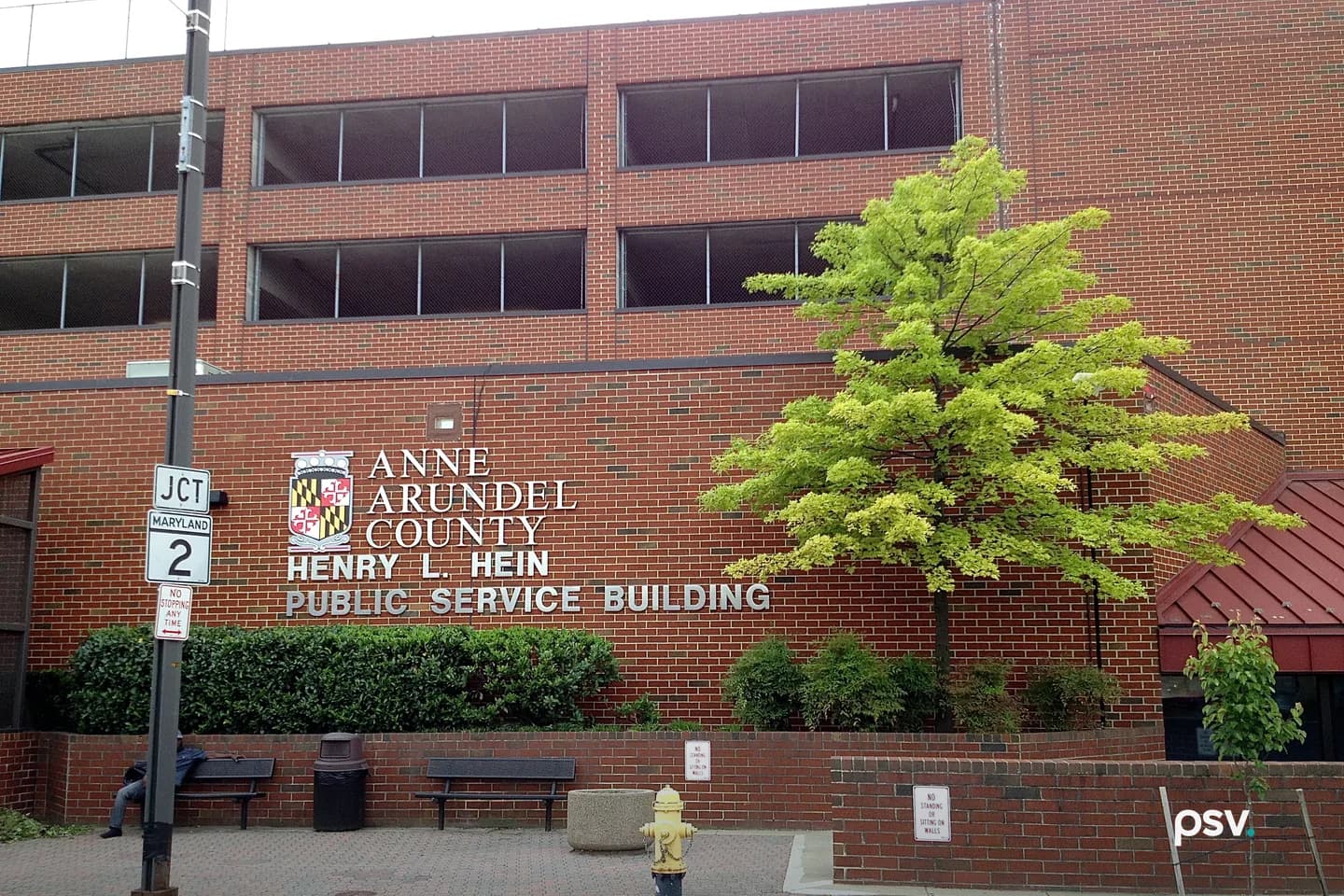
- Djembayz, “Anne Arundel County Henry L Hein Public Service Building,” Wikimedia Commons, CC BY-SA 3.0 (lead photograph source)
Topics
Related PSV analysis
CRE POLICY NEWS
Maryland Puts Every 25 MW Data Center Through State Review
Governor Wes Moore signed Executive Order 01.01.2026.16 on September 23, putting any Maryland data center of 25 megawatts or more through one state review the moment it asks the state for a permit, incentive or letter of support. A new task force grades each project Aligned, Conditionally Aligned or Not Aligned on a public dashboard, and the governor will ask lawmakers to repeal the 2020 sales tax exemption.
CRE POLICY NEWS
Loudoun Leaves 15 Grandfathered Data Center Projects Alone
Loudoun County’s Board of Supervisors on October 6 took up a proposal to end early the 2025 rule that lets 15 pending data center site plans, 30 buildings and about 10.5 million square feet, proceed without a board vote. Staff warned of $45 million to $60 million in potential liability. The board changed nothing, and local outlets report it tabled a $200,000 audit of those projects 7-2.
CRE POLICY NEWS
Cheyenne and Arapaho Citizens Vote a Three-Year Data Center Moratorium on Tribal Land
At their annual Tribal Council meeting in Concho, Oklahoma on October 3, citizens of the Cheyenne and Arapaho Tribes voted on Resolution 100326ATC-004, a moratorium on building new data centers on tribal land. News 9 reported it passed 261 to 83. The resolution says the tribal administration was considering a data center, and that non-disclosure agreements are not in the Tribes’ best interests.
Related guides
Cornerstone PSV guides on the workflows in this article.
Claude for Real Estate Developers
The ground-up developer field guide: site selection through IC memo, built on a real development deal.
Read the guideWhat is CRE AI?
The definitional guide to commercial real estate AI: the core workflows, how it differs from a chatbot, and how to learn it.
Read the guideby PSVLiveYou read the operator view. Now learn to run the workflow.
The AI MBA for commercial real estate: the workflows these briefs describe, taught end to end on real deal files, with live builds and a community of CRE operators.