CRE PROPTECH NEWS
SwiftConnect Buys HID SAFE: The CRE Read on Access Governance
SwiftConnect said on July 22 it acquired HID’s Workforce Business Unit, including HID SAFE, the physical identity and access management suite, and is folding it into its cloud AccessCloud platform. HID keeps a minority, non-controlling stake, and financial terms were not disclosed. For real estate, the deal pushes building access toward one system that both credentials people and governs who is allowed where, and revokes that access automatically when roles change.
Direct answer
Direct answer to SwiftConnect HID SAFE acquisition commercial real estate
Yes, SwiftConnect acquired HID SAFE. The company said on July 22, 2026 that it bought HID’s Workforce Business Unit and will combine HID SAFE’s physical identity and access management software with its AccessCloud access network. HID retains a minority stake and terms were not disclosed. For commercial real estate, the read is that access governance, the rules for who gets into which building, floor, and door, is consolidating into the same cloud layer that issues the mobile credential.
What SwiftConnect announced
On July 22, 2026, SwiftConnect said it acquired HID’s Workforce Business Unit, including HID SAFE, which the company describes as the leading platform for automating identity lifecycle management in the physical world. HID SAFE is a physical identity and access management, or PIAM, suite: the company says it manages the governance layer, automating access requests, approvals, policy enforcement, and revocation based on changes in HR, IT, and security systems. SwiftConnect’s AccessCloud platform connects identity providers, mobile credentials, and access control systems across buildings, campuses, and portfolios. Those descriptions are the companies’ own, distributed through the July 22 press release, not PSV findings, and financial terms were not disclosed.
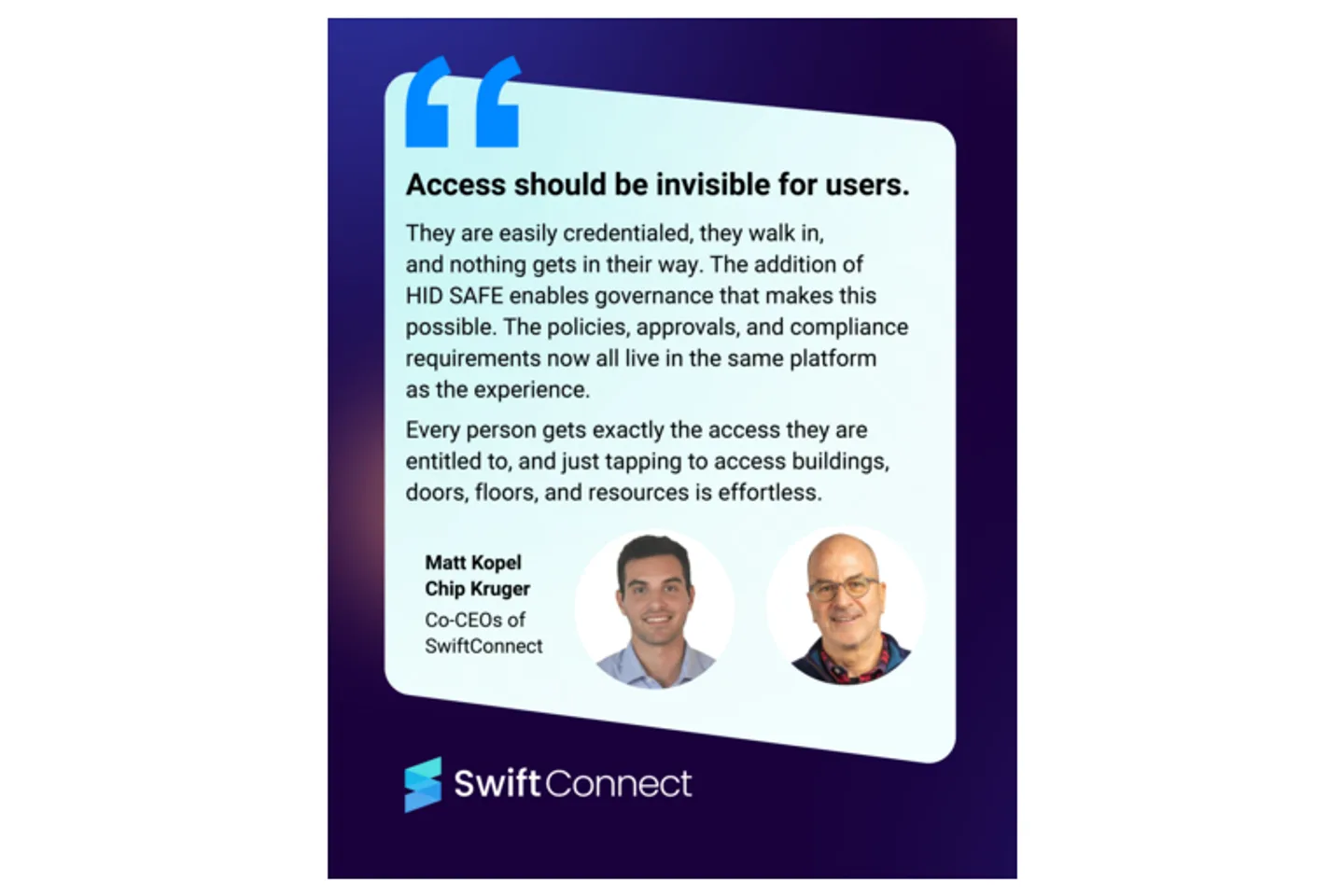
Under the deal, HID divests the unit but keeps a minority, non-controlling interest in SwiftConnect, which the companies say preserves a strategic relationship as the market converges around cloud identity, mobile credentials, and integrated governance. HID had also participated in SwiftConnect’s earlier Series B financing. SwiftConnect says it remains an independent company, controlled by its existing leadership, co-CEOs Matt Kopel and Chip Kruger, with Shane Butler joining as EVP of Identity to lead the SAFE business. In the announcement graphic, the co-CEOs framed the goal as access that “should be invisible for users,” with policies, approvals, and compliance living in the same platform as the experience. That is a stated product ambition, a company claim, not a PSV finding or a tested result.
Why a CRE operator should care
This is market-structure news, not a product launch. Two of the moving parts of workplace access, the credential a person taps to get in and the governance rules that decide what that credential is allowed to open, have typically been separate systems bought from separate vendors. Folding a PIAM suite into a cloud access network points at one record of who is entitled to which building, floor, and door across a portfolio, and one place that grants and, more to the point, revokes that access when someone joins, changes roles, or leaves. For an owner or operator running multi-tenant offices, a campus, or a portfolio, the operational pain the deal targets is real: stale access rights, manual off-boarding, and audit trails stitched together across HR, IT, and the physical security desk.
The counter-consideration is concentration. Putting credentialing and governance in one cloud platform is convenient until it is the single system whose outage locks people out or whose misconfiguration grants access it should not. It also raises the switching cost: an access layer that owns both the badge and the policy is harder to leave than a badge reader. And a governance engine is only as good as the HR and identity feeds it reads, so the promised automatic revocation depends on the building’s data being clean and connected, which in a lot of real portfolios it is not. Consolidation moves the risk, it does not delete it.
The workflow PSV would run on a proptech consolidation
Treat a deal like this as a trigger to build a vendor-and-control file, not to switch systems. The inputs are primary records and the operator’s own footprint: the July 22 press release, the two companies’ published product documentation for AccessCloud and HID SAFE, the operator’s current access-control and identity contracts, and the list of buildings, tenants, and integrations each one touches. An AI assistant reads each record and returns a cited brief: what each platform actually does, where they now overlap, which of the operator’s sites and systems are affected, what the stated integration and ownership terms are, and what questions the change raises, with every claim traced to the document it came from.
The reviewer is the operator’s security or IT lead working with the property team, and the approval gate is explicit: no renewal, migration, or new access deployment moves on a vendor summary alone. The same review produces the questions a human sends to the vendor: roadmap and support commitments for existing HID SAFE and SwiftConnect deployments, how data ownership and retention work when governance and credentialing share a cloud, what the redundancy and offline-fallback story is if the access layer goes down, and how the automatic-revocation logic behaves when an HR or identity feed is late or wrong. The tool assembles the record. It does not decide whether to consolidate a building’s access onto one platform.
What should remain human-owned
The operator read
Finish with the judgment call.
The reported facts are above. Enter your email for PSV's operator conclusion and a year of access to every newsroom brief.
Free. No card. Privacy policy. Unsubscribe anytime.
 by PSVLive
Build the workflow behind this analysis. Train with the operators doing it.
Real deal files, live builds, and production-ready CRE AI workflows inside the CRE AI Institute.











Clear answers
Common questions about SwiftConnect HID SAFE acquisition commercial real estate
What did SwiftConnect acquire from HID?
SwiftConnect said on July 22, 2026 that it acquired HID’s Workforce Business Unit, including HID SAFE, a physical identity and access management (PIAM) software suite. SwiftConnect is folding HID SAFE’s governance layer into its cloud AccessCloud platform, which connects identity providers, mobile credentials, and access control systems across buildings and portfolios. HID keeps a minority, non-controlling stake in SwiftConnect, and the companies did not disclose financial terms.
Why does the SwiftConnect HID SAFE deal matter for commercial real estate?
It consolidates two parts of workplace access that were usually separate: the credential a person taps to get in, and the governance rules that decide what that credential may open. For an owner or operator, that points at one record of who is entitled to which building, floor, and door, and one place that automatically revokes access when someone changes roles or leaves. The trade-off is single-vendor concentration at the front door and dependence on clean HR and identity feeds.
What is HID SAFE?
HID SAFE is a physical identity and access management, or PIAM, software suite that the company describes as automating identity lifecycle management in the physical world. It handles the governance layer of building access: automating access requests, approvals, policy enforcement, and revocation based on changes in HR, IT, and security systems. It was part of HID’s Workforce Business Unit, which SwiftConnect acquired on July 22, 2026, while HID retained a minority stake.
Primary source record
These records support the reported facts in this brief. PSV’s CRE workflow interpretation and test plan are original analysis.
Topics
Related PSV analysis
CRE PROPTECH NEWS
RealPage Acquires Cherre: The CRE Data Consolidation Read
RealPage says it has acquired Cherre, the data intelligence platform institutional owners use to resolve more than 4 billion entities across roughly $4 trillion in real assets. Terms were not disclosed. The companies promise operational independence and an open platform. For operators, the durable question is contractual: who now owns the pipes your portfolio data runs through, and on what terms.
PROPERTY OPERATIONS
AI for Commercial Property Management: Work Orders, CAM, Leases, and Tenant Service
Where AI can assist a commercial property-management team, where deterministic systems must remain authoritative, and which tenant-facing actions always require controls.
CRE AI SOLUTIONS
What a Commercial Real Estate AI Solution Must Prove Before It Goes Live
The best CRE AI solution is not the one with the most impressive demo. It is the one that produces work a principal, investment committee, or client can inspect and trust.
Related guides
Cornerstone PSV guides on the workflows in this article.
Best AI Tools for Commercial Real Estate
The pillar guide to choosing CRE AI tools by workflow fit and control, not vendor hype.
Read the guideThe CRE AI Data & Security Audit
The five-pass audit a CRE firm runs on its own document estate before connecting an assistant: folder access, document provenance, and the approval bands.
Read the guideProptech AI
What proptech AI means, where artificial intelligence actually works in real estate, and what separates useful proptech AI from the hype.
Read the guideby PSVLiveYou read the operator view. Now learn to run the workflow.
The AI MBA for commercial real estate: the workflows these briefs describe, taught end to end on real deal files, with live builds and a community of CRE operators.