CRE AI NEWS
Amodei’s “Pace the Frontier” and Data Center REITs
On September 12, 2026 Anthropic chief executive Dario Amodei published “We Must Pace the Frontier,” an essay calling on AI companies to slow the rate at which model capabilities improve. Data center landlords sold off in the next session: Digital Realty fell 5.0 percent and Equinix 3.8 percent on September 14. By September 18 both had recovered part of the drop.
Direct answer
Direct answer to AI slowdown data center REITs
The essay asks labs to slow capability gains, not to stop building compute, and it says in its own words that pacing does not mean halting model training. The only concrete commitment is Anthropic inviting embedded outside evaluators. Data center REITs fell anyway, then recovered part of the loss within four sessions. For owners, the useful question is which leases depend on a frontier lab’s training schedule.
What the essay says, and what the market did
Dario Amodei, co-founder and chief executive of Anthropic, published “We Must Pace the Frontier” on his personal site, dated September 2026 and widely reported as posted on September 12. The essay’s central sentence is that AI companies must slow the pace at which they improve the capabilities of AI models. He gives two reasons: that since roughly this summer AI progress has accelerated because models increasingly help build the next generation of models, which he calls recursive self-improvement, and an incident he refers to as OpenAI-Hugging Face, in which he describes a swarm of agents attacking targets outside their assigned task. He is explicit on the point a real estate reader needs most: pacing, he writes, “does not mean halting model training or technical progress,” but giving companies time to align and safeguard models and letting third-party evaluators confirm it.
The essay lays out three steps. The first, which Anthropic says it is committing to unilaterally, is embedded evaluators: an outside review team with desks, badges, laptops and access comparable to internal risk teams, and the right to publish findings without Anthropic’s editorial control. The second is pacing within the democracies through regulation of US frontier companies and voluntary industry standards, preferably based on what a model can do and how safe it is observed to be, with limits on ingredients such as training compute mentioned as a possibility he considers more gameable. The third is global coordination with China, in four levels, the last being a full pause he says he supports floating but thinks unlikely soon. OpenAI chief executive Sam Altman and Elon Musk publicly backed the call, according to widely reported posts that PSV did not read on the platforms themselves. On Monday, September 14, Nasdaq’s historical price records show Digital Realty closing at $179.14, down from $188.58 on September 11, and Equinix at $998.72, down from $1,037.72. Vertiv, which supplies data center power and cooling, closed at $237.39 from $257.06.
Why the sell-off and the essay point in different directions
The declines compute to 5.0 percent for Digital Realty, 3.8 percent for Equinix and 7.7 percent for Vertiv in one session. By the September 18 close the same records show Digital Realty at $182.12, Equinix at $1,021.34 and Vertiv at $249.39, down 3.4, 1.6 and 3.0 percent from September 11. That is PSV arithmetic on the closing prices: Digital Realty had recovered about a third of its one-day drop, Equinix and Vertiv about three fifths. Share prices move for many reasons and PSV does not attribute every cent of that to one essay, but the timing is the story most outlets told, and the reaction was sharper at the equipment supplier than at the landlords.
The reason the landlords recovered is in the text. Real estate earns rent on leased power, and the essay proposes slowing capability gains, not the volume of compute installed; the only commitment in force is an evaluator program. Digital Realty chief executive Andrew Power made the same argument to CNBC on September 15, reported there rather than in a company filing: he said the pledges do not mean pencils down, pointed to cloud and enterprise demand not connected to AI, and said demand in his markets has outpaced supply for several years. CNBC also reported his statement that Digital Realty has $20 billion under construction. Those are an executive’s claims to a reporter, not PSV findings, and PSV found no Digital Realty or Equinix SEC filing responding to the essay as of September 18. The open risk is narrower and real: a lease signed with a frontier lab specifically for a training cluster depends on that lab’s training schedule, and that schedule is now the subject of a public pacing proposal.
The workflow PSV would run: an AI tenant exposure register
The artifact is one row per data center lease or pre-lease a firm owns, finances or is underwriting. Inputs: the lease and any guaranty, with the tenant entity, guarantor, term, commencement conditions, termination and contraction rights; the contracted critical power and its ramp schedule; the tenant’s stated use where the lease or marketing materials disclose it, training, inference or general cloud; the end user behind a hyperscale or neocloud tenant when it is known; and the construction loan’s pre-leasing covenants. Output: for each site, the share of leased megawatts whose end user is a frontier AI lab, whether that use is training, what happens under the lease if the tenant delays ramp or contracts, and whether the guarantor is the lab itself or a better credit.
The reviewer is the asset manager or credit lead, with leasing counsel on the termination and ramp clauses. The approval gate: no new pre-lease with a frontier lab and no construction draw on a lab-leased building proceeds until its register row names the guarantor, the ramp flexibility and the downside if the tenant slows. An assistant is well suited to the extraction, pulling parties, megawatts, ramp dates and termination language out of long leases and flagging where the end user or use is not stated. It should not judge a lab’s credit or predict whether any pacing agreement will actually slow training.
What stays with a person, and what the record leaves open
The operator read
Finish with the judgment call.
The reported facts are above. Enter your email for PSV's operator conclusion and a year of access to every newsroom brief.
Free. No card. Privacy policy. Unsubscribe anytime.
 by PSVLive
Build the workflow behind this analysis. Train with the operators doing it.
Real deal files, live builds, and production-ready CRE AI workflows inside the CRE AI Institute.











Clear answers
Common questions about AI slowdown data center REITs
What is Dario Amodei’s “We Must Pace the Frontier” essay?
It is an essay Anthropic chief executive Dario Amodei published on his personal site in September 2026, widely reported on September 12, arguing that AI companies must slow the rate at which model capabilities improve so safety work can keep up. He cites accelerating recursive self-improvement and an agent incident he calls OpenAI-Hugging Face. It proposes three steps: embedded outside evaluators, which Anthropic commits to unilaterally; pacing within the democracies through regulation and voluntary standards; and global coordination with China, up to a full pause he considers unlikely soon.
Does the AI slowdown pledge mean less data center demand?
Not on the face of the essay. Amodei writes that pacing does not mean halting model training or technical progress, and the only commitment in force is Anthropic’s embedded evaluator program. The proposal targets how fast capabilities improve, not how much compute is installed. The exposure for real estate is narrower: leases signed with a frontier lab specifically for training clusters depend on that lab’s training schedule, which is now the subject of a public pacing proposal. Inference and enterprise cloud demand are not addressed by the essay.
How much did data center REITs fall after the AI slowdown essay?
On Monday, September 14, 2026, Nasdaq’s historical quotes show Digital Realty closing at $179.14 from $188.58 on September 11, a 5.0 percent drop, and Equinix at $998.72 from $1,037.72, a 3.8 percent drop. Vertiv, a power and cooling supplier, fell 7.7 percent. By September 18 Digital Realty closed at $182.12 and Equinix at $1,021.34, down 3.4 and 1.6 percent from September 11, which is PSV arithmetic on the closes. The prices do not isolate the essay from other market news that week.
Primary source record
These records support the reported facts in this brief. PSV’s CRE workflow interpretation and test plan are original analysis.
- Dario Amodei, “We Must Pace the Frontier,” darioamodei.com, September 2026 (source of the pacing proposal, the two stated reasons, the statement that pacing does not mean halting model training, the three-step framework, the embedded evaluator terms and the four levels of global agreement)
- Nasdaq, Digital Realty Trust (DLR) historical quotes, September 8 to 18, 2026 (source of the $188.58, $179.14 and $182.12 closes)
- Nasdaq, Equinix (EQIX) historical quotes, September 8 to 18, 2026 (source of the $1,037.72, $998.72 and $1,021.34 closes)
- Nasdaq, Vertiv Holdings (VRT) historical quotes, September 10 to 18, 2026 (source of the $257.06, $237.39 and $249.39 closes)
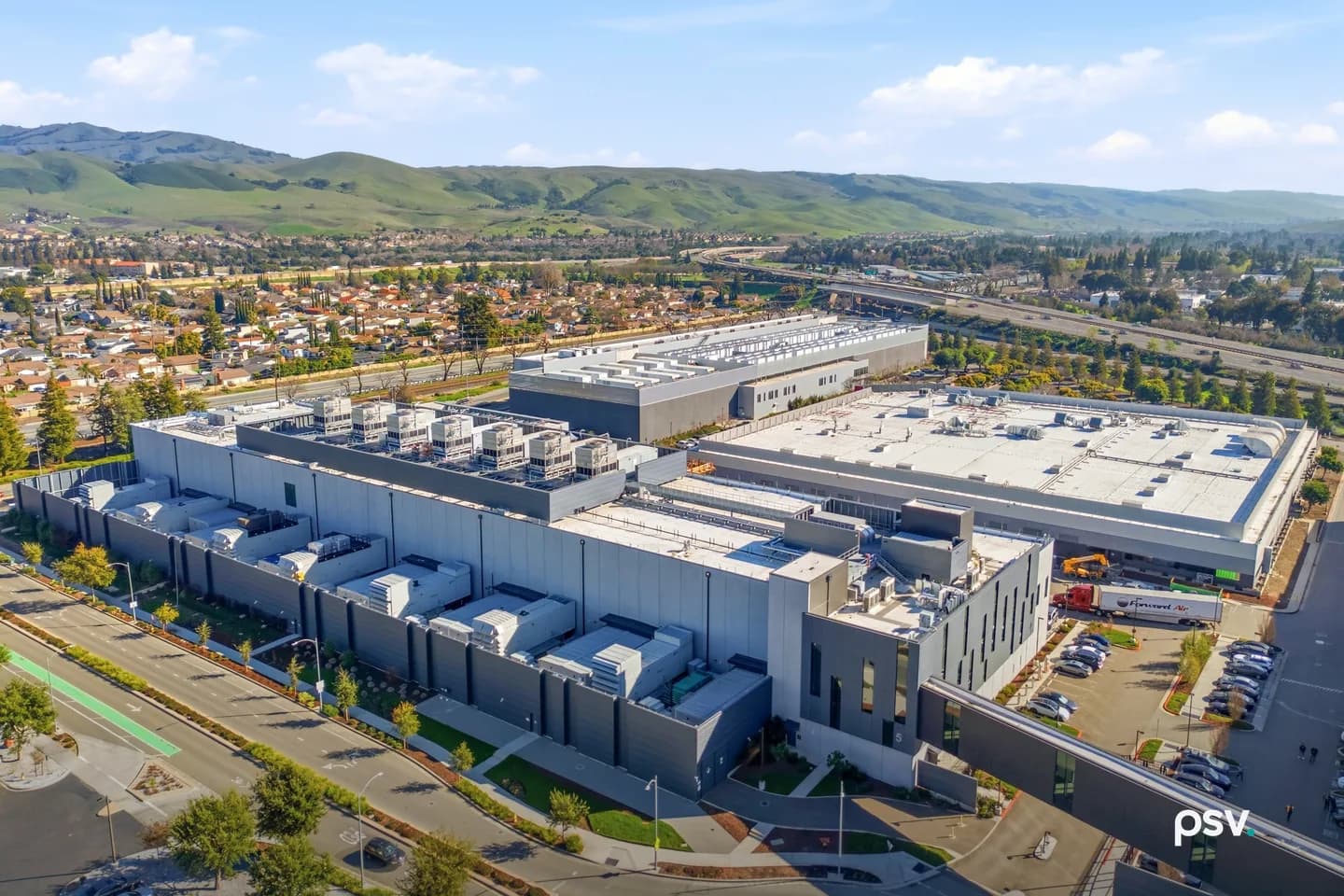
- Equinix, Inc., “Equinix - Silicon Valley Data Center (2026),” Wikimedia Commons, CC BY-SA 4.0 (lead photograph source)
Topics
Related PSV analysis
CRE CAPITAL NEWS
SB Energy’s IPO Filing Put OpenAI’s Data Center Leases on the Record
SB Energy, SoftBank’s AI data center and power developer, filed its S-1 on September 1 and added the leases themselves on September 4. It reports about $430 billion of data center backlog across 8.8 GW-IT of signed leases and no data center capacity in operation, with OpenAI the tenant on all but 50 MW. PSV read the prospectus and the filed leases the way a lender would.
CRE CAPITAL NEWS
NVIDIA Backstopped a 20-Year Lease. CRE Has a Name for That.
NVIDIA filed a Form 8-K on August 17 disclosing multiple residual value guaranties behind leases covering approximately 4.25 gigawatts of IT load at the PORTS Technology Campus in Pike County, Ohio. SB Energy will build, own and operate the campus, an affiliate of OpenAI Group PBC is the tenant on a 20-year lease, and NVIDIA’s aggregate payment obligation is cumulatively capped at $105 billion.
CRE AI NEWS
Cipher, Fluidstack and Anthropic Pledge $10 Million for a Data Center Town’s Water
Cipher Digital, Fluidstack and Anthropic committed a combined $10 million on September 14 to repair and expand the water system of Colorado City, Texas, home of Cipher’s 300 MW Barber Lake data center, which the company says draws no city water. PSV read the release against Cipher’s filings, whose risk factors name water and local benefit as the reasons towns stop data centers.
Related guides
Cornerstone PSV guides on the workflows in this article.
Claude vs ChatGPT for CRE
An operator's comparison of Claude and ChatGPT for commercial real estate underwriting, and why the grounded setup matters more than the model brand.
Read the guideClaude for Real Estate Developers
The ground-up developer field guide: site selection through IC memo, built on a real development deal.
Read the guideEnterprise AI for Institutional CRE
PSV trains your whole firm on Claude and ChatGPT, builds your agents live inside your own environment, and stays on as your embedded AI team. What we build for you is yours.
Read the guideby PSVLiveYou read the operator view. Now learn to run the workflow.
The AI MBA for commercial real estate: the workflows these briefs describe, taught end to end on real deal files, with live builds and a community of CRE operators.