CRE AI NEWS
Contractor Backlog Is Thin Everywhere But Data Centers
Associated Builders and Contractors reported on August 11 that its Construction Backlog Indicator fell to 8.0 months in July, down 0.8 months from both a month and a year ago and the lowest reading since January. Every industry, region and company size declined. The 12 percent of ABC contractors under contract to work on a data center carry 11.4 months of backlog. The other 88 percent carry 7.5.
Direct answer
Direct answer to construction backlog indicator July 2026 data centers
Thin backlog normally hands a developer bidding leverage. It does not here. ABC’s two cohort figures reconcile almost exactly to the 8.0 month headline, so the AI buildout is not padding the average, it is propping it up. Two days later ABC reported construction input prices still 7.4 percent above a year ago, with its chief economist expecting lumber and iron and steel to keep climbing. Soft demand and hard costs at the same time.
What ABC reported on August 11 and August 13
Associated Builders and Contractors reported on August 11, 2026 that its Construction Backlog Indicator fell to 8.0 months in July, based on an ABC member survey conducted July 20 to August 4. The reading is down 0.8 months from both a month and a year ago. In ABC’s words, “every industry, region and company size experienced a decline in backlog in July,” and the South remains the only region carrying larger backlog than one year ago. The association’s Construction Confidence Index readings for sales and staffing levels also fell, while the reading for profit margins increased, and all three components remain above the threshold of 50 that indicates expectations for growth over the next six months. The release is headed “ABC’s Construction Backlog Indicator Plummets in July,” which is the association’s own characterization rather than a PSV one.
The split inside that number is the story. ABC Chief Economist Anirban Basu said backlog “fell sharply in July and is down to the lowest level since January,” and then named what the headline conceals: “The data center boom masks the depth of this weakness, as there is a lack of momentum in any other segment. The 88% of ABC contractors that are not under contract to work on a data center had an average 7.5 months of backlog. That compares poorly to the 12% that are under contract to work on data centers, which have 11.4 months of backlog.” Basu added that the dynamic “has been particularly difficult for small and mid-size contractors,” and that backlog in the $30 million to $50 million annual revenue category fell to its lowest level since March 2020. Those cohort figures are ABC survey results, not PSV estimates.
Two days later, on August 13, ABC reported that overall construction and nonresidential input prices both increased 0.1 percent in July, based on its analysis of Producer Price Index data the U.S. Bureau of Labor Statistics released that morning. Overall construction input prices are 7.4 percent higher than one year ago and nonresidential construction input prices are 7.2 percent higher. Prices fell in two of the three energy subcategories, with crude petroleum down 11.9 percent and unprocessed energy materials down 7.4 percent, while natural gas rose 10.4 percent. Basu attributed the flat month to fuel: “that relatively tame behavior can be traced to the dip in fuel prices that occurred at the start of the month,” with diesel surging more than $0.50 per gallon between the week prices were measured and the end of July. His forward view was explicit: “Given the subsequent rebound in oil prices and ongoing increases in certain materials prices, such as lumber and iron and steel, materials prices will almost certainly continue to climb in the months to come.” That is a forecast from ABC’s economist, not a PSV finding.
One piece of arithmetic is worth doing because it settles what the cohort numbers mean. Weighting ABC’s own splits, 12 percent at 11.4 months plus 88 percent at 7.5 months computes to 7.97 months, which rounds to the 8.0 month headline the association published. That is PSV arithmetic on ABC’s figures rather than an ABC disclosure, and it matters because it rules out the comforting reading. The data center cohort is not a bonus sitting on top of a healthy market. It is the only thing pulling a 7.5 month market up to 8.0. The gap between the two cohorts computes to 3.9 months, or roughly 52 percent more backlog for the contractors holding data center contracts. Separately, the BLS release itself records that prices for final demand construction advanced 2.2 percent in July while the PPI for final demand overall was unchanged, which is a different index measuring what contractors charge rather than what they pay. Those two series are not directly comparable, but a 2.2 percent one-month move in construction output prices alongside a 0.1 percent move in input prices is at least consistent with ABC’s finding that contractors on net expect margins to expand.
Why a CRE operator should care
The instinct when backlog falls is to expect cheaper bids, and that instinct is wrong this month. Backlog is a measure of how much work contractors already have under contract, and it is normally a decent proxy for how hungry they will be for yours. What the July data describes is a market where the demand signal and the cost signal have come apart. A developer reading only the 8.0 month headline, or only the 7.5 month figure for the 88 percent, would conclude that this is the moment to put a job out to bid. A developer reading only the 7.4 percent year-over-year input print would conclude the opposite. Both readings are incomplete. The honest position is that the softness is real and concentrated in everything that is not a data center, the cost inflation is also real and has not responded to the softness, and the two facts have different causes. Nothing in either ABC release promises that a thinner order book will translate into a lower number on a bid form, and PSV is not going to imply one.
The practical consequence for a development or asset management desk is that the relevant question about a general contractor has changed. It used to be a question about the submarket: who is busy here, what else are they bidding, when can they mobilize. On ABC’s July numbers, the more predictive question is whether the contractor and the subs under them hold data center work. A firm at 11.4 months of backlog is pricing scarcity and can decline your job. A firm at 7.5 months needs the work. Those two firms may sit on the same street and quote the same scope very differently, and the sorting variable is a contract type rather than a geography. Basu’s note that the pressure has fallen hardest on small and mid-size contractors sharpens this, because the $30 million to $50 million revenue band at its lowest backlog since March 2020 is exactly the band that builds mid-rise multifamily, small industrial, medical office and retail repositioning. The same band is competing for electricians, switchgear, structural steel and skilled project management against campuses whose economics tolerate a much higher price for both.
There is also a margin signal worth reading carefully. ABC reported that the Construction Confidence Index reading for profit margins rose in July even as sales and staffing readings fell, and Basu flagged the oddity himself: contractors on net expect margins to expand over the next six months despite a 7 percent annual increase in input costs and the prospect of continued inflation. That is contractors telling a survey they intend to hold or improve price into a softening order book. Combine it with the 2.2 percent one-month rise in the BLS index for final demand construction and the picture is not a market about to discount. For an owner, that argues for treating any bid received in this window as a genuine market test rather than a negotiating floor, and for asking what the number assumes about materials six and twelve months out rather than what it assumes about today.
The workflow PSV would run
The first workflow is a bid environment brief, refreshed monthly, and it exists so that nobody on the team argues about the market from memory. The inputs are the published records rather than impressions: ABC’s Construction Backlog Indicator and Construction Confidence Index releases with the cohort splits when the association publishes them, ABC’s monthly input price release, the underlying BLS Producer Price Index news release including the final demand construction series, and the firm’s own bid tabs for the trailing twelve months with scope, date, bidder count and spread between low and second bid. The output is one page per active or contemplated project stating the current backlog reading, the cohort split, the year-over-year input print, the firm’s own realized bid spread, and a plain sentence on whether the last three bids came in above or below budget. The reviewer is the head of construction or the development lead. The approval gate is that no budget revision, up or down, gets signed off on a macro reading alone: it needs a bid tab or a subcontractor quote behind it, with the source and pull date recorded.
The second workflow is a contractor exposure register, and July’s numbers are the argument for building it. For each general contractor and each major trade on the firm’s bidder list, the register records the firm, the revenue band, whether they currently hold data center or large mission-critical work, which of their key subs do, their stated current backlog in months, the date that was asked and who asked it. The output is a sortable table. The reviewer is whoever assembles bid lists. There is no approval gate because nothing is being decided by the register itself, it is a monitoring layer that turns an anecdote into a record. Two disciplines make it worth keeping. Ask the backlog question the same way every time so the answers are comparable across firms and across quarters, and re-ask on a fixed interval rather than when someone remembers, because the whole point is to see a bidder move from hungry to scarce before it shows up as a number on a bid form. Applied to the July data, the register is what tells a team whether their own bidder list looks like the 12 percent or the 88 percent, which is a question no national survey can answer for them.
What stays human, and what the data does not say
The operator read
Finish with the judgment call.
The reported facts are above. Enter your email for PSV's operator conclusion and a year of access to every newsroom brief.
Free. No card. Privacy policy. Unsubscribe anytime.
 by PSVLive
Build the workflow behind this analysis. Train with the operators doing it.
Real deal files, live builds, and production-ready CRE AI workflows inside the CRE AI Institute.











Clear answers
Common questions about construction backlog indicator July 2026 data centers
What was the ABC Construction Backlog Indicator in July 2026?
Associated Builders and Contractors reported on August 11, 2026 that its Construction Backlog Indicator fell to 8.0 months in July, based on a member survey conducted July 20 to August 4. The reading is down 0.8 months from both a month and a year ago, and ABC Chief Economist Anirban Basu said backlog “fell sharply in July and is down to the lowest level since January.” ABC said every industry, region and company size experienced a decline, with the South the only region carrying larger backlog than one year ago. The association’s Construction Confidence Index readings for sales and staffing levels also fell while the reading for profit margins increased, and all three components remain above the threshold of 50 that indicates expectations for growth over the next six months. The Construction Backlog Indicator is an ABC member survey rather than a census, and ABC’s membership skews commercial and industrial merit shop.
How much more backlog do contractors with data center work have?
ABC reported that the 12 percent of its contractors under contract to work on a data center carry an average 11.4 months of backlog, while the 88 percent that are not carry 7.5 months. The gap computes to 3.9 months, or roughly 52 percent more backlog for the data center cohort, which is PSV arithmetic on ABC’s published figures. More consequentially, weighting the two cohorts by their own shares, 12 percent at 11.4 months plus 88 percent at 7.5 months computes to 7.97 months, which rounds to the 8.0 month headline ABC published. That reconciliation rules out reading the data center boom as a bonus on top of an otherwise healthy market: it is what pulls a 7.5 month market up to 8.0. Basu said the dynamic “has been particularly difficult for small and mid-size contractors,” noting that backlog in the $30 million to $50 million annual revenue category fell to its lowest level since March 2020. ABC did not publish the equivalent cohort split for a year ago, so whether the gap is widening cannot be computed from these releases.
Does falling contractor backlog mean construction bids will get cheaper?
Not on the July record, and neither ABC release says so. Two days after the backlog report, on August 13, 2026, ABC reported that overall construction input prices rose 0.1 percent in July and remain 7.4 percent higher than one year ago, with nonresidential construction input prices 7.2 percent higher, based on its analysis of the U.S. Bureau of Labor Statistics Producer Price Index data released that morning. Basu attributed the flat month to a dip in fuel prices at the start of July and said that “given the subsequent rebound in oil prices and ongoing increases in certain materials prices, such as lumber and iron and steel, materials prices will almost certainly continue to climb in the months to come.” ABC also reported that the Construction Confidence Index reading for profit margins rose in July, meaning contractors on net expect margins to expand despite the cost increases. The BLS release separately records that prices for final demand construction, a different index measuring what contractors charge rather than what they pay, advanced 2.2 percent in July. Softening demand and rising costs are running at the same time, so a thinner order book should be treated as a market to test with real bids rather than an assumed discount.
Primary source record
These records support the reported facts in this brief. PSV’s CRE workflow interpretation and test plan are original analysis.
- Associated Builders and Contractors, “ABC’s Construction Backlog Indicator Plummets in July,” August 11, 2026
- Associated Builders and Contractors, “ABC: Construction Materials Prices Flat in July, Up 7.4% From a Year Ago,” August 13, 2026
- U.S. Bureau of Labor Statistics, Producer Price Index news release for July 2026, published August 13, 2026
- Associated Builders and Contractors, methodology for the Construction Backlog Indicator and Construction Confidence Index
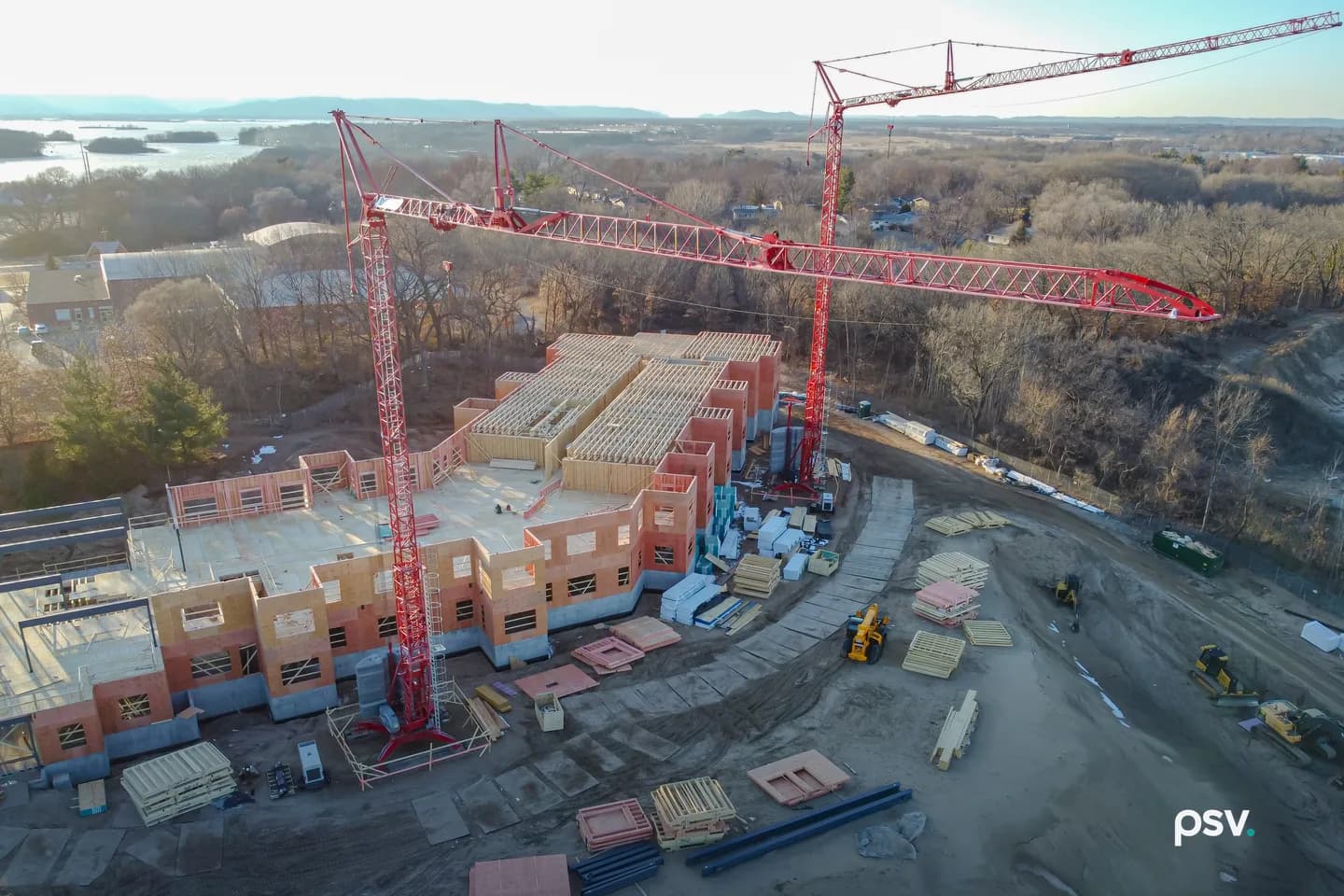
- Wikimedia Commons, “Tower crane aerial 01” by Wikideas1, released CC0 (source of the lead photograph)
Topics
Related PSV analysis
CRE CAPITAL NEWS
Riot’s $573M Bridge Matures Before the Rent Starts
Riot Platforms filed a Form 8-K on August 14 reporting that a project subsidiary closed a senior secured delayed-draw term loan of up to $573.0 million, with Morgan Stanley Senior Funding as administrative agent, to buy long-lead equipment for the 191 critical IT megawatt data center at its Rockdale campus. The loans mature December 31, 2026. The first megawatts are not due to energize until December 2027.
CRE CAPITAL NEWS
CBRE’s Infrastructure Line Outgrew Leasing: The CRE Read
CBRE reported second quarter revenue of $11.2 billion on July 29, up 15.5 percent, and raised its 2026 core EPS outlook to $7.80 to $7.90. Buried in the segment detail is the number that matters to operators: revenue from critical infrastructure services reached $676 million, up from $403 million a year earlier, and that one line added more new revenue in the quarter than global leasing did.
CRE POLICY NEWS
PJM Moves to Curtail Data Centers: The CRE Read on Firm Power
The PJM Board of Managers issued a decisional letter on July 27 directing two filings to FERC by the end of July. One creates a Reliability Backstop Procurement to backfill a 6,831 megawatt capacity shortfall. The other creates an Interim Resource Adequacy Service, under which new large loads that have not brought their own new capacity by June 1, 2027 are cut before anybody else is.
Related guides
Cornerstone PSV guides on the workflows in this article.
Claude Engineering Partner for CRE
What it means to run Claude with an engineering partner: the operating model, the controls, and who owns what.
Read the guideClaude for Real Estate Developers
The ground-up developer field guide: site selection through IC memo, built on a real development deal.
Read the guideEnterprise AI for Institutional CRE
PSV trains your whole firm on Claude and ChatGPT, builds your agents live inside your own environment, and stays on as your embedded AI team. What we build for you is yours.
Read the guideby PSVLiveYou read the operator view. Now learn to run the workflow.
The AI MBA for commercial real estate: the workflows these briefs describe, taught end to end on real deal files, with live builds and a community of CRE operators.