CRE CAPITAL NEWS
Riot’s $573M Bridge Matures Before the Rent Starts
Riot Platforms filed a Form 8-K on August 14 reporting that a project subsidiary closed a senior secured delayed-draw term loan of up to $573.0 million, with Morgan Stanley Senior Funding as administrative agent, to buy long-lead equipment for the 191 critical IT megawatt data center at its Rockdale campus. The loans mature December 31, 2026. The first megawatts are not due to energize until December 2027.
Direct answer
Direct answer to Riot Platforms Rockdale data center credit facility
This is credit-lease real estate with the credit not yet in the file. The facility is non-recourse to Riot Platforms, secured only by the project entities, and sized at roughly a quarter of the $2.1 to $2.3 billion the company puts on the project. It is interim money bridging to an investment-grade credit backstop that the press release names and the 8-K does not, on a lease whose tenant the filed record never identifies.
What Riot filed on August 14
Riot Platforms, Inc. (Nasdaq: RIOT) filed a Current Report on Form 8-K on August 14, 2026 under Item 1.01, Entry into a Material Definitive Agreement, and Item 2.03, Creation of a Direct Financial Obligation. The report says that on August 10, 2026 Riot DC Logistics, LLC, a wholly owned subsidiary described in the filing as the Borrower, entered into a credit agreement with several banks and other financial institutions party to it as lenders and with Morgan Stanley Senior Funding, Inc. as administrative agent. The lenders agreed to provide a senior secured delayed-draw term loan facility in an aggregate principal amount of up to $573.0 million, available for borrowing during an availability period commencing August 10, 2026. In the company’s words, the proceeds “are intended to fund the purchase of long-lead equipment and related project equipment, and certain other expenses associated with the Company’s 191 critical IT MW data center project at its Rockdale Facility.” Loans bear interest at the Borrower’s election at Adjusted Term SOFR plus 2.75 percent or at the Base Rate plus 1.75 percent, and they mature on December 31, 2026. That is a tenor of 143 days from the commencement of the availability period, which is PSV arithmetic on the two dates the filing gives.
Three structural terms in the same report matter more than the coupon. The obligations are guaranteed by each subsidiary of the Borrower and by an affiliate, RPI AUS01-0H DC LLC, a Delaware limited liability company, which the filing groups with the Borrower as the Credit Parties. The facility is secured by a lien on substantially all of the assets of the Credit Parties under a Pledge and Security Agreement. And the credit agreement provides that there is “no recourse against the Company or any other direct or indirect parent of the Borrower, or their respective affiliates, other than the Credit Parties,” with the agent and lenders required to look solely to the Credit Parties and the collateral, subject to customary carve-outs for fraud, willful misrepresentation and misappropriation of collateral proceeds. Covenants are described as customary for a secured term loan of this type, limiting indebtedness, liens, restricted payments, investments, affiliate transactions and changes in the nature of the Borrower’s business. The 8-K states that the credit agreement itself “will be filed as an exhibit to the Company’s Quarterly Report on Form 10-Q for the fiscal quarter ending September 30, 2026,” so everything above is the company’s summary of a document that is not yet public.
The asset the money is buying was disclosed four days earlier. Riot filed a separate Form 8-K on August 10, 2026, furnishing its second quarter earnings release as Exhibit 99.1 and its Q2 2026 Earnings Deck as Exhibit 99.2 under Item 2.02, and then, under Item 8.01, expressly incorporating by reference the section of the release headed “191 IT MW Data Center Lease with a Leading Frontier AI Lab at Rockdale.” That drafting choice matters to anyone grading evidence: the rest of the earnings release is furnished and excluded from Section 18 liability, while the lease section is filed. In that section Riot says it executed a Data Center Lease and Services Agreement with “one of the world’s leading frontier AI labs” for 191 MW of critical IT capacity, on a build-to-suit Tier 3 basis, with an initial term of 20 years running through June 2048 and approximately $9.1 billion of total initial contract revenue, plus two five-year extension options at the tenant’s election that would carry a total potential contract value of approximately $16.1 billion. Delivery is phased, with the initial 96 IT MW expected in December 2027 and the full 191 IT MW by June 2028, using what the company calls its existing, fully approved interconnection at Rockdale. It is Riot’s second tenant at that campus, after the AMD lease announced January 16, 2026. Slide 10 of the deck adds the underwriting: average annual revenue of $457 million, average annual net operating income of $365 to $411 million, and total capital expenditures of $2.1 to $2.3 billion, with footnotes stating that revenue is based on total contract value including annual escalators, that the NOI range is an estimate based on an 80 to 90 percent NOI margin, and that capex excludes tenant fit-out costs.
Two things in the record do not line up, and both are checkable. The earnings release describes the financing as a “$573 million interim financing facility provided by Morgan Stanley to fund initial development costs while the investment-grade credit backstop is finalized.” The 8-K describes Morgan Stanley Senior Funding, Inc. as administrative agent for a syndicate of “several banks and other financial institutions from time to time party thereto as lenders,” which is a different statement about who is holding the paper. Agent is not the same as provider, and the filing names no lender other than the agent. Second, the phrase “investment-grade credit backstop” appears in the furnished release and nowhere in the filed 8-K. No backstop provider is named, no terms are given, no conditions are listed and no deadline is stated. The December 31, 2026 maturity reads as the practical deadline, but the filing does not say so.
Why a CRE operator should care
Strip the megawatts out and this is a build-to-suit financing, and the numbers translate straight into the metrics a development desk already uses. Riot’s own $457 million of average annual revenue against 191 critical IT MW computes to roughly $2.39 million per megawatt a year, or roughly $199 per critical kilowatt a month, which is PSV arithmetic on the company’s published figures rather than a Riot disclosure. Capital cost of $2.1 to $2.3 billion against the same 191 MW computes to roughly $11.0 to $12.0 million per critical IT megawatt, excluding tenant fit-out. Put the two together and the stabilized yield on cost computes to roughly 15.9 percent at the conservative end, $365 million of NOI against $2.3 billion of capex, and roughly 19.6 percent at the aggressive end, $411 million against $2.1 billion. A 16 to 20 percent development yield on a 20-year lease is not a logistics number or an office number. It is the number that explains why every landowner with an interconnection queue position is suddenly in this business, and it is also the number that should prompt the obvious question about what risk is being paid for. Riot’s figures are internally consistent, which is worth saying: cumulative NOI of $7.3 to $8.2 billion over the base term computes to $365 to $410 million a year, and $365 to $411 million against $457 million of revenue computes to a 79.9 to 89.9 percent margin, matching the 80 to 90 percent range the deck’s own footnote assumes.
The tenor is the story. The facility matures December 31, 2026. The first 96 IT MW is expected in December 2027, and full deployment in June 2028. So the loan funding the equipment comes due roughly eleven months before the first megawatt is scheduled to energize and rent can begin, which is PSV arithmetic on the company’s two dates. That is not a defect, it is what interim financing is: a short, expensive instrument that buys transformers, switchgear and cooling plant on lead times measured in years, and that gets taken out by permanent capital once the credit underneath it is documented. Every CRE operator who has ever carried a construction loan into a takeout knows the shape and knows the exposure. The takeout here depends on a credit backstop that has not been described in any filed document, tied to a tenant the filed record does not name. Press coverage has attached a name to that tenant on the strength of unnamed sources. The filed record does not, and neither does PSV. For an underwriter, the practical consequence is that the single most important input to this deal, the identity and covenant strength of the counterparty on a $9.1 billion obligation, is not available from primary records.
The third feature is the ring fence, and it cuts both ways. Non-recourse at the project level means Riot Platforms shareholders are not on the hook beyond the Credit Parties and their collateral, which is the standard and sensible way to build a large project off a smaller balance sheet. Riot’s disclosed liquidity at June 30 was over $1.2 billion, including 11,380 bitcoin worth approximately $666.0 million at the quarter-end price of $58,527 and $548.9 million of cash, of which $77.5 million was restricted. Against $2.1 to $2.3 billion of capex for this one project, the gap is why the facility exists at all. But the same ring fence means the lenders are looking at an entity, not at the parent, and the collateral until delivery is equipment and a leasehold rather than an operating asset. Notice the affiliate guarantor too, RPI AUS01-0H DC LLC, which is pulled into the Credit Parties without the 8-K explaining what it holds. Riot says it has now contracted 241 of the 391 IT MW of potential at Rockdale, which computes to roughly 61.6 percent of the campus, so the entity structure at that site is going to keep multiplying and the question of which assets sit inside which fence is going to keep mattering.
The workflow PSV would run
The first workflow is a capital-stack abstract for a build-to-suit, and it is the same one that belongs on any development the firm is financing at the project level. The inputs are documents, not headlines: the credit agreement with its availability period, maturity, pricing grid and undrawn fee, the guaranty and the schedule of guarantors, the pledge and security agreement with the collateral description, the lease and its rent commencement, escalator and delivery-phase provisions, the takeout commitment or backstop if one exists, and the equipment purchase orders the proceeds actually fund. The output is one page per project entity stating what is borrowed, from whom, at what rate, secured by what, guaranteed by whom, maturing when, and what specific event is supposed to retire it, with the source document and pull date behind every field. The reviewer is the capital markets lead. The approval gate is the one that would have caught every construction blowup any of us have seen: no project plan clears review until a named person has read the takeout, and if the takeout is a term sheet, a conditional commitment or a backstop still being finalized, it is recorded as an open item with an owner and a date, not as financing.
The second workflow is a counterparty evidence register, and this filing is the argument for it. Facts about a deal arrive at different evidentiary grades, and coverage flattens them. Here the grades are unusually clean: the credit agreement terms are a company summary of an unfiled document, the lease terms are filed under Item 8.01, the deck numbers are furnished under Item 2.02, the NOI range is an explicit management estimate resting on an assumed margin, the capex figure excludes fit-out by its own footnote, and the tenant’s identity is a press attribution to unnamed sources. PSV would keep one row per material claim recording the claim, the document carrying it, the Item number, whether it was filed or furnished or unfiled, the date pulled and a re-check interval, then re-pull on that interval so a promotion, a revision or a quiet disappearance surfaces without anyone remembering to look. The output is a table. The reviewer is whoever relies on the claim in a model. There is no approval gate because nothing is being decided, it is a monitoring layer. Applied here, the whole credit agreement stays at the lowest grade until the Form 10-Q for the quarter ending September 30, 2026 attaches it.
What stays human, and what is still unknown
The operator read
Finish with the judgment call.
The reported facts are above. Enter your email for PSV's operator conclusion and a year of access to every newsroom brief.
Free. No card. Privacy policy. Unsubscribe anytime.
 by PSVLive
Build the workflow behind this analysis. Train with the operators doing it.
Real deal files, live builds, and production-ready CRE AI workflows inside the CRE AI Institute.











Clear answers
Common questions about Riot Platforms Rockdale data center credit facility
What are the terms of Riot Platforms’ $573 million Rockdale credit facility?
Riot Platforms, Inc. (Nasdaq: RIOT) reported in a Form 8-K filed August 14, 2026 under Items 1.01 and 2.03 that on August 10, 2026 its wholly owned subsidiary Riot DC Logistics, LLC entered into a credit agreement with several banks and other financial institutions as lenders and with Morgan Stanley Senior Funding, Inc. as administrative agent. The lenders agreed to provide a senior secured delayed-draw term loan facility of up to $573.0 million, available during an availability period commencing August 10, 2026. Proceeds are intended to fund long-lead equipment, related project equipment and certain other expenses associated with the company’s 191 critical IT MW data center project at the Rockdale Facility. Loans bear interest at Adjusted Term SOFR plus 2.75 percent or the Base Rate plus 1.75 percent at the borrower’s election, and mature December 31, 2026, a tenor of 143 days from the start of the availability period. Obligations are guaranteed by each subsidiary of the borrower and by an affiliate, RPI AUS01-0H DC LLC, and secured by a lien on substantially all assets of those Credit Parties. There is no recourse against Riot Platforms or any other parent, subject to customary carve-outs for fraud, willful misrepresentation and misappropriation of collateral proceeds. The credit agreement itself is not yet public; the 8-K says it will be filed as an exhibit to the Form 10-Q for the quarter ending September 30, 2026.
What does the Riot Rockdale lease compute to per kilowatt-month, and what is the yield on cost?
Riot’s Q2 2026 Earnings Deck puts average annual revenue on the 191 critical IT MW lease at $457 million, average annual net operating income at $365 to $411 million, and total capital expenditures at $2.1 to $2.3 billion excluding tenant fit-out. Average annual revenue of $457 million against 191 MW computes to roughly $2.39 million per megawatt a year, or roughly $199 per critical kilowatt a month. Capex of $2.1 to $2.3 billion against 191 MW computes to roughly $11.0 to $12.0 million per critical IT megawatt. Stabilized yield on cost therefore computes to roughly 15.9 percent at $365 million of NOI against $2.3 billion of capex and roughly 19.6 percent at $411 million against $2.1 billion. All of that is PSV arithmetic on Riot’s published figures rather than Riot disclosures. The company’s own numbers are internally consistent: cumulative NOI of $7.3 to $8.2 billion over the base term computes to $365 to $410 million a year, and $365 to $411 million against $457 million of revenue computes to a 79.9 to 89.9 percent margin, matching the 80 to 90 percent NOI margin range the deck’s footnote assumes.
Who is the tenant on Riot’s 191 MW Rockdale lease?
The filed record does not say. Riot’s August 10, 2026 earnings release, the lease section of which is incorporated by reference into Item 8.01 of that day’s Form 8-K and is therefore filed rather than merely furnished, describes the counterparty only as “one of the world’s leading frontier AI labs.” No filed Riot document names the tenant. Press coverage has attached a name on the strength of unnamed sources; neither Riot nor the reported counterparty has confirmed it in a filed document, and PSV does not name it either. What the filed record does give are the terms: a Data Center Lease and Services Agreement for 191 MW of critical IT capacity on a build-to-suit Tier 3 basis, an initial term of 20 years running through June 2048, approximately $9.1 billion of total initial contract revenue, two five-year extension options at the tenant’s election carrying a total potential value of approximately $16.1 billion, and phased delivery with the initial 96 IT MW expected in December 2027 and full 191 IT MW deployment by June 2028. For an underwriter this is the material gap: the identity and covenant strength of the counterparty on a $9.1 billion obligation is the single most important input to the deal and it is not available from primary records.
Primary source record
These records support the reported facts in this brief. PSV’s CRE workflow interpretation and test plan are original analysis.
- Riot Platforms, Inc., Form 8-K reporting the Rockdale credit agreement (Items 1.01 and 2.03), filed August 14, 2026
- Riot Platforms, Inc., Form 8-K reporting second quarter 2026 results and the Rockdale lease (Items 2.02 and 8.01), filed August 10, 2026
- Riot Platforms, Inc., Exhibit 99.1, “Riot Platforms Reports Second Quarter 2026 Financial Results and Strategic Highlights,” August 10, 2026
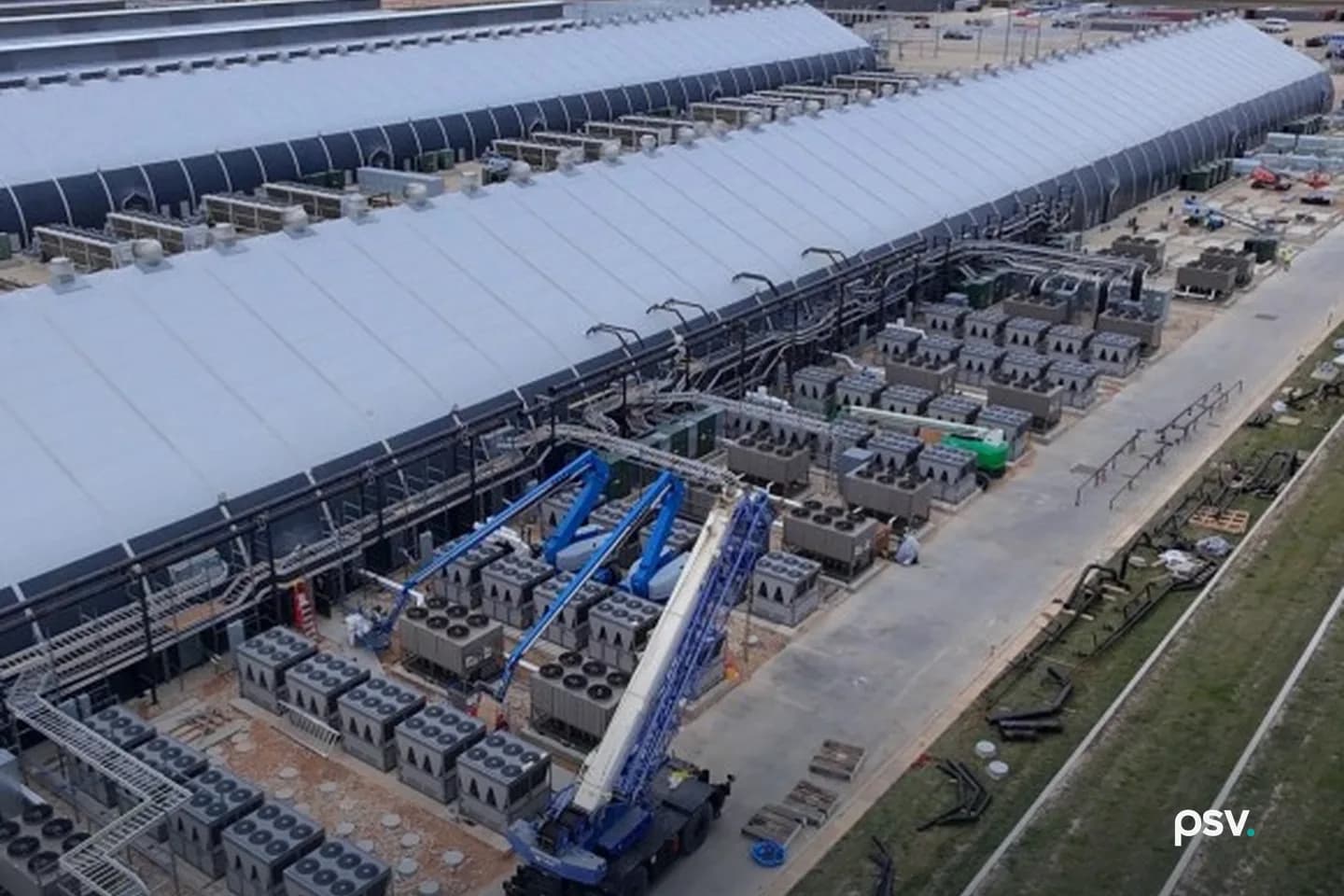
- Riot Platforms, Inc., Exhibit 99.2, Q2 2026 Earnings Deck, August 10, 2026 (source of the lead photograph)
- Riot Platforms, Inc., EDGAR filing history (CIK 0001167419)
Topics
Related PSV analysis
CRE CAPITAL NEWS
Hut 8’s $9.8B Beacon Point Lease: The CRE Read on a Fully Leased AI Campus
Hut 8 said on July 20 it signed a second 15-year lease at its Beacon Point campus in Nueces County, Texas, a 352 megawatt deal with a base-term contract value of $9.8 billion. The lease fully commercializes the one-gigawatt campus, doubling the tenant’s contracted capacity to 704 megawatts. For real estate, the detail that matters is the structure: a triple-net, take-or-pay lease to a single investment-grade tenant, energizing in 2027.
CRE CAPITAL NEWS
IREN Signed $2.8B in AI Contracts. The CRE Read on a New Data Center Capital Stack
IREN Limited said on July 20 it signed $2.8 billion in new multi-year cloud contracts with leading AI developers, raising its 2026 AI Cloud run-rate revenue target above $4 billion. The detail that matters for real estate is how it is funded: customer prepayments covering roughly 45 percent of the associated GPU capital, on top of equipment-backed financing. The AI data center is being underwritten on contracted cash flow, not speculation.
CRE CAPITAL NEWS
Fermi’s $6.5B Lease: The Guarantee Line Vanished
Fermi Inc. said on August 10 that it executed its first binding customer lease at Project Matador in Carson County, Texas: 222 MW of total facility power to TensorWave, at approximately $6.5 billion of contracted revenue over an initial 15-year term. The wire then carried a corrected version of the same release. The sentence about a guarantee from one of the global leaders in AI is not in it.
Related guides
Cornerstone PSV guides on the workflows in this article.
AI for Commercial Real Estate Lenders
Screening at volume, credit memos drafted from the borrower package, every figure traced to the page it came from, and the book watched after close.
Read the guideCRE AI Training
Hands-on CRE AI training for practicing operators, routing into the CRE AI Institute. No coding required, built on a real practice deal.
Read the guideBest AI Tools for Commercial Real Estate
The pillar guide to choosing CRE AI tools by workflow fit and control, not vendor hype.
Read the guideby PSVLiveYou read the operator view. Now learn to run the workflow.
The AI MBA for commercial real estate: the workflows these briefs describe, taught end to end on real deal files, with live builds and a community of CRE operators.