CRE POLICY NEWS
Texas Paused the Data Center Grid Queue, and the Gate Is Paperwork
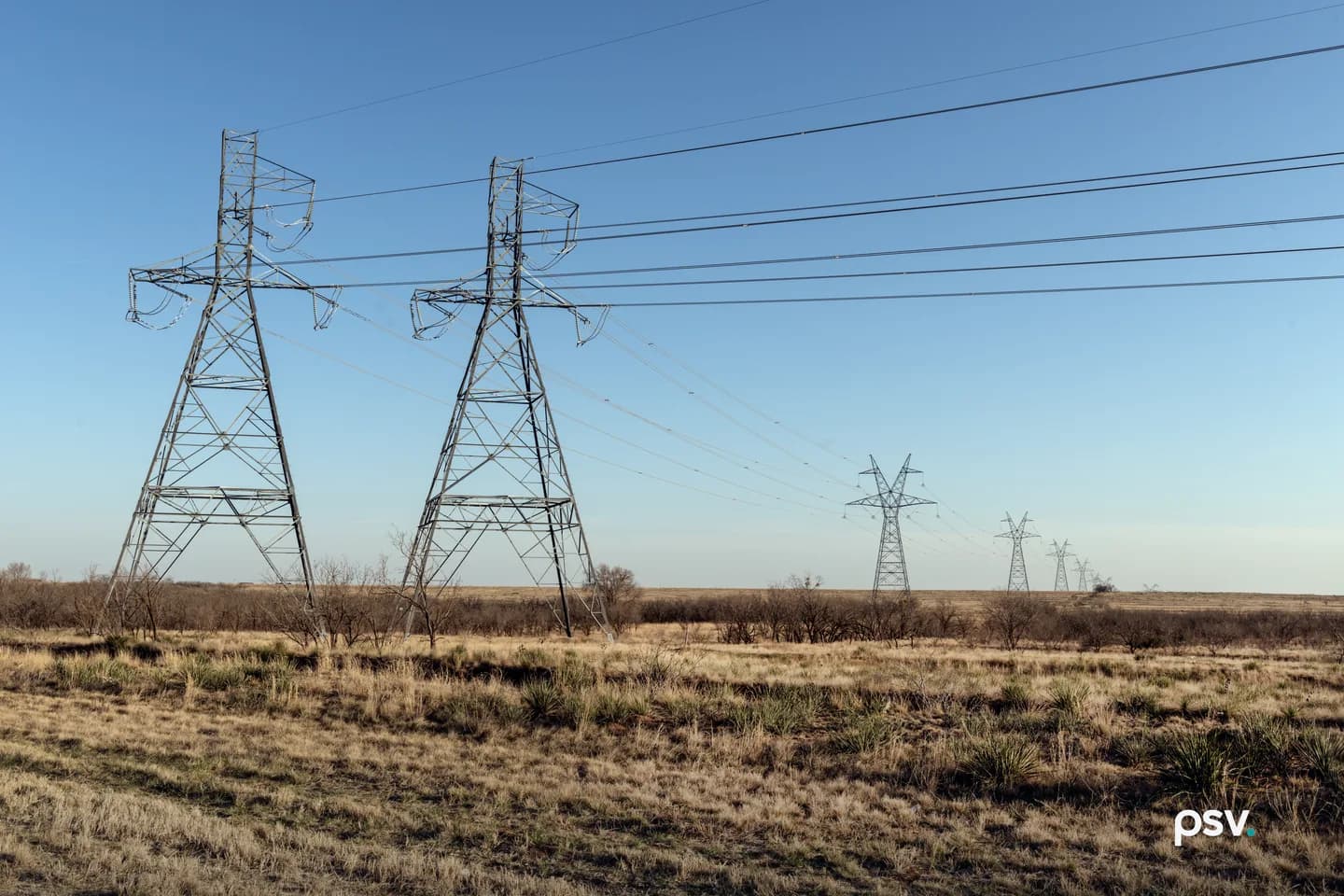
Governor Greg Abbott directed a verification and audit of every data center advancing through ERCOT’s interconnection process on August 3. The Public Utility Commission of Texas made it operative on August 20, granting ERCOT good cause exceptions that suspend Batch Zero classification deadlines. ERCOT then told the market it intends to issue conditional classifications by August 31. PSV read the letter, the order and ERCOT’s filed presentation.
Direct answer
Direct answer to ERCOT data center interconnection pause
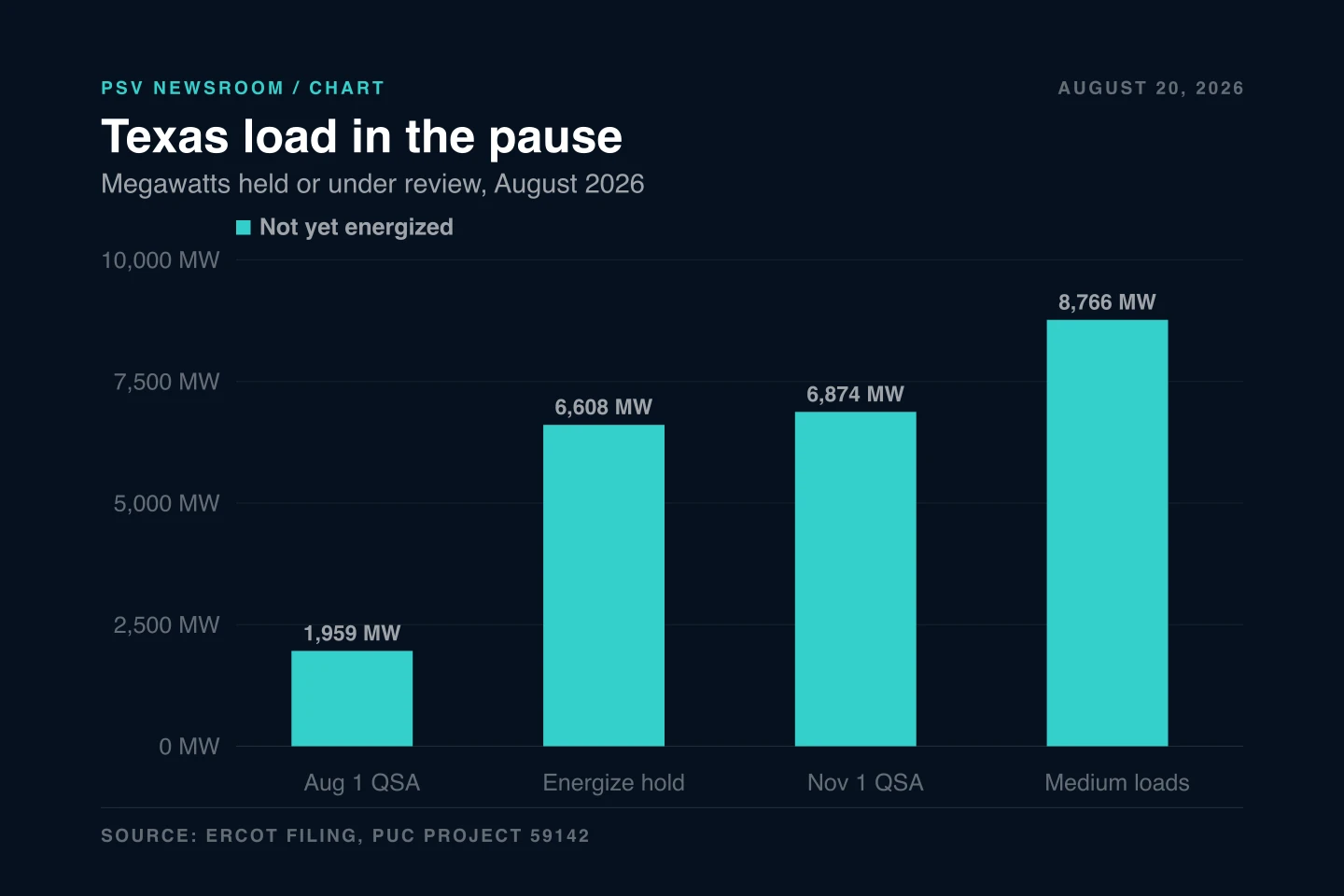
Texas did not stop data centers, it moved the gate from power to proof. ERCOT has paused approvals to energize large load data centers and crypto facilities of 75 megawatts or more until it verifies the documents behind their interconnection requests, and 17 such loads carrying 6,608 megawatts of peak demand have cleared every other ERCOT process and are waiting. The reports go to the Commission December 10. Loads that fail verification, or do not respond, are disqualified from Batch Zero.
What Texas ordered, and what the Commission signed
On August 3, 2026 Governor Greg Abbott wrote to Public Utility Commission of Texas Chairman Thomas Gleeson and ERCOT President and Chief Executive Officer Pablo Vegas with a directive in one sentence: the PUC and ERCOT must conduct a comprehensive verification and audit of all data centers advancing through ERCOT’s interconnection process before any additional data centers are approved to move forward. The letter states that ERCOT is considering approximately 474 gigawatts of requests to connect to the Texas grid, more than five times Texas’ record peak electricity demand for ERCOT, and that approximately 90 percent of the new power requests are data centers. It gives a trigger, which most coverage skipped: the failure of some data centers to comply with the PUC’s survey measuring water and power usage under the General Appropriations Act. And it sets out five categories of information to collect from each project, covering state and local tax incentives, grants and abatements received or expected; projected annual and peak electricity consumption and progress toward on-site generation; projected annual and peak water consumption, water sources, and whether cooling will be air-cooled, closed-loop or another water-efficient system; measures to reduce impacts on neighbors including noise mitigation, light controls, setbacks, traffic improvements and emergency response coordination; and the ownership and controlling interests in the project. Any project that fails the verification and audit, the letter says, must be denied.
ERCOT moved the same day. Market Notice M-A080326-01, issued August 3, told the market it would not meet the August 7, 2026 deadline to classify Large Loads in the Batch Zero study and would seek relief from the Commission. On August 10 it filed that request in PUC Project No. 59142, seeking three good cause exceptions under 16 Texas Administrative Code § 25.3(b) to the requirement of 16 TAC § 25.361(b)(16), so it could deviate from ERCOT Planning Guide §§ 9.3.1(2)(a), 5.3.5(5)(a)(ii) and 9.2.2(3)(a). The Commission granted all three on August 20, 2026 in an Order Granting Good Cause Exceptions signed by Chairman Gleeson and the commissioners. The order records what ERCOT intends to do with the time: temporarily pause the transitional Batch Zero interconnection study of loads that are 75 megawatts or more, including data centers and virtual currency mining facilities, until the verification and audit are complete, and separately request community impact information from all data centers and crypto facilities of 25 megawatts or more that have not yet energized. ERCOT told the market on August 21, in Market Notice M-A080326-02, that it intends to notify interconnecting distribution and transmission service providers of each large load’s conditional classification by August 31, 2026, which starts the dispute and reconciliation process in the Planning Guide.
Why a grid docket reads like a site diligence file
The thing being audited is not capacity. It is documentation, and the list ERCOT filed on August 20 is one an acquisitions team would recognize on sight. To hold a Batch Zero eligibility path, a developer must show site control with evidence such as a deed, lease, purchase and sale agreement or option agreement; long-lead equipment ordered, supportable by purchase orders and delivery schedules; a notice to proceed showing the developer instructed the service providers to construct the required interconnection facilities; end-use customer confirmation, meaning a retail electric service agreement if the developer is itself the end user or a binding contract with the end user if it is not; site approvals such as orders, permits and resolutions, or a statement that no approvals are required; a binding general contractor contract; a binding substation contractor contract with the contractor’s electrical license; an affiliate form backed by an organizational chart and ownership documents; financial security confirmed by the transmission or distribution service provider; and satisfaction of contribution in aid of construction. ERCOT states it may conduct site verification, meaning physical inspection, of loads with a requested initial energization date before April 1, 2027. Those are ERCOT’s filed requirements, not a PSV interpretation of them.
The filing also sizes what is sitting still. Seventeen large load data center and crypto facilities, representing 6,608 megawatts of total peak demand ramping over five years, have finished every ERCOT process except approval to energize, and ERCOT has paused those approvals. Six large loads representing approximately 1,959 megawatts were expected in the August 1 quarterly stability assessment with projected energization in the first quarter of 2027, and a separate set of 17 large loads representing approximately 6,874 megawatts is potentially eligible for the November 1 assessment with projected energization in the second quarter of 2027. On the community impact side, ERCOT’s April snapshot counted 157 medium data center and crypto loads, those at least 25 megawatts and under 75, totaling approximately 8,766 megawatts. One number in the presentation is worth more than any of those to a developer: ERCOT says it has reviewed 290 dynamic models and approximately 18 percent were acceptable on first review. The consequence is stated without hedging. Large loads that do not pass verification, or do not respond, will be disqualified from Batch Zero.
| Date | What happens | Record |
|---|---|---|
| August 3, 2026 | Governor directs verification and audit; ERCOT pauses Batch Zero | Abbott letter; ERCOT M-A080326-01 |
| August 20, 2026 | Commission grants three good cause exceptions | Order in Project No. 59142 |
| August 31, 2026 | ERCOT intends to notify service providers of conditional classifications | ERCOT M-A080326-02 |
| August to September | Requests for information sent for eligibility and community impact | ERCOT presentation, Aug 20 |
| October to November | Additional requests, site verifications, opportunity to cure | ERCOT presentation, Aug 20 |
| December 10, 2026 | Batch Zero Eligibility Verification and Community Impact reports filed | ERCOT presentation, Aug 20 |
| December 17, 2026 | Commission open meeting on both reports | ERCOT presentation, Aug 20 |
| April 9, 2027 | Batch Zero study results deadline, unchanged so far | ERCOT presentation, Aug 20 |
The workflow PSV would run on an interconnection file
The artifact worth building here is an interconnection evidence file kept per site, structured to the eligibility list rather than to a marketing deck. The inputs are documents a developer already holds, and the point of the exercise is finding which ones do not exist yet: the deed, lease, purchase and sale agreement or option that evidences site control and the parcels it actually covers; the purchase orders and delivery schedules behind long-lead equipment; the notice to proceed and the date it was issued; the retail electric service agreement or the binding end-user contract; every discretionary approval on the site with its issuing body and status, or the written basis for saying none are required; the executed general contractor and substation contractor agreements with the contractor’s license; the organizational chart and ownership documents that answer the ownership and controlling interests question; the financial security instrument and the service provider’s confirmation of it; and the contribution in aid of construction record. Alongside them sits the second file the Governor’s letter asks for, which most developers have never assembled in one place: every state and local incentive, grant and abatement received or expected, the projected annual and peak electricity and water consumption, the water source, the cooling technology by name, the on-site generation plan, and the noise, lighting, setback, traffic and emergency response commitments made to the host community.
The output is a single readiness sheet: one row per eligibility requirement, the document that satisfies it, the date and signatory of that document, the gap where no document exists, and the person who owns closing the gap. An assistant can assemble that sheet from a document set, cite the page behind every cell, keep it current as executed agreements land, and flag when a requirement moves from evidenced to unevidenced because a contract lapsed or a parcel changed. It should not draft an attestation. Several of these requirements are satisfied by a developer’s legal declaration that it meets them, which makes them a signature by an officer with liability attached rather than an output. The reviewer is the development lead working with counsel and the interconnection consultant, and the approval gate is that nothing is submitted to a service provider or to ERCOT on a machine-assembled record without that human signature. PSV has not audited any project in this queue, has no view on whether any particular load should qualify, and is describing a filed process rather than predicting its outcome.
What stays with a person, and what the record does not settle
The operator read
Finish with the judgment call.
The reported facts are above. Enter your email for PSV's operator conclusion and a year of access to every newsroom brief.
Free. No card. Privacy policy. Unsubscribe anytime.
 by PSVLive
Build the workflow behind this analysis. Train with the operators doing it.
Real deal files, live builds, and production-ready CRE AI workflows inside the CRE AI Institute.











Clear answers
Common questions about ERCOT data center interconnection pause
Did Texas stop approving new data centers?
It paused a specific gate rather than banning anything. On August 3, 2026 Governor Greg Abbott directed the Public Utility Commission of Texas and ERCOT to conduct a comprehensive verification and audit of all data centers advancing through ERCOT’s interconnection process before any additional data centers are approved to move forward. ERCOT issued Market Notice M-A080326-01 the same day, saying it would not meet the August 7, 2026 deadline to classify Large Loads in the transitional Batch Zero study. On August 20, 2026 the Commission granted ERCOT three good cause exceptions in Project No. 59142 under 16 TAC § 25.3(b), permitting it to delay classification, to include conditionally classified base loads in the August 1 and November 1 quarterly stability assessments, and to review dynamic data submissions after the August 7 deadline with the same 24-day cure period. In the order, ERCOT states it intends to temporarily pause the Batch Zero study of loads of 75 megawatts or more, including data centers and virtual currency mining facilities, until the verification and audit are complete. ERCOT’s filing adds that it may still approve energization for large loads that are not data centers or crypto facilities.
How many megawatts of Texas data centers are waiting on ERCOT?
ERCOT’s presentation filed in PUC Project No. 59142 on August 20, 2026 gives four figures. Seventeen large load data center and crypto facilities representing 6,608 megawatts of total peak demand ramping over five years have finished every ERCOT process except approval to energize, and those approvals are paused. Six large loads representing approximately 1,959 megawatts were expected in the August 1, 2026 quarterly stability assessment with projected energization in the first quarter of 2027. A separate set of 17 large loads representing approximately 6,874 megawatts is potentially eligible for the November 1, 2026 assessment, with projected energization in the second quarter of 2027. ERCOT’s April snapshot counted 157 medium data center and crypto loads, meaning at least 25 megawatts and under 75, totaling approximately 8,766 megawatts, and those receive the community impact request. Separately, Governor Abbott’s August 3 letter states ERCOT is considering approximately 474 gigawatts of connection requests overall, more than five times Texas’ record peak demand, with approximately 90 percent of new power requests coming from data centers.
What does ERCOT verify in the data center audit?
Documents, not capacity. ERCOT’s August 20, 2026 filing lists the eligibility evidence a large load must show under PGRR 145: site control evidenced by a deed, lease, purchase and sale agreement or option agreement; long-lead equipment supported by purchase orders and delivery schedules; a notice to proceed instructing the service providers to construct the required interconnection facilities; end-use customer confirmation, meaning a retail electric service agreement if the developer is the end user or a binding contract with the end user if not; discretionary site approvals such as orders, permits and resolutions, or a statement that none are required; a binding general contractor contract; a binding substation contractor contract with the contractor’s electrical license; an affiliate form with organizational chart and ownership documents; financial security confirmed by the transmission or distribution service provider; and satisfaction of contribution in aid of construction. ERCOT states it may conduct physical site verification of loads with a requested initial energization date before April 1, 2027, and that large loads which do not pass verification, or do not respond, will be disqualified from Batch Zero. ERCOT also reports it has reviewed 290 dynamic models and approximately 18 percent were acceptable on first review. Its verification and community impact reports are due to the Commission December 10, 2026, with a December 17, 2026 open meeting.
Primary source record
These records support the reported facts in this brief. PSV’s CRE workflow interpretation and test plan are original analysis.
- Letter from Governor Greg Abbott to PUCT Chairman Thomas Gleeson and ERCOT President and CEO Pablo Vegas, August 3, 2026
- Office of the Texas Governor, “Governor Abbott Directs Comprehensive Data Center Audit,” August 3, 2026
- Public Utility Commission of Texas, Order Granting Good Cause Exceptions, Project No. 59142, filed August 20, 2026
- ERCOT, “Good Cause Exceptions for PGRR 145, Batch Zero Verification and Audit Process, and Community Impact Review Process,” filed in PUC Project No. 59142, August 20, 2026 (chart source)
- ERCOT Market Notice M-A080326-01, “Update Regarding Batch Zero Timelines and Processes,” August 3, 2026
- ERCOT Market Notice M-A080326-02, “PUC Approval of Good Cause Exceptions Relating To Batch Zero Process,” August 21, 2026
- Carol M. Highsmith, “Power lines and towers near Snyder in Scurry County, Texas” (Library of Congress, public domain; lead photograph source)
Topics
Related PSV analysis
CRE POLICY NEWS
PJM Moves to Curtail Data Centers: The CRE Read on Firm Power
The PJM Board of Managers issued a decisional letter on July 27 directing two filings to FERC by the end of July. One creates a Reliability Backstop Procurement to backfill a 6,831 megawatt capacity shortfall. The other creates an Interim Resource Adequacy Service, under which new large loads that have not brought their own new capacity by June 1, 2027 are cut before anybody else is.
CRE POLICY NEWS
Pennsylvania’s Data Center Order Turns on One Number
Governor Josh Shapiro signed Executive Order 2026-05 on August 18, directing Commonwealth agencies to hold every data center proposal with peak demand over 25 megawatts to the Governor’s Responsible Infrastructure Development Requirements. Data centers come out of the Permit Fast Track Program entirely, and the Department of Environmental Protection will not issue a permit until a project has its local and municipal approvals in hand.
CRE POLICY NEWS
TVA Repriced Data Center Power. The Tariff Isn’t Public.
The TVA Board voted in Memphis on August 20 to move data centers out of the manufacturing rate class and onto a rate of their own. Officials at the meeting described an October 1 start, a roughly 10 percent increase, a three-year phase-in for existing sites, and an upfront capacity commitment charge on new load above 5 megawatts. TVA’s own release names none of those terms.
Related guides
Cornerstone PSV guides on the workflows in this article.
The CRE AI Data & Security Audit
The five-pass audit a CRE firm runs on its own document estate before connecting an assistant: folder access, document provenance, and the approval bands.
Read the guideWhat is CRE AI?
The definitional guide to commercial real estate AI: the core workflows, how it differs from a chatbot, and how to learn it.
Read the guideby PSVLiveYou read the operator view. Now learn to run the workflow.
The AI MBA for commercial real estate: the workflows these briefs describe, taught end to end on real deal files, with live builds and a community of CRE operators.