CRE CAPITAL NEWS
Hadrian’s $1.37B Raise: One Building Is 77% of It
Hadrian said on August 6 that it raised $1.37 billion at a $7.87 billion valuation to build more highly automated factories, with JPMorganChase’s Strategic Investment Group as anchor co-lead. The company puts its footprint at just under 3 million square feet across four sites. Its own earlier release shows that 2.2 million of that is a single repurposed railcar plant in rural Alabama.
Direct answer
Direct answer to Hadrian Series D automated factories industrial real estate
Hadrian’s four factories total approximately 2.85 million square feet, and the Cherokee, Alabama plant is 2.2 million of it, which computes to roughly 77 percent of the company sitting on one adaptive-reuse site. The other three run about 600,000 to 650,000 square feet combined. The AI factory tenant is not absorbing new tilt-up. It is taking stranded heavy industrial that already has the power, the rail and the floor.
What Hadrian announced
On August 6, 2026, Hadrian said it raised $1.37 billion in new equity financing to accelerate the buildout of domestic manufacturing capacity for defense, aerospace and industrial systems. The release, datelined Torrance, California, says the raise values the company at $7.87 billion, and it does not say whether that figure is pre-money or post-money. Read as post-money, $1.37 billion against $7.87 billion computes to roughly 17 percent of the company, which is PSV arithmetic on the released numbers rather than a company statement. The round is co-led by WCM Investment Management, Washington Harbour Partners, Valor Equity Partners, 137 Ventures and Baillie Gifford. JPMorganChase’s Strategic Investment Group joined as anchor co-lead, investing through the bank’s Security and Resiliency Initiative, the $1.5 trillion, ten-year program JPMorganChase announced on October 13, 2025 that carries up to $10 billion of direct equity and venture capital across supply chain and advanced manufacturing, defense and aerospace, energy, and frontier technologies. 1789 Capital took major participation, and the release also lists Morgan Stanley Wealth Management, funds managed by Apollo, accounts advised by T. Rowe Price Associates, CapitalG, Andreessen Horowitz, Founders Fund, Lux Capital, Altimeter and Construct Capital.
Hadrian says the money funds new factories, expanded research and development, and additional production lines over the next year, including munitions and autonomous systems, under a model it calls Factories-as-a-Service. Founder and chief executive Chris Power said that “production is now the frontline of deterrence” and framed the raise as funding the technicians and engineers who will rebuild the industrial base. The company also says it is broadening access to technician equity. Those are Hadrian’s characterizations of its own raise. The release names no customer contract value, no revenue figure and no delivery volume, and nothing in the record attributes a dollar of the round to any specific program.
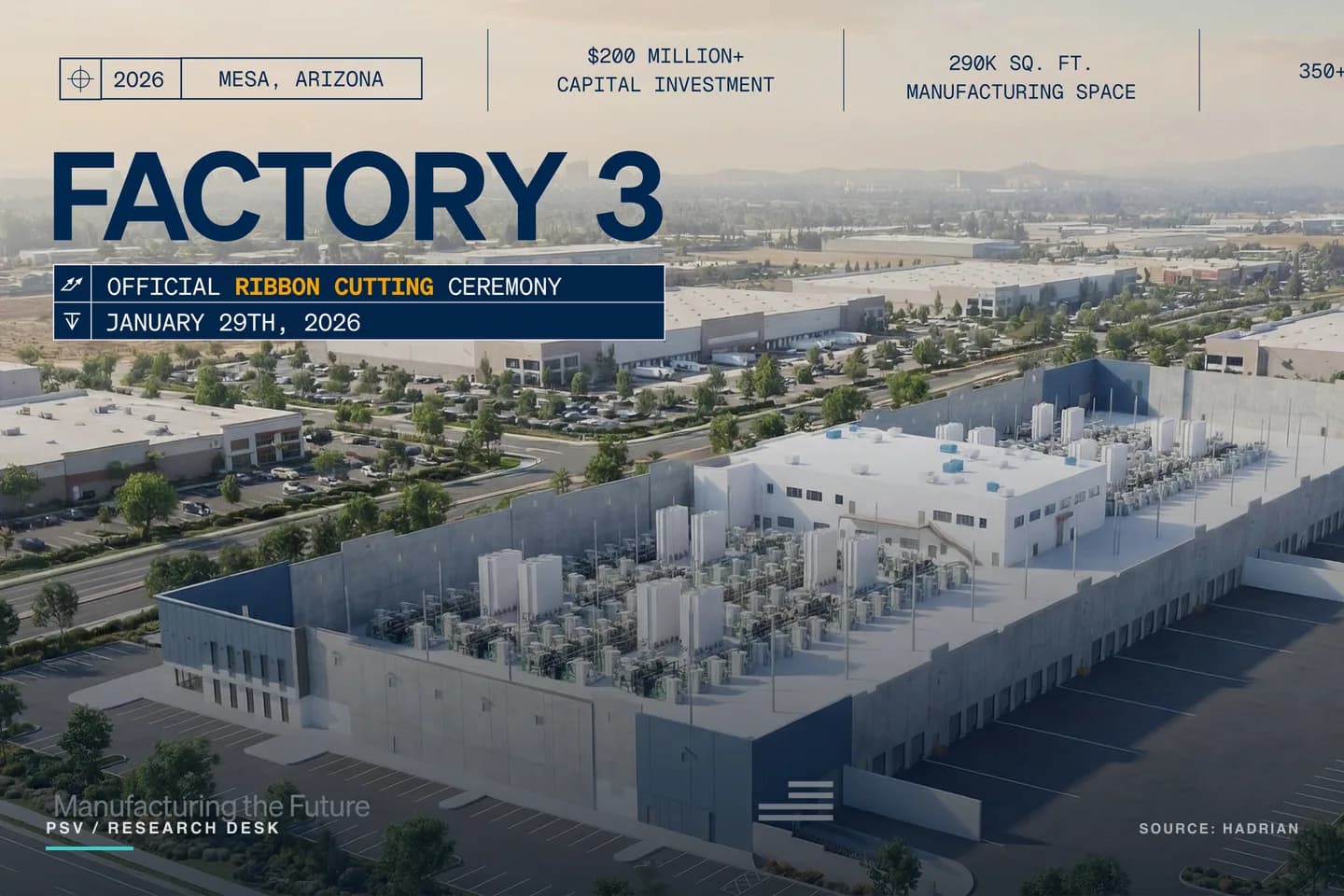
The real estate is in the numbers the company itself published, in two releases five months apart. The August release says that since its Series C twelve months earlier, Hadrian opened factories in Mesa, Arizona and Muscle Shoals, Alabama, bringing its footprint to just under 3 million square feet across four sites, two of them in Torrance. Its March 20, 2026 release opening the Alabama plant is more specific: four facilities totaling approximately 2.85 million square feet, of which the Alabama site alone is 2.2 million square feet. Do that subtraction and the other three sites together come to roughly 650,000 square feet, close to the approximately 600,000 square feet the boilerplate at the bottom of that same March release still ascribes to three facilities, the two figures differing by about 50,000 square feet on rounded numbers. Hadrian’s January 29, 2026 release puts Mesa at 290,000 square feet, which leaves the two Torrance sites somewhere around 310,000 to 360,000 square feet combined. On the company’s own published figures, 2.2 million of 2.85 million square feet computes to roughly 77 percent of Hadrian’s entire physical footprint on a single site.
Why a CRE operator should care
Run the capital against the space and this tenant stops looking like industrial. Hadrian’s Alabama plant is a public-private partnership with the Navy that the company puts at more than $2.4 billion of total investment, combining more than $1.5 billion of private capital with $900 million of government funding through Navy appropriations, which computes to the public side carrying roughly 38 percent. Against a 2.2 million square foot site, $2.4 billion computes to roughly $1,090 per square foot. Mesa is the same shape at smaller scale: $200 million of investment against 290,000 square feet computes to roughly $690 per square foot. Nothing speculative gets built at those numbers, and neither figure is shell cost. Most of it is process: machine tools, robotics, power distribution, environmental systems, and the software layer Hadrian calls Opus. When a tenant’s improvements run several times the value of the box they sit in, that tenant is not moving at lease expiry. Put it in your renewal probability, your rollover assumptions and what you are willing to fund on day one.
The Alabama site is the more useful signal for anyone who owns older industrial. The March release says the Cherokee plant was formerly the largest railcar manufacturing facility in the country before production was outsourced to Mexico. That is the profile worth screening for: a stranded heavy-industrial building with the power service, the rail, the crane capacity and the floor loading already in it, in a rural county, reactivated by a venture-funded operator with a federal program behind it. Note also who holds it. At the ribbon cutting, Representative Robert Aderholt thanked AE Shoals for providing the facility that makes the project possible, which places Hadrian as an occupier at the site that is roughly three quarters of its footprint rather than the owner of it. Hadrian has not published a lease term, a rent or an ownership position at any of the four sites, so tenure at the other three is simply unknown from the record.
The labor math runs the same direction and it is counterintuitive. Cherokee is expected to create up to 1,000 jobs when fully operational, which computes to one job per 2,200 square feet, against roughly one per 830 square feet at Mesa. The bigger, more automated plant is the less labor-dense one per foot. Hadrian says Opus is engineered so that technicians with limited prior manufacturing experience reach full productivity within 30 days. That is a company claim and not a PSV finding, and no independent record tests it. But it is the claim that makes a rural county with no legacy machinist pool a viable site at all, and if it holds even loosely it widens the site-selection map to exactly the markets where obsolete industrial trades cheapest.
The workflow PSV would run
If Hadrian is a template rather than an exception, the question for an owner or an acquisitions desk is which buildings in your footprint fit that template before someone else prices them. That is a screening problem, and it is the kind PSV builds. The inputs are all records: county assessor and parcel files for industrial buildings above a size threshold and below a year-built threshold, utility interconnection queues and substation capacity filings for available service, rail-served flags from Class I and shortline network data, permit and listing records for clear height, crane capacity and floor loading, state and local incentive awards for what a jurisdiction has actually paid before, and county labor data for the trades inside a commute shed. The output is a ranked shortlist with a one-page evidence card per site, and every attribute on that card links to the record it came from with the date it was pulled.
The reviewer is the acquisitions lead, not the model. The approval gate is explicit and it has two locks. No site advances to a letter of intent until a person has confirmed the power position with the utility directly, because interconnection queue data goes stale faster than anything else on the card, and until a person has verified the ownership chain and current control, because the whole point of a stranded plant is that title, liens and control are usually messier than the assessor file suggests. Everything the system produces is a candidate and a citation. Nothing it produces is a decision. The gain is that a two-person desk can look seriously at every qualifying building across eleven states instead of the forty a broker sends over, which is the same pattern a screening layer produces everywhere: more looked at, not more approved.
What stays human, and what is still unknown
The operator read
Finish with the judgment call.
The reported facts are above. Enter your email for PSV's operator conclusion and a year of access to every newsroom brief.
Free. No card. Privacy policy. Unsubscribe anytime.
 by PSVLive
Build the workflow behind this analysis. Train with the operators doing it.
Real deal files, live builds, and production-ready CRE AI workflows inside the CRE AI Institute.











Clear answers
Common questions about Hadrian Series D automated factories industrial real estate
How much did Hadrian raise in its Series D and at what valuation?
Hadrian said on August 6, 2026 that it raised $1.37 billion in new equity financing and that the raise values the company at $7.87 billion. The release does not say whether that valuation is pre-money or post-money. Read as post-money, $1.37 billion against $7.87 billion computes to roughly 17 percent of the company, which is PSV arithmetic on the released figures rather than a company statement. The round is co-led by WCM Investment Management, Washington Harbour Partners, Valor Equity Partners, 137 Ventures and Baillie Gifford, with JPMorganChase’s Strategic Investment Group as anchor co-lead investing through the bank’s $1.5 trillion Security and Resiliency Initiative, which carries up to $10 billion of direct equity and venture capital. 1789 Capital took major participation, alongside Morgan Stanley Wealth Management, funds managed by Apollo, accounts advised by T. Rowe Price Associates, CapitalG, Andreessen Horowitz, Founders Fund, Lux Capital, Altimeter and Construct Capital. Hadrian names no customer contract value, revenue figure or delivery volume in the release.
How big is Hadrian’s real estate footprint and where is it?
Hadrian’s August 6, 2026 release puts its footprint at just under 3 million square feet across four sites: two in Torrance, California, one in Mesa, Arizona, and one in Alabama. Its March 20, 2026 release is more specific, giving four facilities totaling approximately 2.85 million square feet, of which the Alabama site alone is 2.2 million square feet. That computes to roughly 77 percent of the company’s entire footprint on a single site, leaving the other three at roughly 650,000 square feet combined, close to the approximately 600,000 square feet the same March release ascribes to three facilities in its boilerplate. Hadrian’s January 29, 2026 release puts Mesa at 290,000 square feet, which leaves the two Torrance sites at roughly 310,000 to 360,000 square feet combined. The Alabama figure is site area the company says it is transforming in phases, not delivered operating floor. The company names that site Muscle Shoals in the August release and Cherokee in the March release; both towns are in Colbert County.
What does an AI-powered factory tenant mean for industrial real estate?
It means a different underwriting profile than logistics. Hadrian’s Alabama plant carries more than $2.4 billion of total investment, combining more than $1.5 billion of private capital with $900 million of Navy appropriations, which against a 2.2 million square foot site computes to roughly $1,090 per square foot. Mesa computes to roughly $690 per square foot on $200 million against 290,000 square feet. Almost none of that is shell. When improvements run several times the value of the building, renewal probability rises and the tenant is effectively anchored. The building type being absorbed is also not new tilt-up: the Cherokee plant was formerly the largest railcar manufacturing facility in the country before production moved to Mexico, so the scarce asset is stranded heavy industrial that already has power service, rail, crane capacity and floor loading. Hadrian is an occupier rather than the owner at that site, and it has published no lease terms at any of its four locations.
Primary source record
These records support the reported facts in this brief. PSV’s CRE workflow interpretation and test plan are original analysis.
- Hadrian, Series D financing release, August 6, 2026
- Hadrian, Cherokee, Alabama factory opening release, March 20, 2026
- Hadrian, Factory 3 Mesa ribbon cutting release, January 29, 2026
- JPMorganChase, Security and Resiliency Initiative launch, October 13, 2025
- JPMorganChase, Todd Combs to head the Strategic Investment Group
Topics
Related PSV analysis
CRE CAPITAL NEWS
Fifth Wall Backs Atoms: Why the Biggest Proptech Fund Just Bet on Robots as Tenants
Travis Kalanick’s Atoms announced a $1.7 billion equity round on July 22, led by Andreessen Horowitz, with Ben Horowitz joining the board and Bain Capital, Uber, and Fifth Wall participating. Fifth Wall’s check has been reported at $135 million, which would be the real estate fund’s largest single investment. The read that matters for CRE: physical AI treats real estate as its storage layer, and the tenants it creates are robots.
CRE CAPITAL NEWS
TSMC Lifts Arizona to $265 Billion: The CRE Read
TSMC used its record second quarter to commit another $100 billion to Arizona, lifting its total state investment to $265 billion across a planned ten fabs, two advanced packaging plants, and a research center. The expansion is driven by demand for AI chips, and for commercial real estate it concentrates one of the country’s largest advanced-manufacturing buildouts in a single Phoenix submarket.
CRE CAPITAL NEWS
Alpaca’s $223M Close: The AI Stack Was the Pitch
Alpaca Real Estate said on August 6 that it held the final close of its debut fund at approximately $223 million, inclusive of roughly $21 million of co-investments, about 18 months after the first close. Public pensions, foundations and RIAs underwrote a first-time manager whose stated differentiator is a proprietary AI platform. The interesting number is not the fund size.
Related guides
Cornerstone PSV guides on the workflows in this article.
Claude Engineering Partner for CRE
What it means to run Claude with an engineering partner: the operating model, the controls, and who owns what.
Read the guideClaude for Real Estate Developers
The ground-up developer field guide: site selection through IC memo, built on a real development deal.
Read the guideIndustrial & Logistics AI Underwriting
Custom AI employees for industrial real estate underwriting. WALT analysis, tenant credit, clear-height and power modeling, and lender packages.
Read the guideby PSVLiveYou read the operator view. Now learn to run the workflow.
The AI MBA for commercial real estate: the workflows these briefs describe, taught end to end on real deal files, with live builds and a community of CRE operators.