CRE CAPITAL NEWS
NVIDIA Guaranteed a Lease It Will Never Occupy
NVIDIA disclosed in an 8-K filed August 17 that it entered residual value guaranties with SB Energy covering leases for approximately 4.25 gigawatts of IT load at the PORTS-Pike Technology Campus in Pike County, Ohio. An affiliate of OpenAI Group PBC is the tenant. SB Energy will build, own and operate under a 20-year lease. NVIDIA’s aggregate payment obligation is cumulatively capped at $105 billion.
Direct answer
Direct answer to NVIDIA OpenAI Ohio data center lease guaranty
This is credit enhancement, not an acquisition. NVIDIA does not take the space and is not the tenant. It stands behind the residual value of somebody else’s lease, and its obligation terminates, per the filing, when OpenAI achieves a satisfactory credit rating. Read plainly, a chipmaker made an unrated tenant financeable on 20-year paper. That is an instrument commercial real estate has used for decades, pointed at a counterparty the industry has never underwritten.
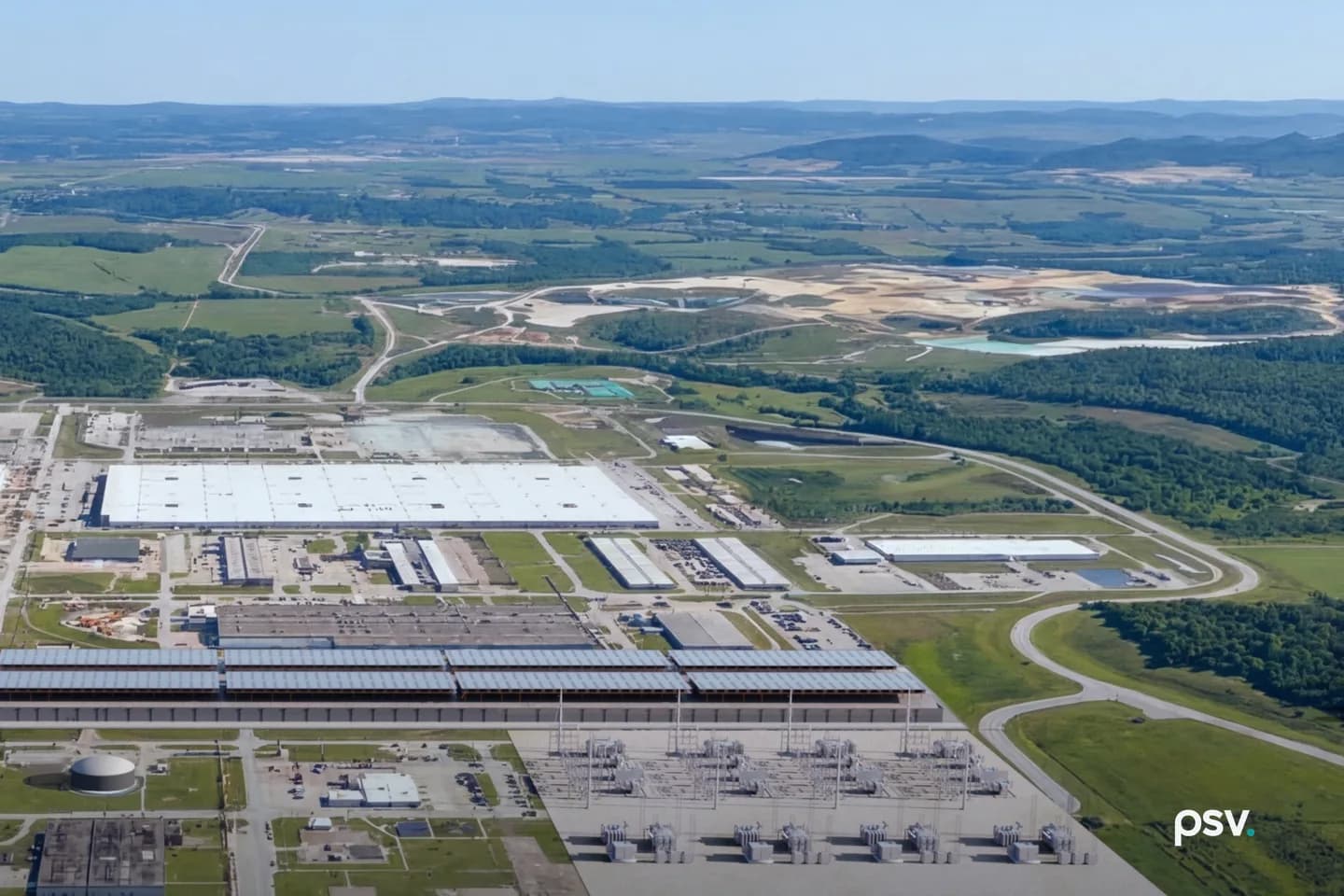
What NVIDIA filed on August 17
On August 17, 2026, NVIDIA Corporation filed a Current Report on Form 8-K reporting entry into a material definitive agreement. The filing says NVIDIA announced a multi-year partnership with SB Energy Corp. to advance development of the PORTS Technology Campus in Pike County, Ohio, and that through the partnership and the credit support described in the filing, NVIDIA has secured land, power and shell capacity at the site to host NVIDIA AI compute infrastructure. An affiliate of OpenAI Group PBC will be the tenant. The instruments themselves are residual value guaranties, entered with SB Energy as lessor, relating to leases for approximately 4.25 gigawatts of IT load in the aggregate. NVIDIA states that its aggregate payment obligation is cumulatively capped at $105 billion for its initial commitment, that an agreement generally becomes effective upon commencement of the applicable lease, and that its payment obligations are conditioned on the lessor satisfying applicable ready-for-service conditions, expected beginning in 2028. NVIDIA also discloses it can provide credit support for approximately an additional 3.8 gigawatts at the site, exercisable in its sole discretion. The form of the agreements will be filed as an exhibit to NVIDIA’s Form 10-Q for the fiscal quarter ended July 26, 2026, so the operative documents are not yet public.
The accompanying press release, furnished as Exhibit 99.1 and issued the same day, supplies the site facts. SB Energy will build, own and operate the data center under a 20-year lease to OpenAI. The initial deployment is designed to support 4.25 IT-GW, with an option on the remaining 3.75 IT-GW for 8 IT-GW total, and the campus reindustrializes the decommissioned Portsmouth Gaseous Diffusion Plant on private and federal land, developed in collaboration with AEP Ohio, the U.S. Department of Energy and the U.S. Department of Commerce. Capacity is expected to come online in phases beginning in 2028. SB Energy and SoftBank will build at least 10 GW of new energy generation and invest at least $4.2 billion in new regional grid infrastructure through a partnership with AEP Ohio the release describes as designed to protect ratepayers. SB Energy’s originally announced $40 million community benefits fund is joined by an incremental $40 million from OpenAI, which the release’s bullets total as an initial $80 million fund. NVIDIA will separately invest $1.5 billion in SB Energy, joining SoftBank Group and OpenAI as investors. Goldman Sachs and JP Morgan advised SB Energy; Morgan Stanley advised NVIDIA. One detail does not reconcile across the two records: the 8-K describes the option as approximately an additional 3.8 gigawatts, while the press release calls it the remaining 3.75 IT-GW against an 8 IT-GW total. The gap is 50 megawatts of stated option capacity, immaterial to the thesis and worth noting because the 8-K is the filed document and the release is furnished, not filed.
Why a CRE operator should care
Strip the AI vocabulary and this is a landlord-credit transaction of a kind every real estate professional already knows. A developer is building a single-tenant asset on a 20-year lease to a tenant whose credit will not carry the paper on its own, so a third party with a stronger balance sheet stands behind it. What is unusual is who the third party is and what exactly it promised. NVIDIA is not a parent guarantor and not a co-tenant; it manufactures the equipment the tenant will install. And the promise is narrower than a lease guaranty. Per the 8-K, on a trigger event, meaning OpenAI’s insolvency resulting in a default under a lease or OpenAI’s failure to make payments, NVIDIA pays an amount generally equal to any shortfall between the guaranteed minimum value of a lease and amounts recovered through a replacement lease or sale. That is residual value coverage, not rent coverage: it makes the lessor whole on value after a reletting or sale attempt rather than paying rent on schedule. NVIDIA may then elect to assume the lease, require the lessor to relet, initiate a sale process, allow termination, or defer those remedies for up to a year while paying specified project agreement costs. Anyone quoting this deal to a client should be able to say which of those five things NVIDIA can do, because they are not equivalent outcomes for a lender.
Two disclosures deserve to be read together, because they define what the credit support is actually for. First, NVIDIA’s obligations terminate on the earliest of the 20th anniversary of lease commencement, OpenAI terminating the lease per its terms, OpenAI achieving a satisfactory credit rating, or other customary events. A guaranty that expires when the tenant gets rated is a bridge across an unrated tenant’s credit gap, and the filing says so as clearly as a filing can. Second, OpenAI has agreed to reimburse and indemnify NVIDIA for any and all amounts actually paid to the lessor. That indemnity runs back to the party whose insolvency is one of the two trigger events, which is worth sitting with: in the scenario the guaranty exists to cover, the reimbursement right is a claim against an insolvent estate. Neither point is a criticism of the structure. Both are the sort of thing a credit officer is paid to notice, and neither appears in a headline. The arithmetic is also worth doing yourself. A $105 billion cap against approximately 4.25 gigawatts of IT load computes to roughly $24.7 billion per IT gigawatt, or about $24.7 million per megawatt of guaranteed exposure, which is PSV arithmetic on NVIDIA’s filed figures and not a valuation of the campus. On the site side, at least $4.2 billion of grid investment across 8 IT-GW computes to roughly $525 million per IT gigawatt, and at least 10 GW of generation for 8 IT-GW computes to about 1.25 gigawatts of generation per gigawatt of IT load. The $80 million community fund computes to under one tenth of one percent of the guaranty cap.
The workflow PSV would run
The first workflow is a credit-support abstraction, and most firms do not have one because parent guaranties used to be short enough to read once. The inputs are the primary documents: the guaranty or credit support agreement itself, the lease it attaches to, the guarantor’s filings, and any 8-K or exhibit describing it. The output is a one-page card per instrument with eight fields, each carrying the sentence it came from and the date it was pulled: instrument type, what event triggers payment, what quantity gets paid, when the obligation becomes effective, what caps it, what terminates it, what remedies the guarantor may elect, and who indemnifies whom. Applied to this filing, the card reads residual value guaranty, triggered by tenant insolvency causing default or nonpayment, paying the shortfall against a guaranteed minimum value net of reletting or sale recovery, effective on lease commencement subject to ready-for-service, capped cumulatively at $105 billion, terminating on the earliest of four listed events including a satisfactory tenant credit rating, with five elective remedies and a tenant indemnity running back to NVIDIA. A model can draft that card from the filed text in minutes. The reviewer is whoever signs credit memos. The approval gate is that no card leaves draft until a person has read the underlying document, and that a card sourced only from a press release stays flagged as incomplete until the operative agreement is filed, which for this transaction means waiting on NVIDIA’s next Form 10-Q.
The second workflow is a schedule and power dependency register, because the value of every number above is conditioned on things that have not happened. NVIDIA’s payment obligations depend on the lessor satisfying ready-for-service conditions expected beginning in 2028. The campus depends on at least 10 GW of new generation and at least $4.2 billion of grid work being built. The option capacity depends on NVIDIA electing to exercise it, in its sole discretion, which is the filing’s language and not a commitment. PSV would keep one row per dependency with the document that establishes it, the stated date if any, the party who controls it, and a re-check interval, then diff the primary record on that interval so a slipped date or a quiet restatement surfaces on its own rather than in a client meeting. The output is a status table, not a narrative, and it uses the same discipline PSV applied to the August 10 NVIDIA financing announcement: announced is not committed, committed is not funded, and executed is not yet in service. There is no approval gate on a monitoring layer. The point is that nothing in a model silently inherits a 2028 date that was always conditional.
What stays human, and what is still unknown
The operator read
Finish with the judgment call.
The reported facts are above. Enter your email for PSV's operator conclusion and a year of access to every newsroom brief.
Free. No card. Privacy policy. Unsubscribe anytime.
 by PSVLive
Build the workflow behind this analysis. Train with the operators doing it.
Real deal files, live builds, and production-ready CRE AI workflows inside the CRE AI Institute.











Clear answers
Common questions about NVIDIA OpenAI Ohio data center lease guaranty
What did NVIDIA agree to at the PORTS-Pike Technology Campus?
In a Form 8-K filed August 17, 2026, NVIDIA Corporation disclosed a multi-year partnership with SB Energy Corp. to advance the PORTS Technology Campus in Pike County, Ohio, and entry into multiple residual value guaranties with SB Energy as lessor relating to leases for approximately 4.25 gigawatts of IT load in the aggregate. An affiliate of OpenAI Group PBC is the tenant. NVIDIA states its aggregate payment obligation is cumulatively capped at $105 billion for its initial commitment, that an agreement generally becomes effective upon commencement of the applicable lease, and that its payment obligations are subject to the lessor satisfying applicable ready-for-service conditions, expected beginning in 2028. NVIDIA can also provide credit support for approximately an additional 3.8 gigawatts at its sole discretion. The accompanying press release says SB Energy will build, own and operate the data center under a 20-year lease to OpenAI, and that NVIDIA will separately invest $1.5 billion in SB Energy. The form of the agreements will be filed with NVIDIA’s Form 10-Q for the quarter ended July 26, 2026, so the operative documents are not yet public.
Is a residual value guaranty the same as a lease guaranty?
No, and the difference decides what a lender actually holds. A conventional lease or parent guaranty puts the guarantor behind the rent obligation, generally paying on schedule when the tenant does not. NVIDIA’s 8-K describes something narrower. On a trigger event, meaning OpenAI’s insolvency resulting in a default under a lease or OpenAI’s failure to make payments, NVIDIA pays an amount generally equal to any shortfall between the guaranteed minimum value of a lease and amounts recovered through a replacement lease or sale. That makes the lessor whole on value after a reletting or sale attempt rather than paying rent as it comes due, and it means recovery timing and the reletting market both sit inside the instrument. NVIDIA may then elect to assume the lease, require the lessor to seek to relet, initiate a sale process, allow the lease to terminate, or defer those remedies for up to one year while paying specified project agreement costs. Those five elections are not equivalent outcomes for a lender, which is why the operative documents matter more than the headline cap.
Why does NVIDIA’s guaranty end if OpenAI gets a credit rating?
Because the guaranty exists to cover a credit gap, and a rating closes it. Per the filing, NVIDIA’s obligations under an agreement terminate upon the earliest to occur of the 20th anniversary of the commencement of the applicable lease, the termination of the lease by OpenAI in accordance with its terms, OpenAI achieving a satisfactory credit rating, or other customary termination events. Read alongside the rest of the structure, that is the clearest statement in either document of what the credit support is for: making an unrated tenant financeable on 20-year paper until it can carry the paper itself. One related disclosure belongs in the same read. OpenAI has agreed to reimburse and indemnify NVIDIA for any and all amounts actually paid by NVIDIA to the lessor, and OpenAI’s insolvency is one of the two trigger events, so in the scenario the guaranty is written to cover, that reimbursement right would be a claim against an insolvent estate. Neither point is a criticism of the structure; both are what a credit officer is paid to notice.
Primary source record
These records support the reported facts in this brief. PSV’s CRE workflow interpretation and test plan are original analysis.
- NVIDIA Corporation, Form 8-K filed August 17, 2026 (Items 1.01, 2.03, 7.01, 9.01), U.S. Securities and Exchange Commission
- NVIDIA Corporation, Exhibit 99.1 press release, “NVIDIA Guarantees SB Energy’s PORTS-Pike Technology Campus in Ohio to Exclusively Host NVIDIA AI Compute,” August 17, 2026
- NVIDIA Corporation, EDGAR filing history (CIK 0001045810)
- SB Energy, PORTS-Pike Technology Campus project site (source of the lead rendering)
- U.S. Department of Energy, Portsmouth Site Description (the decommissioned Portsmouth Gaseous Diffusion Plant in Pike County, Ohio)
Topics
Related PSV analysis
CRE CAPITAL NEWS
NVIDIA’s $500B: Compute Joins the Real Asset Stack
NVIDIA said on August 10 that it signed memorandums of understanding with Apollo, BlackRock, Blackstone, Brookfield, Goldman Sachs and KKR to establish independent compute financing platforms and mobilize over $500 billion of third-party capital. Read the About sections of that same release and the CRE fact is already on the page: three of the six describe real estate as a core business, and one of them calls itself the world’s largest alternative asset manager.
CRE CAPITAL NEWS
Fermi’s $6.5B Lease: The Guarantee Line Vanished
Fermi Inc. said on August 10 that it executed its first binding customer lease at Project Matador in Carson County, Texas: 222 MW of total facility power to TensorWave, at approximately $6.5 billion of contracted revenue over an initial 15-year term. The wire then carried a corrected version of the same release. The sentence about a guarantee from one of the global leaders in AI is not in it.
CRE CAPITAL NEWS
DOE Leases Paducah for a $100B AI Campus: The CRE Read
The Department of Energy said on July 29 that it selected Brookfield to lease land and develop a data center campus at its Paducah Site in western Kentucky, and selected NextEra Energy to build and own the power behind it. The partners put the privately funded investment above $100 billion, with up to 1.8 gigawatts of utility capacity and more than 1.2 gigawatts of compute. No tenant has been named.
Related guides
Cornerstone PSV guides on the workflows in this article.
Claude vs ChatGPT for CRE
An operator's comparison of Claude and ChatGPT for commercial real estate underwriting, and why the grounded setup matters more than the model brand.
Read the guideClaude for Real Estate Underwriting
The grounded underwriting workflow: real deal documents in, your rules applied, a source citation behind every number, a person signs off.
Read the guideClaude Engineering Partner for CRE
What it means to run Claude with an engineering partner: the operating model, the controls, and the handoff.
Read the guideby PSVLiveYou read the operator view. Now learn to run the workflow.
The AI MBA for commercial real estate: the workflows these briefs describe, taught end to end on real deal files, with live builds and a community of CRE operators.