CRE CAPITAL NEWS
Fermi’s $6.5B Lease: The Guarantee Line Vanished
Fermi Inc. said on August 10 that it executed its first binding customer lease at Project Matador in Carson County, Texas: 222 MW of total facility power to TensorWave, at approximately $6.5 billion of contracted revenue over an initial 15-year term. The wire then carried a corrected version of the same release. The sentence about a guarantee from one of the global leaders in AI is not in it.
Direct answer
Direct answer to Fermi TensorWave data center lease Project Matador
Read against the corrected release, $6.5 billion over 180 months on 222 MW computes to roughly $162.70 per kW-month of total facility power, which is turnkey pricing rather than powered shell. The counterparty is a venture-funded AMD cloud, the 15-year clock does not start until the final delivery phase commences, and the lease is conditioned on receipt of requisite project guaranties and financing. No guarantor is named in the public record.
What Fermi announced, and what the corrected release removed
On August 10, 2026, Fermi Inc. (Nasdaq: FRMI)(LSE: FRMI), operating as Fermi America, said it had executed its first binding customer lease at its Project Matador campus in Carson County, Texas. The release says the lease is between Fermi’s subsidiary Fermi Campus 1 LLC and TensorWave TEX1, LLC, a subsidiary of the AI cloud provider TensorWave Inc., and that it covers a facility supported by 222 megawatts of total facility power following commencement of the final delivery phase. The transaction summary gives the rest: a turnkey structure in which Fermi develops, constructs and delivers the facility while TensorWave takes occupancy in phases, an initial term of 15 years following commencement of the final delivery phase with two renewal options of five years each, approximately $6.5 billion of contracted revenue over that initial term for phase one excluding renewals, phased delivery beginning in the second half of 2027, and expansion rights over two additional data centers that would bring the partnership to more than 650 MW. The release also states that the lease contains customary conditions, including the receipt of requisite project guaranties and financing. On the campus itself Fermi says approximately 6 GW of the planned 17 GW is already permitted, more than $1.5 billion has been invested in the buildout to date, and first power is targeted for 2026.
Then the same release went out again. ACCESS Newswire distributed a second version headed “CORRECTION FROM SOURCE,” carrying the line “Reason for change: Unfinalized version was submitted.” Two things are in the first version and not in the corrected one. The third headline bullet originally read that Fermi and TensorWave “have lined up world-class partners to collaborate on the project and expect certain of the obligations under the lease to be guaranteed by one of the global leaders in AI,” and in the corrected version it stops after “collaborate on the project.” The transaction summary originally carried a “Guarantee” line reading “Fermi expects certain of the obligations under the lease to be guaranteed by one of the global leaders in AI,” and the corrected version has no Guarantee line at all. A third, smaller edit runs the same direction: the first version says the facility “is expected to support” tens of thousands of next-generation AMD Instinct GPUs, and the corrected version says it “is being designed to support” them. What survives in both is the chairman’s quote, in which Marius Haas describes a committed partner ecosystem “of developers, guarantors, and financing providers,” and the Conditions line naming receipt of requisite project guaranties. So a guarantee structure is still in the record as a condition. What is gone is the characterization of who provides it.
Two absences are worth stating plainly, because both are the kind of thing a summary will smooth over. First, as of this writing PSV found no Form 8-K reporting the lease and no Fermi filing mentioning TensorWave in EDGAR full-text search, so every figure above traces to a press release rather than to a filed agreement. A Form 8-K on an August 10 event would not be late until August 14. Second, the balance sheet behind the announcement is filed, and it is recent: Fermi told the SEC that on July 14, 2026 it consummated $375 million of 5.00% convertible senior notes due 2031 and that the initial purchasers exercised their $56.25 million option in full, for $431.25 million of gross proceeds and approximately $416.81 million net, of which approximately $34.5 million paid for capped call transactions. The initial conversion rate of 105.0862 shares per $1,000 principal computes to a conversion price of approximately $9.52 per share. Fermi raised that money roughly four weeks before it announced a $6.5 billion lease, and $431.25 million of gross proceeds computes to roughly 6.6 percent of the contracted revenue now attached to a single tenant.
Why a CRE operator should care
Start with the rent, because the headline number is a term total and nobody underwrites a term total. Approximately $6.5 billion over an initial 15-year term computes to roughly $433.3 million a year. Against 222 MW that is roughly $1.95 million per MW-year, and divided out it computes to roughly $162,700 per MW-month, or roughly $162.70 per kW-month. Do it the other way as a check: 222,000 kW across 180 months is 39,960,000 kW-months, and $6.5 billion over that computes to $162.66. That is PSV arithmetic on Fermi’s published figures, not a Fermi disclosure, and it is a turnkey number rather than a powered-shell number, which the transaction summary makes explicit when it says Fermi develops, constructs and delivers the facility. Read it next to a powered-shell comp and you will conclude Fermi is expensive. Read it as what it is, a fully built and delivered facility on a private grid, and it is a market-shaped rate.
Now apply the denominator problem, because this is where most operators will misread the deal. The 222 MW is described as total facility power, not critical IT load, and Fermi has published no PUE for the facility. Those are not the same denominator and the difference is not small. Assume a design PUE somewhere between 1.15 and 1.30 and the IT load implied by 222 MW of facility power falls between roughly 171 and 193 MW, which moves the same $433.3 million a year to somewhere between roughly $187 and $211 per critical kW-month. That range is PSV arithmetic on an assumption Fermi has not published, and it is offered as a caution rather than a comp. The operating point is simply this: when a data center lease is quoted on facility power, it is not directly comparable to a market survey quoted on critical load, and the gap between the two readings here is roughly 25 percent.
Then read the two clocks and the counterparty, which is where the actual risk sits. Delivery begins in the second half of 2027, but the 15-year term does not begin at first occupancy. It begins on commencement of the final delivery phase, a date the release does not give, so the revenue clock starts at an undisclosed point after phasing completes and the $6.5 billion is anchored to a date nobody outside the deal can put on a calendar. The tenant is TensorWave, which the release describes as an AI cloud powered exclusively by AMD Instinct GPUs and backed by investors including Magnetar, AMD Ventures, Maverick Silicon, Nexus Venture Partners and Western Frontier. That is a venture-funded private company taking a 15-year obligation of approximately $6.5 billion, which is precisely why the guarantee sentence mattered and precisely why its removal is the most consequential edit on the page. And keep the scale honest in both directions: 222 MW is roughly 1.3 percent of the 17 GW Fermi says the campus is expected to reach, and the full 650 MW would be roughly 3.8 percent. This is a real anchor lease and it is a small fraction of the plan.
The workflow PSV would run
The first workflow is the one this deal argues for directly, and it is a counterparty and conditions file rather than a lease abstract. Anyone underwriting a data center lease to a neocloud tenant, whether as the landlord, the lender, the equity or the buyer of the paper, needs the answer to four questions before the term total means anything, and the inputs are records: the executed lease and every exhibit if you are inside the deal, the guaranty instruments and the identity and financials of each guarantor, the conditions precedent list with the responsible party and the deadline for each, the tenant’s own funding record and disclosed capital, the GPU supply agreements or purchase commitments that make the tenant’s business plan physical, and the interconnection and permitting record for the site itself. The output is one page per lease that states the contracted term total, the date the term actually commences, the conditions that remain unsatisfied, the guarantor by name with the obligations it covers, and the source document and pull date behind every one of those fields. The reviewer is the credit or investment lead. The approval gate is that no unnamed guarantor ever clears: an obligation guaranteed by an unnamed party is an unguaranteed obligation until a person has read the instrument.
The second workflow is smaller, cheaper and, on the evidence of this story, badly missing from most desks: version-diffing the primary record. A press release is not a static document. It gets corrected, reissued, quietly amended on a company newsroom, superseded by an 8-K that says something narrower, and the secondary coverage almost never re-reports the change. What PSV would run is unglamorous: capture the full text of every release, filing and newsroom post for the counterparties and assets you actually track, timestamp each capture, and diff each new version against the last, surfacing only the changes that touch a number, a name, a date or a guarantee. The output is an alert with the two versions side by side and the deleted text highlighted. The reviewer is whoever owns the position. There is no approval gate here because nothing is being decided, which is the point: it is a monitoring layer, not a judgment layer. In this case it would have caught, within minutes and without anyone reading a word, that the single sentence converting a venture-backed tenant into investment-grade contracted revenue had been withdrawn from the release while the coverage built on it stayed up.
What stays human, and what is still unknown
The operator read
Finish with the judgment call.
The reported facts are above. Enter your email for PSV's operator conclusion and a year of access to every newsroom brief.
Free. No card. Privacy policy. Unsubscribe anytime.
 by PSVLive
Build the workflow behind this analysis. Train with the operators doing it.
Real deal files, live builds, and production-ready CRE AI workflows inside the CRE AI Institute.










Clear answers
Common questions about Fermi TensorWave data center lease Project Matador
What are the terms of the Fermi TensorWave data center lease?
Fermi Inc. (Nasdaq: FRMI)(LSE: FRMI) said on August 10, 2026 that it executed its first binding customer lease at Project Matador in Carson County, Texas, between its subsidiary Fermi Campus 1 LLC and TensorWave TEX1, LLC, a subsidiary of TensorWave Inc. The lease covers a facility supported by 222 megawatts of total facility power following commencement of the final delivery phase, on a turnkey structure in which Fermi develops, constructs and delivers the facility while TensorWave takes occupancy in phases. The initial term is 15 years following commencement of the final delivery phase, with two renewal options of five years each, and Fermi puts contracted revenue at approximately $6.5 billion over that initial term for phase one excluding renewals. Delivery is phased beginning in the second half of 2027. The lease carries expansion rights over two additional data centers that would bring the partnership to more than 650 MW, and it contains customary conditions including the receipt of requisite project guaranties and financing. As of this writing PSV found no Form 8-K reporting the lease and no Fermi filing mentioning TensorWave in EDGAR full-text search, so the terms trace to a press release rather than a filed agreement.
What changed between the original Fermi release and the corrected version?
ACCESS Newswire distributed a second version of the same August 10, 2026 announcement headed “CORRECTION FROM SOURCE” and carrying the line “Reason for change: Unfinalized version was submitted.” Two credit-relevant passages appear in the first version and not in the corrected one. The third headline bullet originally said Fermi and TensorWave expect certain of the obligations under the lease to be guaranteed by one of the global leaders in AI, and the corrected bullet stops after describing world-class partners collaborating on the project. The transaction summary originally carried a Guarantee line stating the same expectation, and the corrected transaction summary has no Guarantee line. A third edit softens the GPU language from a facility that is expected to support tens of thousands of next-generation AMD Instinct GPUs to one that is being designed to support them. What survives in both versions is the chairman’s reference to a committed partner ecosystem of developers, guarantors and financing providers, and the Conditions line naming receipt of requisite project guaranties, so a guarantee structure remains in the record as a condition while the characterization of who provides it is gone.
What does the Fermi lease compute to per kW-month, and is that expensive?
Approximately $6.5 billion over an initial 15-year term computes to roughly $433.3 million a year, which against 222 MW is roughly $1.95 million per MW-year, or roughly $162,700 per MW-month. Checked the other way, 222,000 kW across 180 months is 39,960,000 kW-months and $6.5 billion over that computes to $162.66 per kW-month. That is PSV arithmetic on Fermi’s published figures rather than a Fermi disclosure, and it is a turnkey rate rather than a powered-shell rate, since the transaction summary states that Fermi develops, constructs and delivers the facility. One denominator caution matters more than the rate itself: the 222 MW is described as total facility power, not critical IT load, and Fermi has published no PUE. Assuming a design PUE between 1.15 and 1.30 puts the implied IT load between roughly 171 and 193 MW and the same annual revenue between roughly $187 and $211 per critical kW-month, a range that is PSV arithmetic on an unpublished assumption. A lease quoted on facility power is not directly comparable to a market survey quoted on critical load.
Primary source record
These records support the reported facts in this brief. PSV’s CRE workflow interpretation and test plan are original analysis.
- Fermi Inc., “Fermi Announces Binding Lease Agreement with TensorWave”, ACCESS Newswire, August 10, 2026
- Fermi Inc., Form 8-K reporting the $375 million 5.00% convertible senior notes due 2031, filed July 15, 2026
- Fermi Inc., Form 8-K on the commencement of the convertible notes offering, filed July 9, 2026
- Fermi Inc., EDGAR filing history (CIK 0002071778)
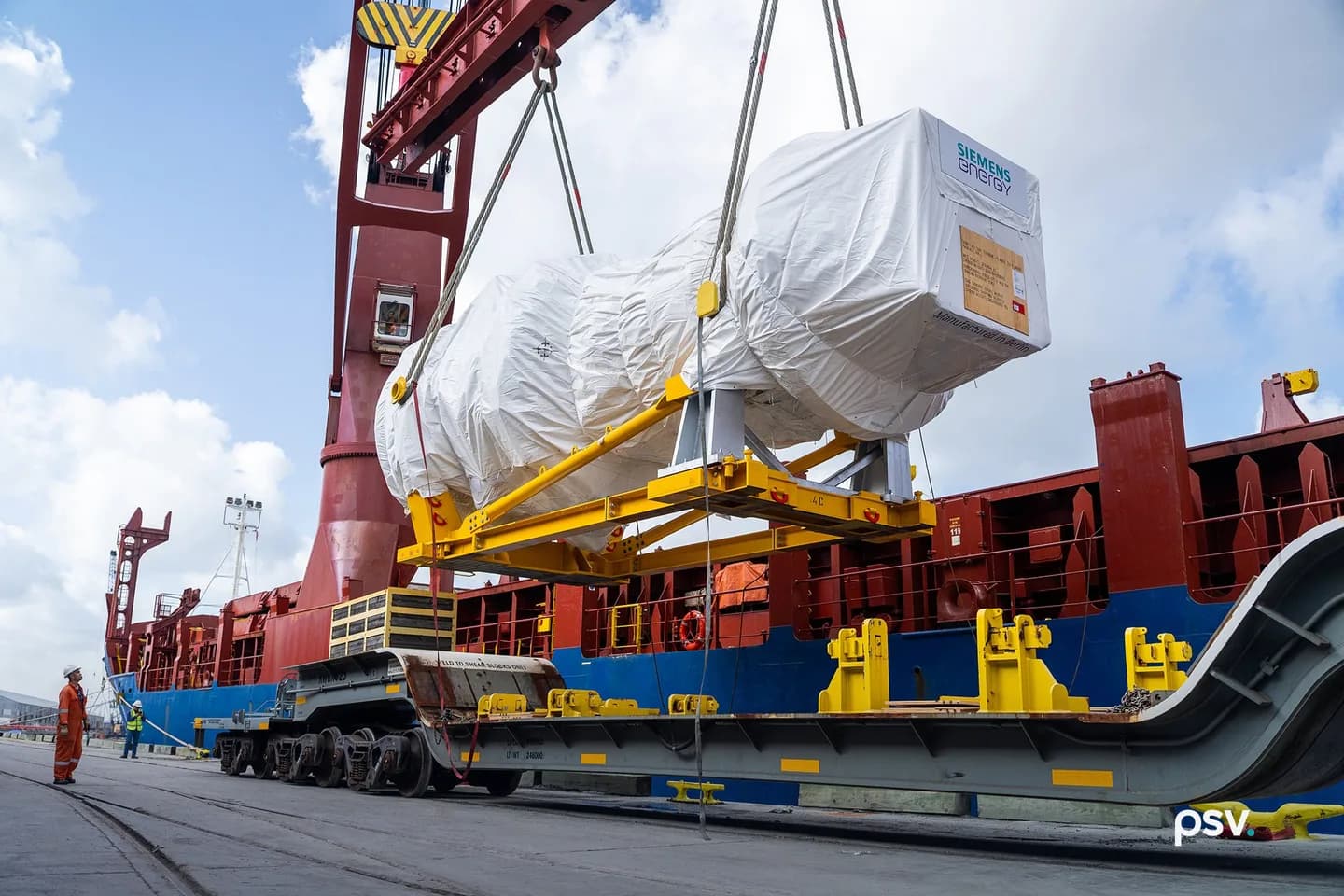
- Fermi America newsroom, “First Siemens Energy Turbines Arrive for Project Matador”, July 21, 2026
Topics
Related PSV analysis
CRE CAPITAL NEWS
Hut 8’s $9.8B Beacon Point Lease: The CRE Read on a Fully Leased AI Campus
Hut 8 said on July 20 it signed a second 15-year lease at its Beacon Point campus in Nueces County, Texas, a 352 megawatt deal with a base-term contract value of $9.8 billion. The lease fully commercializes the one-gigawatt campus, doubling the tenant’s contracted capacity to 704 megawatts. For real estate, the detail that matters is the structure: a triple-net, take-or-pay lease to a single investment-grade tenant, energizing in 2027.
CRE CAPITAL NEWS
IREN Signed $2.8B in AI Contracts. The CRE Read on a New Data Center Capital Stack
IREN Limited said on July 20 it signed $2.8 billion in new multi-year cloud contracts with leading AI developers, raising its 2026 AI Cloud run-rate revenue target above $4 billion. The detail that matters for real estate is how it is funded: customer prepayments covering roughly 45 percent of the associated GPU capital, on top of equipment-backed financing. The AI data center is being underwritten on contracted cash flow, not speculation.
CRE CAPITAL NEWS
Csquare Raised $1.05B. The Data Center Market Is Asking for Proof.
Brookfield-backed Csquare priced its initial public offering at $21 a share, below its marketed $23 to $27 range, raising $1.05 billion rather than the $1.35 billion implied at the top end. The result does not erase demand for digital infrastructure. It does put a sharper public-market price on leverage, delivery, and the difference between a data center story and a data center cash flow.
Related guides
Cornerstone PSV guides on the workflows in this article.
Claude for Real Estate Underwriting
The grounded underwriting workflow: real deal documents in, your rules applied, a source citation behind every number, a person signs off.
Read the guideWhat is CRE AI?
The definitional guide to commercial real estate AI: the core workflows, how it differs from a chatbot, and how to learn it.
Read the guideby PSVLiveYou read the operator view. Now learn to run the workflow.
The AI MBA for commercial real estate: the workflows these briefs describe, taught end to end on real deal files, with live builds and a community of CRE operators.