CRE POLICY NEWS
OpenAI’s $20B Project Camellia: The CRE Read on an Unfiled Entitlement
Effingham County, Georgia announced on July 22 that OpenAI will build a $20 billion, 3.2 gigawatt campus inside the Savannah Gateway Industrial Hub. Five days later the county published a second statement: the only document it has received is a Development of Regional Impact cover page, no completed application has been submitted, and the site plan circulating online is a blank state template someone filled in.
Direct answer
Direct answer to OpenAI Project Camellia Effingham County commercial real estate
OpenAI has a power contract, not an entitlement. Georgia Power is contracted to deliver 3.2 gigawatts in phases between 2028 and 2032, and OpenAI’s own July 26 fact sheet commits to paying 100 percent of the electric-service cost. But Effingham County said on July 27 that it holds only a DRI Project Sheet Cover Page. Under Georgia’s data center rule, effective December 15, 2025, that review has to finish before the county can act.
What the county and OpenAI have actually filed and said
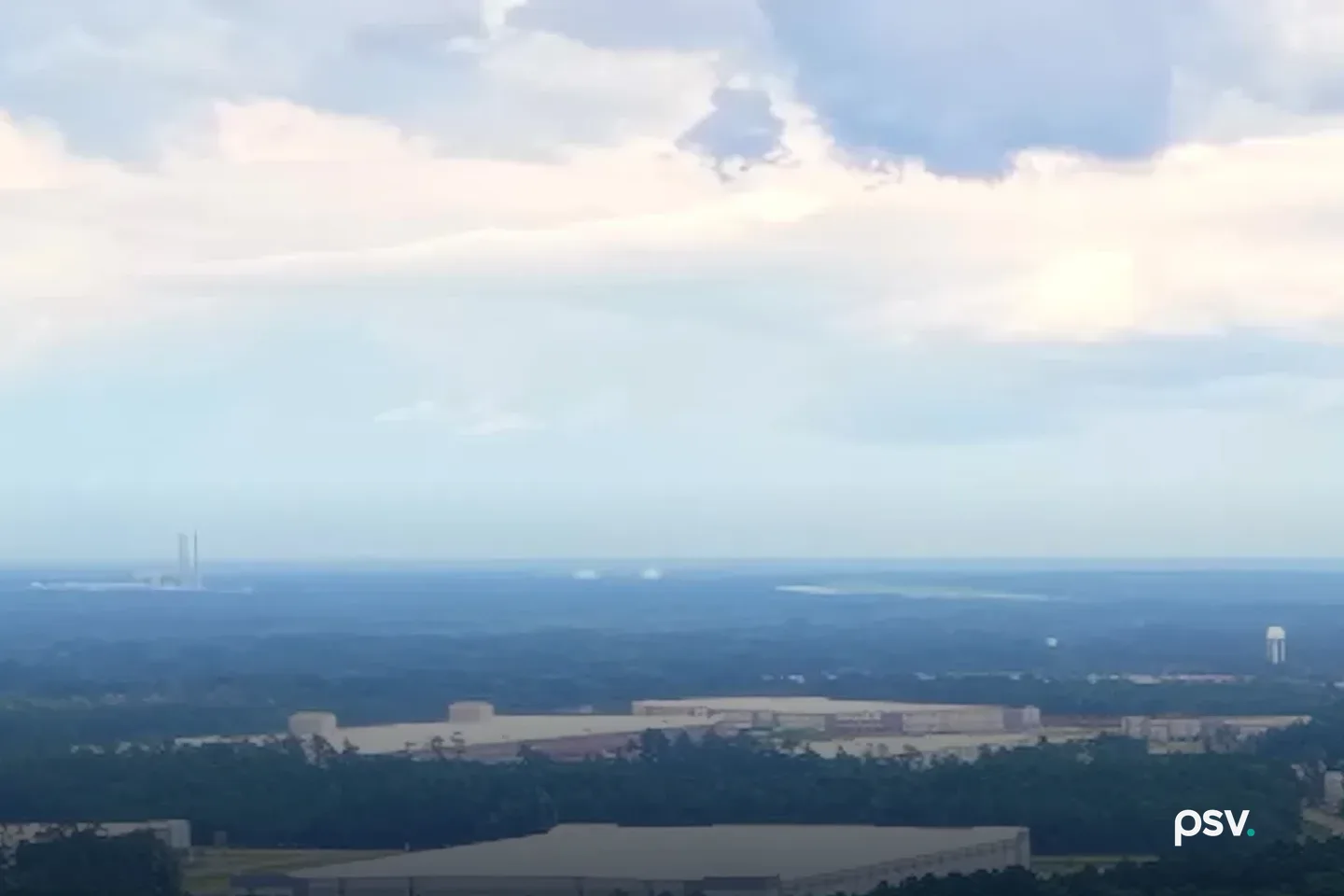
On July 22, 2026, the Effingham County Industrial Development Authority, the Effingham County Board of Commissioners and the Effingham County School District jointly announced that OpenAI will establish a data center campus inside the Savannah Gateway Industrial Hub, a 2,600 acre logistics campus developed by The Broe Group. The county put the capital investment at $20 billion and called it one of the largest private investments in the history of coastal Georgia. County Manager Tim Callanan said the project could become the catalyst for Project Zero, the county’s commitment to eliminate homestead property taxes, “as early as next year,” with current estimates of a 40 percent reduction for the average homeowner. Those are the county’s figures and the county’s projection, not PSV findings. OpenAI is contracting with Georgia Power for 3.2 gigawatts, expected to be delivered in phases between 2028 and 2032.
OpenAI’s own Project Camellia fact sheet, dated July 26, 2026, commits the company to paying 100 percent of the project’s infrastructure and electric-service costs, to closed loop cooling that it says keeps ongoing water use similar to an office building with the same headcount, to an $80 million community support commitment, to reporting through an annual independent audit, and to becoming the largest property taxpayer in Effingham County. Two published records disagree on employment: the county’s July 22 release says 400 long-term jobs, while OpenAI’s fact sheet says more than 1,000 permanent jobs once fully built out. Then, on July 27, the county published a separate statement. It said the only document submitted to the county at this time is the DRI Project Sheet Cover Page, that no completed Development of Regional Impact application has been submitted, and that images circulating on social media purporting to show the application are a blank state template that individuals filled in with information never submitted to or approved by the county. At $20 billion against 3.2 gigawatts, the announced investment computes to roughly $6.25 million per megawatt of contracted capacity.
Why a CRE operator should care
For three years the binding constraint on a data center moved from land to power. This story is the marker that it has moved again, to the local approval record. OpenAI has the scarce thing: a utility contract for 3.2 gigawatts on a named schedule, at a site already zoned industrial, inside a hub built for exactly this. What it does not yet have is the document that lets the county act. Georgia’s Department of Community Affairs rewrote its DRI rules on November 20, 2025, effective December 15, 2025, and added category 16, Technological Facility (Including Data Centers), with a threshold of more than 500,000 gross square feet or more than 200 acres. Press accounts describe a campus of roughly 1,400 acres. On either measure this project clears the trigger by an order of magnitude, and the rule requires the Regional Commission review to be completed before local government action.
That is the repricing argument, and it cuts against the reflex. The announcement already moved land expectations around Rincon and Pooler, because that is what a $20 billion headline does. The entitlement docket is what will move schedules, and it is at page one with first power targeted for 2028. Every megaproject runs this sequence, and the press release leads the plat by quarters, not weeks. The tell here is the second statement. A county does not publicly disown a fake site plan five days after its own announcement unless the information vacuum is already being filled by something else, and in a vacuum the loudest document wins. An operator underwriting land, build-to-rent, or industrial supply near this site is currently pricing a project whose reviewable record is one cover page. The correct posture is not skepticism about whether it happens. It is precision about when, because the difference between 2028 and 2031 is the entire hold period on a land bank.
The workflow PSV would run on an announcement-to-entitlement gap
Treat the gap itself as the tracked object. Build an entitlement file from primary records only: the county’s DRI submissions as they post, the Coastal Regional Commission’s DRI docket and its review report, the Board of Commissioners and Planning Board agendas and minutes, the school district and IDA board packets that carry any abatement or bond structure, the Georgia Public Service Commission docket for the load and the tariff, and the county’s own newsflash channel, which is where the July 27 correction actually appeared. An AI assistant reads each new record on a schedule and returns a cited memo: what was filed, on what date, by whom, what it supersedes, what the next required step is, and what changed since the last check, with every claim traced to the document it came from and every unverified item marked as unverified rather than smoothed over.
The reviewer is the acquisitions or development lead working with land counsel, and the approval gate is explicit: no land bid, no option extension, no supply assumption, and no rezoning position moves on a summary. The same review produces the questions a human sends: to the Coastal Regional Commission on whether a complete DRI has been received and where it sits in the 30 day review, to the county on the difference between the 400 job figure and the 1,000 job figure and which one underpins the tax projection, to Georgia Power and the PSC on the phasing and the demand-response terms, and to counsel on what the county can and cannot approve before the review closes. The assistant assembles and dates the record. It does not decide what the record is worth.
What should remain human-owned
The operator read
Finish with the judgment call.
The reported facts are above. Enter your email for PSV's operator conclusion and a year of access to every newsroom brief.
Free. No card. Privacy policy. Unsubscribe anytime.
 by PSVLive
Build the workflow behind this analysis. Train with the operators doing it.
Real deal files, live builds, and production-ready CRE AI workflows inside the CRE AI Institute.









Clear answers
Common questions about OpenAI Project Camellia Effingham County commercial real estate
What is OpenAI’s Project Camellia in Effingham County, Georgia?
Project Camellia is a data center campus OpenAI is developing inside the Savannah Gateway Industrial Hub, a 2,600 acre logistics campus developed by The Broe Group in Effingham County, Georgia. The Effingham County Industrial Development Authority, Board of Commissioners and School District announced it jointly on July 22, 2026, putting the capital investment at $20 billion and calling it one of the largest private investments in the history of coastal Georgia. OpenAI is contracting with Georgia Power for 3.2 gigawatts, expected to be delivered in phases between 2028 and 2032. OpenAI’s own fact sheet, dated July 26, 2026, commits the company to paying 100 percent of the infrastructure and electric-service costs, to closed loop cooling, to an $80 million community support commitment, and to reporting through an annual independent audit.
Has OpenAI filed a Development of Regional Impact application for Project Camellia?
Not a complete one, according to the county. Effingham County published a statement on July 27, 2026 saying the only document submitted to it at that time is the DRI Project Sheet Cover Page, that no completed Development of Regional Impact application has been submitted, and that images circulating on social media claiming to show the application are a blank state template that individuals filled in with information never submitted to or approved by the county. Georgia’s Department of Community Affairs rules, adopted November 20, 2025 and effective December 15, 2025, put technological facilities including data centers in the DRI review category at more than 500,000 gross square feet or more than 200 acres, and require the Regional Commission review before local government action.
Why does the Project Camellia entitlement status matter for commercial real estate?
Because it separates the power question from the schedule question. OpenAI holds the scarce input, a utility contract for 3.2 gigawatts on a named delivery schedule at an already-zoned industrial site. What is not yet on the record is the land use application that lets the county act, and first power is targeted for 2028. An operator underwriting land, build-to-rent or industrial supply near Rincon and Pooler is pricing a project whose reviewable record is currently one cover page. The useful posture is not doubt about whether the campus happens, it is precision about when, because a slip from 2028 to 2031 changes the entire hold period on a land bank.
Primary source record
These records support the reported facts in this brief. PSV’s CRE workflow interpretation and test plan are original analysis.
- OpenAI: Building AI infrastructure with the Effingham County community (July 22, 2026)
- OpenAI: Project Camellia Fact Sheet (July 26, 2026)
- Effingham County, GA press release: Project Camellia (July 22, 2026)
- Effingham County, GA: Statement regarding circulating DRI images (July 27, 2026)
- Georgia Department of Community Affairs, Rules Chapter 110-12-3, Developments of Regional Impact (adopted November 20, 2025, effective December 15, 2025)
Topics
Related PSV analysis
CRE POLICY NEWS
New York’s Hyperscale Data Center Moratorium: The CRE Read
Governor Kathy Hochul signed Executive Order 62 on July 14, pausing state environmental permits for new hyperscale data centers of 50 megawatts or more for up to one year while New York writes a statewide environmental study and new development standards. It is the first statewide freeze in the country, and it lands on the hottest development pipeline in commercial real estate.
CRE CAPITAL NEWS
Hut 8’s $9.8B Beacon Point Lease: The CRE Read on a Fully Leased AI Campus
Hut 8 said on July 20 it signed a second 15-year lease at its Beacon Point campus in Nueces County, Texas, a 352 megawatt deal with a base-term contract value of $9.8 billion. The lease fully commercializes the one-gigawatt campus, doubling the tenant’s contracted capacity to 704 megawatts. For real estate, the detail that matters is the structure: a triple-net, take-or-pay lease to a single investment-grade tenant, energizing in 2027.
CRE CAPITAL NEWS
Brookfield Buys Aypa for $7B: The CRE Read on AI Power
Brookfield said on July 22 that it agreed to acquire Aypa Power, the largest standalone battery storage developer in North America, from Blackstone Energy Transition Partners for roughly $7 billion enterprise value and $3 billion of equity. Aypa brings about 6.5 GW operating and contracted, 95 percent of it under contracts averaging 17 years, plus a pipeline above 20 GW. For real estate, the binding constraint on AI has moved from land to electrons.
Related guides
Cornerstone PSV guides on the workflows in this article.
Claude for Real Estate Developers
The ground-up developer field guide: site selection through IC memo, built on a real development deal.
Read the guideClaude vs ChatGPT for CRE
An operator's comparison of Claude and ChatGPT for commercial real estate underwriting, and why the grounded setup matters more than the model brand.
Read the guideIndustrial & Logistics AI Underwriting
Custom AI employees for industrial real estate underwriting. WALT analysis, tenant credit, clear-height and power modeling, and lender packages.
Read the guideby PSVLiveYou read the operator view. Now learn to run the workflow.
The AI MBA for commercial real estate: the workflows these briefs describe, taught end to end on real deal files, with live builds and a community of CRE operators.