CRE POLICY NEWS
APS Has Not Committed to Serve a New Large Load Since 2024
Closing briefs in the Arizona Public Service rate case were docketed on August 27, and they carry a fact no site selection memo in metro Phoenix can ignore. Microsoft, an intervenor, told the Arizona Corporation Commission that APS has been unable to commit to serve any new large load customer since January 1, 2024. APS’s own brief describes a large queue of uncommitted customers. PSV read the briefs.
Direct answer
Direct answer to APS large load commitment Arizona data center
Power, not land and not capital, is the gate in APS territory, and the record now puts a date on the gate. Microsoft’s closing brief puts the freeze at over thirty months and cites an APS discovery response for it. APS is asking the Commission to make data centers take one tariff, sign a load commitment agreement and post collateral. The Attorney General wants 75 megawatt customers to fund transmission up front. None of it is decided.

What more than twenty parties put in the record on August 27
Arizona Public Service Company’s rate case, Docket No. E-01345A-25-0105 before the Arizona Corporation Commission, reached the end of its evidentiary phase last week. Docket Control shows post-hearing and closing briefs from more than twenty parties all filed on August 27, 2026, including APS itself, the Commission’s Utilities Division, the Residential Utility Consumer Office, Freeport Minerals, Kroger, Walmart, the Arizona Large Customer Group, the Federal Executive Agencies, NRG Energy, Calpine, Sierra Club, Western Resource Advocates, AARP, several school and citizen groups, and Microsoft Corporation. The single sentence in that stack that matters most to a commercial real estate operator sits on page 2 of Microsoft’s closing brief, filed by Albert H. Acken of Acken Law and received by Docket Control at 3:23 p.m. that afternoon. Describing why it believes the traditional model of a utility procuring all of its own generation has broken down, Microsoft writes that the model “has proven insufficient to support new large-load growth, as APS has been unable to commit to serve any new large load customers since January 1, 2024.” Ten pages later it repeats the point and adds the duration: “That APS has been unable to do so in over thirty months is a strong signal that procuring the many thousands of megawatts of new generation needed to serve projected demands will be too much for APS, a single-state utility, to handle alone.” The footnote behind the sentence cites MSFT-15, described in the brief as APS’s response to Microsoft Data Request 4.1. That is Microsoft’s characterization of an APS discovery response entered as a hearing exhibit, not a sentence APS wrote about itself, and PSV has not read the underlying data request response, which is not among the documents posted to the public docket images.
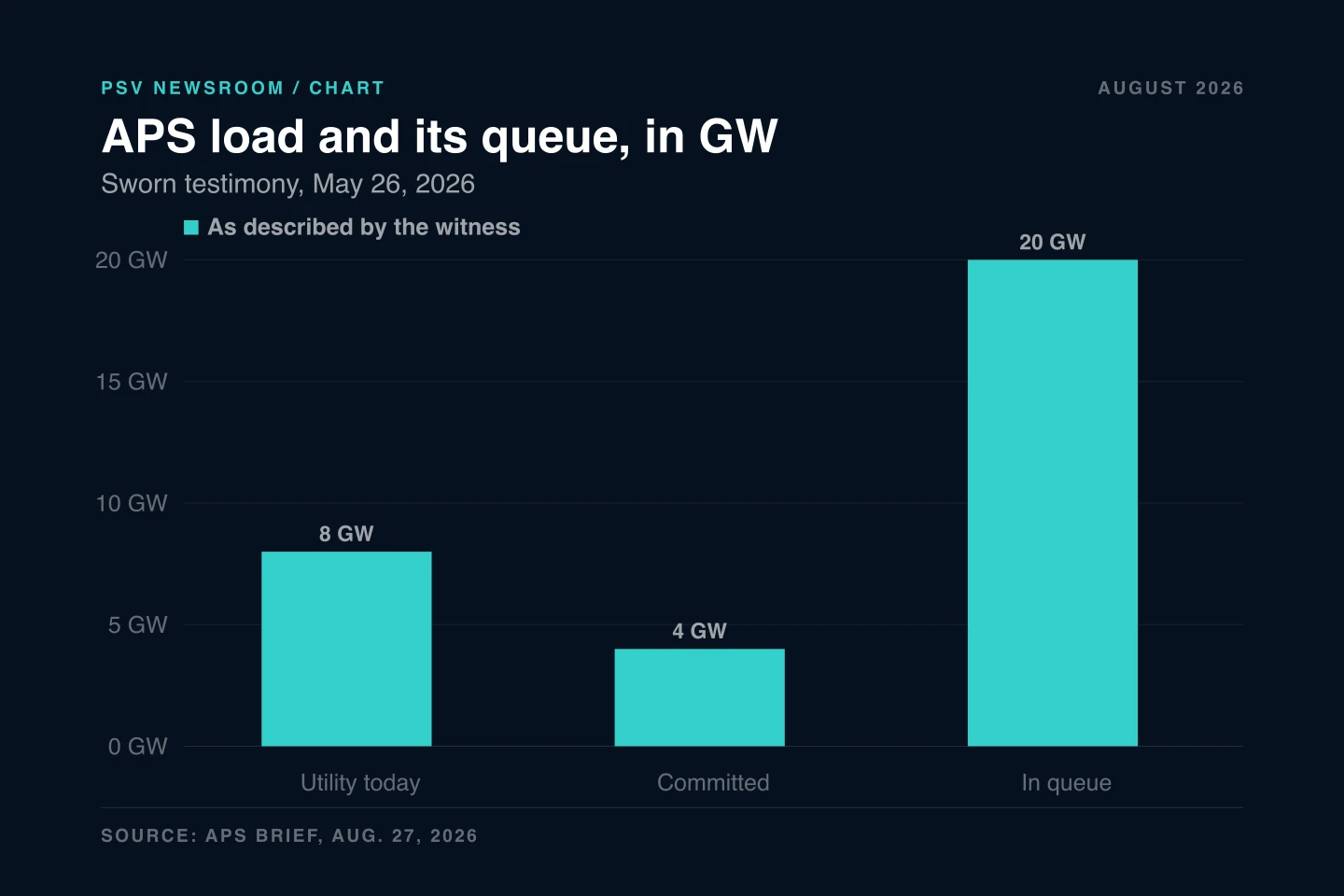
APS’s own 344 page initial post-hearing brief, filed the same afternoon at 3:14 p.m. by counsel from Pinnacle West Capital Corporation, does not repeat that sentence, but the picture it paints is consistent with it. The company tells the Commission it is serving growth “at a pace never before seen in the Company’s 140-year history.” It reports that its all-time peak demand, set during the test year in August 2024 at 8,210 megawatts, was eclipsed on August 2, 2026 by a new record of 9,164 megawatts, which the brief characterizes as growth of just under a gigawatt, or more than 10 percent, in two years. APS’s own newsroom release dated August 4, 2026 confirms that figure, dates the peak to Sunday, August 2 between 6 and 7 p.m., gives the prior record as 9,053 megawatts on July 24, 2026, and notes that one megawatt serves about 160 Arizona homes. Run APS’s own conversion against APS’s own two-year delta and the 954 megawatt increase computes to roughly 152,600 homes’ worth of demand added in twenty-four months, which is PSV arithmetic on the company’s stated figures rather than a company statement. The brief also quotes APS witness Tetlow from the hearing transcript on May 26, 2026: “to be an eight gigawatt utility committed to 4 more gigawatts with 20 gigawatts sitting in a queue is like no time in history that I’ve ever seen.” Elsewhere APS describes “a large queue of uncommitted customers,” which its own testimony defines as prospective customers seeking service who are tracked separately and are not included in the base load forecast. Separately, the record cites APS testimony that the company expects its grid to double in size over the next ten to fifteen years, largely driven by large, high load factor customers.
Why a utility rate case decides where a data center can go
APS is not asking the Commission for permission to say no. It is asking for a set of tools that change what a large load customer signs, pays and posts before it can be served, and those tools are the part of this docket that lands directly on a development pro forma. The company’s brief calls its revisions to Rate Schedule XHLF, the extra high load factor tariff, “the lynch pin” of its customer protection strategy, and it describes four changes. First, data center customers and other similarly situated large-use customers must take service under XHLF, with no choice of schedule. Second, a customer on that schedule must execute a service agreement including a Load Commitment Agreement, and the revised tariff now names the terms that agreement will address: contract length, early termination or exit fees, minimum and maximum monthly energy and demand thresholds, financial security or collateral based on the customer’s energy and demand requirements as well as creditworthiness criteria, required timeframes for contract renewal notice, special charges and other service details. Third, APS proposes to eliminate the market proxy index option that currently lets a customer avoid generation and power supply adjustment charges, on the stated ground that market prices are likely no longer adequate to recover the generation costs of serving that class. Fourth, the XHLF rates themselves are re-cut to reflect a growth-based cost allocation. The company illustrates that last one with its own arithmetic: if $100 million of growth-related revenue requirement were added annually over five years, the proposed allocator would have the E-34 and E-35 classes and the XHLF class absorb an additional 30 percent and 45 percent respectively of that incremental growth at the end of the term, compared with the traditional allocation method. APS also tells the Commission that failing to adopt these reforms would leave residential customers paying $36 million in additional rates in this case alone. Every figure in this paragraph is APS’s own submission to a regulator, not a PSV finding, and none of it has been ruled on.
The other parties are arguing about who gets to build the generation, which is the same question seen from the other end. Microsoft’s position is that it will pay the full cost of serving itself and wants the right to procure the power directly, and it puts two models in front of the Commission: expanding the existing, already approved AG-X program, and a tariff-based tri-party power purchase agreement under which a large load customer, APS and a generation provider contract together for the resources needed to serve that customer. Microsoft calls both of them bring your own generation options and argues that customer-procured power “firewalls” new generation costs so that other customers do not pay for them. The Administrative Law Judge pushed a third option at the parties, asking whether APS can and should require a large load customer to contribute or advance plant other than distribution, which is the contributions in aid of construction question. The State of Arizona, appearing through Attorney General Kristin K. Mayes’s office, answered yes and went further: its closing brief recommends the Commission require large load customers with more than 75 megawatts of aggregate capacity to make contributions equal to the revenue requirement for any distribution and transmission facilities required to serve them, and it points to the Kansas State Corporation Commission’s approval of Evergy’s Large Load Power Service tariff, which uses the same 75 megawatt definition, as precedent. Four days later, on August 31, 2026, the same Attorney General published a press release calling on the Legislature and Governor Hobbs to pass legislation halting data center approvals until Arizona has a plan to manage the industry’s growth, citing rising energy bills and a Department of the Interior cut of almost 30 percent to Arizona’s Colorado River supply, and saying “The only sane thing to do is to pause the approval of new data centers.” That release also announces an October 14 town hall in Ahwatukee on Menlo Digital’s planned hyperscale project. The two documents are separate acts by the same office, one inside a rate proceeding and one addressed to the Legislature, and PSV is reporting them as such rather than as a single coordinated policy.
The workflow PSV would run on a utility rate docket
Most operators treat a utility rate case as somebody else’s problem, and then discover the outcome as a tariff sheet eighteen months later. The workflow this argues for is a standing docket watch on every utility that serves a market you are underwriting or holding. The inputs are all public and mostly free. Every state commission runs an electronic docket; Arizona’s is eDocket, and the same docket detail record that lists the case also lists every filing with its date, its filer and its image number, which resolves to a PDF anyone can pull. The other inputs are the utility’s own rate case page and newsroom, which carry the company’s framing and its operational records such as peak demand announcements; the tariff sheets and any redlined revisions filed as exhibits, because that is where the actual contract terms live; the procedural order setting the schedule, which tells you when the record closes and when the recommended opinion is due; and the interconnection or large load queue disclosures where the utility publishes them. The output is one row per utility per market with columns that decide a schedule: the docket number and case caption; the date the evidentiary record closed; the rate schedule a project of your size would be required to take; the contract instrument that schedule requires and its named terms, meaning term length, exit fees, demand floors and ceilings, and collateral; whether the utility has proposed to require contributions in aid of construction for transmission and at what megawatt threshold; who else has intervened and what they are asking for; the next procedural date; and a citation to the filing and page every cell was read from. One derived column carries the finding: what a project of your size would owe up front and sign under each of the competing proposals now in front of the Commission, rather than under today’s tariff.
The reviewer is the development lead for the interconnection and contribution rows and the asset manager or capital markets lead for the tariff and contract rows, with outside regulatory counsel on any column that turns on what a commission can lawfully order. The approval gate is that no site goes into a schedule, no reserve gets sized and no offering assumption changes until a named person signs the table. An assistant is genuinely useful here and can carry most of the volume: pulling the docket record, reading a 344 page brief and a 50 page brief and extracting the proposed tariff terms into cells, tracking new filings against a schedule, and flagging when a party’s position changes between rounds. Three things it should not do. It should not treat a party’s brief as a finding of fact, because a brief is advocacy and the Commission has not ruled. It should not convert a proposed tariff term into a budget line, because the terms in front of this Commission are contested and several of them are mutually exclusive. And it should not infer from a queue number that a specific parcel can or cannot be served, because that is an engineering and interconnection determination the public record does not contain. PSV has run no model of APS’s system, has verified no engineering claim, and is describing a records review built on filings anyone can download. No cost, schedule, availability or return outcome is promised.
What stays with a person, and what the record does not settle
The operator read
Finish with the judgment call.
The reported facts are above. Enter your email for PSV's operator conclusion and a year of access to every newsroom brief.
Free. No card. Privacy policy. Unsubscribe anytime.
 by PSVLive
Build the workflow behind this analysis. Train with the operators doing it.
Real deal files, live builds, and production-ready CRE AI workflows inside the CRE AI Institute.










Clear answers
Common questions about APS large load commitment Arizona data center
Can Arizona Public Service serve a new data center?
Not on the record now in front of the Arizona Corporation Commission. In its closing brief in Docket No. E-01345A-25-0105, docketed August 27, 2026, Microsoft Corporation told the Commission that the traditional model in which a utility procures all of its own generation “has proven insufficient to support new large-load growth, as APS has been unable to commit to serve any new large load customers since January 1, 2024,” and later that APS has been unable to do so “in over thirty months.” Microsoft cites MSFT-15, described as APS’s response to Microsoft Data Request 4.1, for the point. That is Microsoft’s characterization of an APS discovery response entered as a hearing exhibit rather than a statement APS wrote about itself, and the underlying data request response is not among the documents posted to the public docket images. APS’s own 344 page initial post-hearing brief, filed the same afternoon, does not use that sentence, but it does describe “a large queue of uncommitted customers,” which its testimony defines as prospective customers seeking service who are tracked separately and are not included in the base load forecast, and it quotes APS witness Tetlow from the May 26, 2026 hearing describing the position as “an eight gigawatt utility committed to 4 more gigawatts with 20 gigawatts sitting in a queue.” The Commission has not ruled, so nothing here is a finding of fact.
What is APS proposing for data centers in its rate case?
A mandatory tariff with a signed commitment behind it. APS calls its revisions to Rate Schedule XHLF, the extra high load factor schedule, the lynch pin of its plan to keep large load growth from shifting costs to other customers, and its brief lists four changes. Data center customers and other similarly situated large-use customers must take service under XHLF rather than choosing a schedule. A customer on XHLF must execute a service agreement including a Load Commitment Agreement, and the revised tariff names the terms it will address: contract length, early termination or exit fees, minimum and maximum monthly energy and demand thresholds, financial security or collateral based on the customer’s energy and demand requirements as well as creditworthiness criteria, required timeframes for contract renewal notice, special charges and other service details. The market proxy index option, which currently lets a customer avoid generation and power supply adjustment charges, would be eliminated on the stated ground that market prices are likely no longer adequate to recover that class’s generation costs. And the XHLF rates are re-cut under a growth-based cost allocation, which APS illustrates by saying that if $100 million of growth-related revenue requirement were added annually over five years, the E-34 and E-35 classes and the XHLF class would absorb an additional 30 percent and 45 percent respectively of that incremental growth compared with the traditional method. APS also tells the Commission that failing to adopt the reforms would leave residential customers paying $36 million in additional rates in this case alone. All of these are APS submissions to a regulator, not rulings.
Would Arizona make data centers pay for transmission up front?
It is on the table, and the Attorney General asked for it. The Administrative Law Judge asked the parties whether APS can and should require a large load customer to contribute or advance plant other than distribution, which is the contributions in aid of construction question. In its closing brief the State of Arizona, appearing through the Office of Attorney General Kristin K. Mayes, answered yes and recommended that the Commission require large load customers with more than 75 megawatts of aggregate capacity to make contributions in aid of construction and advances in aid of construction equal to the revenue requirement for any distribution and transmission facilities required to serve them. The State points to the Kansas State Corporation Commission’s approval of Evergy’s Large Load Power Service tariff, which uses the same 75 megawatt threshold and does not let those customers roll interconnection and infrastructure costs into the utility’s rate base, as precedent. Microsoft argued a different path in its own brief, asking the Commission to let large customers procure generation directly through an expanded AG-X program or a tariff-based tri-party power purchase agreement among the customer, APS and a generation provider. Separately, on August 31, 2026, the Attorney General published a press release calling on the Legislature and Governor Hobbs to pass legislation halting data center approvals until Arizona has a growth plan. None of these positions has been adopted; the Commission has not issued a recommended opinion and order.
Primary source record
These records support the reported facts in this brief. PSV’s CRE workflow interpretation and test plan are original analysis.
- Arizona Public Service Company’s Initial Post-Hearing Brief, Arizona Corporation Commission Docket No. E-01345A-25-0105, docketed August 27, 2026 (image E000054017; source of the XHLF changes, the Load Commitment Agreement terms, the 8,210 MW and 9,164 MW peak figures, the $36 million residential figure, the 30 and 45 percent growth allocation illustration, and the Tetlow testimony quoted on the chart)
- Microsoft Corporation’s Closing Brief, Arizona Corporation Commission Docket No. E-01345A-25-0105, docketed August 27, 2026 (image E000054018; source of the statement that APS has been unable to commit to serve any new large load customer since January 1, 2024, cited there to MSFT-15, APS Response to Microsoft Data Request 4.1)
- State of Arizona’s Closing Brief, filed by the Office of the Arizona Attorney General, Arizona Corporation Commission Docket No. E-01345A-25-0105, docketed August 27, 2026 (image E000054023; source of the 75 megawatt contributions in aid of construction recommendation and the Evergy Large Load Power Service comparison)
- Arizona Attorney General’s Office, “Attorney General Mayes Calls for Statewide Pause on Data Centers, Announces Town Hall on Ahwatukee Data Center Project,” August 31, 2026
- Arizona Public Service, “APS Customers Set New Peak Energy Demand Record,” August 4, 2026 (independent confirmation of the 9,164 MW peak, the 9,053 MW prior record and the 160 homes per megawatt conversion)
- Dennis Schroeder, National Renewable Energy Laboratory / ENERGY.GOV, “Abengoa Solar,” January 19, 2012, showing construction of the Solana Plant in Gila Bend, Arizona (public domain; lead photograph source)
Topics
Related PSV analysis
CRE POLICY NEWS
Texas Paused the Data Center Grid Queue, and the Gate Is Paperwork
Governor Greg Abbott directed a verification and audit of every data center advancing through ERCOT’s interconnection process on August 3. The Public Utility Commission of Texas made it operative on August 20, granting ERCOT good cause exceptions that suspend Batch Zero classification deadlines. ERCOT then told the market it intends to issue conditional classifications by August 31. PSV read the letter, the order and ERCOT’s filed presentation.
CRE POLICY NEWS
TVA Repriced Data Center Power. The Tariff Isn’t Public.
The TVA Board voted in Memphis on August 20 to move data centers out of the manufacturing rate class and onto a rate of their own. Officials at the meeting described an October 1 start, a roughly 10 percent increase, a three-year phase-in for existing sites, and an upfront capacity commitment charge on new load above 5 megawatts. TVA’s own release names none of those terms.
CRE POLICY NEWS
Pennsylvania’s Data Center Order Turns on One Number
Governor Josh Shapiro signed Executive Order 2026-05 on August 18, directing Commonwealth agencies to hold every data center proposal with peak demand over 25 megawatts to the Governor’s Responsible Infrastructure Development Requirements. Data centers come out of the Permit Fast Track Program entirely, and the Department of Environmental Protection will not issue a permit until a project has its local and municipal approvals in hand.
Related guides
Cornerstone PSV guides on the workflows in this article.
Claude for Real Estate Developers
The ground-up developer field guide: site selection through IC memo, built on a real development deal.
Read the guideWhat is CRE AI?
The definitional guide to commercial real estate AI: the core workflows, how it differs from a chatbot, and how to learn it.
Read the guideby PSVLiveYou read the operator view. Now learn to run the workflow.
The AI MBA for commercial real estate: the workflows these briefs describe, taught end to end on real deal files, with live builds and a community of CRE operators.