CRE PROPTECH NEWS
Autodesk Paid $3.53 Billion to Own the Work Order
Autodesk closed its acquisition of MaintainX on August 3 and filed the price and the debt behind it on August 28. The company that sells the drawings for a building now sells the maintenance record too, and its Architecture, Engineering, Construction and Operations family just crossed half of quarterly revenue. PSV read the merger 8-K, the earnings release and the 10-Q.
Direct answer
Direct answer to Autodesk MaintainX acquisition
The design software incumbent bought its way into building operations. Autodesk recorded preliminary purchase consideration of approximately $3.53 billion, net of cash acquired, for MaintainX, a maintenance and asset operations product, funded with a $1 billion term loan drawn at 4.58 percent, commercial paper and cash. For a CRE operator the consequence is not a feature release, it is that the asset register, the work order history and the warranty dates now sit with the same vendor as the design file.

What Autodesk filed, and the three prices in the record
Autodesk, Inc. acquired MaintainX, Inc. on August 3, 2026, and filed the first full description of what it cost and how it was paid for on August 28, in its Form 10-Q for the quarter ended July 31, 2026. Note 19 of that filing describes MaintainX as a modern maintenance and asset operations solution and records preliminary purchase consideration of approximately $3.53 billion, net of cash acquired. Autodesk states it is still determining the initial purchase accounting and that, based on the timing of the acquisition and the lack of available information, it is impracticable to disclose a preliminary purchase price allocation at this time. The deal was signed three months earlier: on May 28, 2026 Autodesk entered an Agreement and Plan of Merger with Matterhorn Acquisition Corp., MaintainX Inc. and Shareholder Representative Services LLC, and the Form 8-K filed that day put aggregate consideration at approximately $3.575 billion, subject to certain customary adjustments. Autodesk’s own press release the same day called it an all-cash transaction valued at approximately $3.6 billion. The records do not agree, and the disagreement is worth naming rather than smoothing: the same August 28 10-Q gives two figures on the same stated basis, approximately $3.53 billion net of cash acquired in Note 19 and approximately $3.6 billion net of cash acquired in the liquidity discussion in Management’s Discussion and Analysis. PSV uses the Note 19 figure below because it is the accounting disclosure, and flags that Autodesk has not explained the difference.
The financing is disclosed with more precision than the price. On August 3, 2026 Autodesk borrowed $1 billion under a 364-day term loan at a weighted average interest rate of 4.58 percent to consummate the acquisition. In July 2026 the company established a commercial paper program permitting up to $2 billion aggregate face amount of short-term unsecured notes outstanding at any time, and it says it partially funded MaintainX with borrowings under that program; $1 billion was outstanding at July 31, 2026 at a weighted average interest rate of 4.17 percent. The balance came from cash on hand. The Term Loan Credit Agreement requires Autodesk to maintain a maximum leverage ratio of Consolidated Covenant Debt to Consolidated EBITDA no greater than 3.50 to 1.00 during the term, subject to adjustment up to 4.00 to 1.00 for up to four consecutive fiscal quarters following the consummation of certain material acquisitions. Autodesk separately carries $2.50 billion aggregate principal of senior notes. One thing the filing does not do is break out how much of the commercial paper balance went to MaintainX, so the debt-funded share of the purchase price is not computable from the record, and no one should quote one.
Why this is a real estate story and not a software story
What Autodesk bought is the work order. MaintainX is used to manage maintenance activity, asset information, inspections, work orders and operational workflows, and its solution is designed to capture valuable, high-frequency data on asset condition, maintenance history and performance in the field. That description is Autodesk’s, from its May 28 release, and the same release is unusually direct about why the data is the point: MaintainX’s central position in day-to-day maintenance and operational activity gives Autodesk access to rich data on asset history, inspections, maintenance patterns and real-world performance, and Autodesk believes expanding further into operations will unlock higher-value system level AI, extend its duration with assets and systems from years to decades, and meaningfully expand its addressable market. Those are the company’s claims about its own strategy, not PSV findings. Autodesk folded the purchase into a new unit called Autodesk Operations Solutions, which brings together Tandem, its digital twin product, along with Flexsim, Fusion Operations and Factory Design Utilities. Chief Executive Officer Andrew Anagnost framed the whole quarter in the same terms, saying that AI turns connected data and context into actionable project intelligence and that Autodesk builds project intelligence across the asset lifecycle by converging design, make and operate.
The size of the built-world half of Autodesk is what makes this a CRE story rather than a trade-press item. In the results Autodesk filed on August 27 for the quarter ended July 31, 2026, the Architecture, Engineering, Construction and Operations family produced $1,029 million of net revenue, up 17 percent as reported and 15 percent in constant currency, against total net revenue of $2,046 million, which computes to 50 percent of the quarter. AECO is now the largest of the four product families, ahead of AutoCAD and AutoCAD LT at $500 million, Manufacturing at $385 million and Media and Entertainment at $92 million, with Other at $40 million. Total revenue grew 16 percent as reported and 14 percent in constant currency, billings reached $1,854 million, GAAP operating margin was 29 percent and free cash flow was $561 million. Now set the price against what was bought. MaintainX expects to achieve in excess of $135 million of annualized recurring revenue for calendar year 2026, with growth in excess of 50 percent, per the May release. Approximately $3.53 billion computes to roughly 26 times that stated ARR floor, and to less if the actual figure lands above it. It also computes to roughly 42 percent of the midpoint of Autodesk’s own full-year fiscal 2027 revenue guidance of $8,295 million to $8,345 million. A company that already sells the drawings decided the maintenance record was worth that.
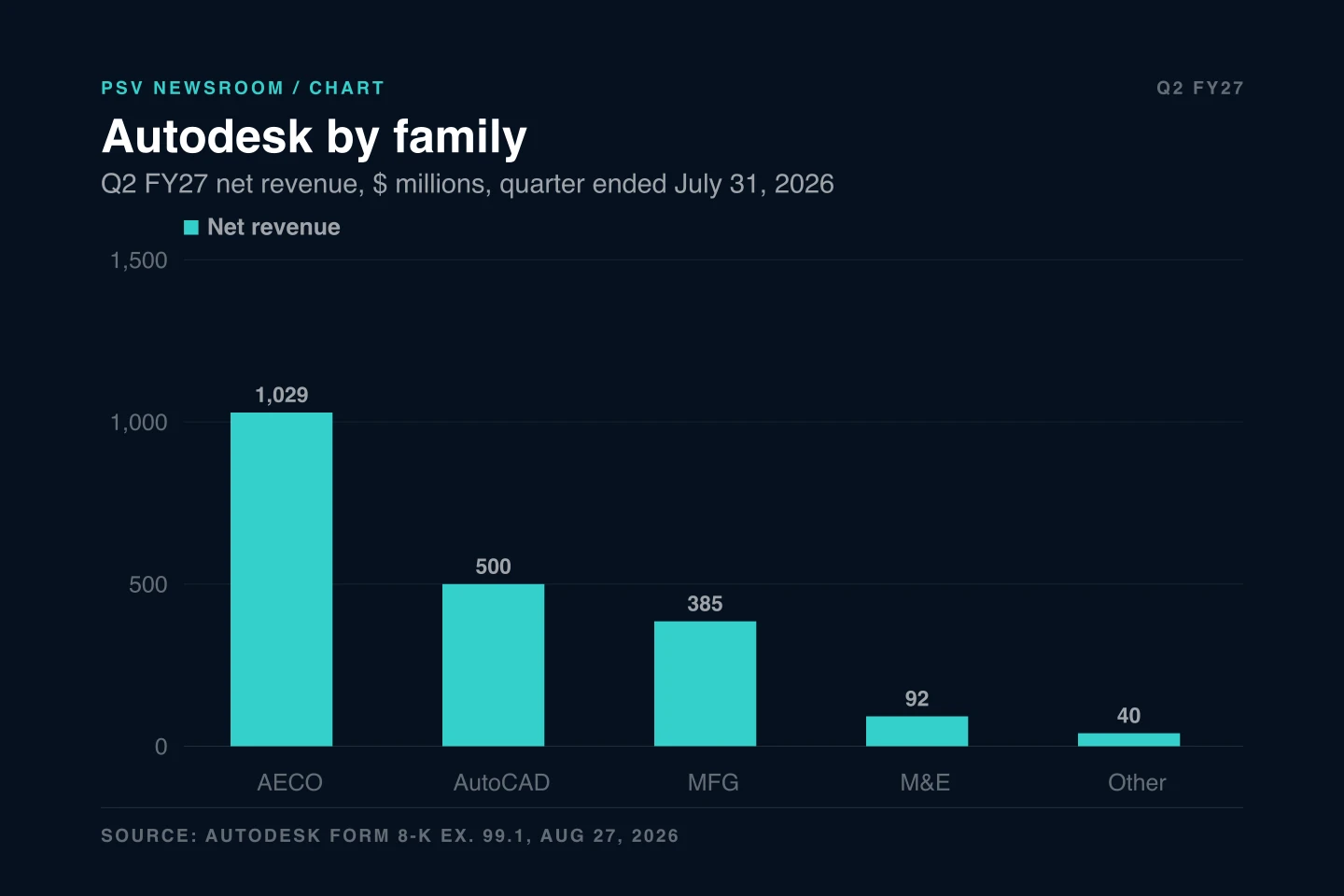
| Product family | Q2 FY27 net revenue | Year over year | Share of total |
|---|---|---|---|
| AECO | $1,029m | 17% (15% cc) | 50% |
| AutoCAD and AutoCAD LT | $500m | 14% (11% cc) | 24% |
| Manufacturing | $385m | 15% (12% cc) | 19% |
| Media and Entertainment | $92m | 15% (14% cc) | 4% |
| Other | $40m | 29% (23% cc) | 2% |
| Total net revenue | $2,046m | 16% (14% cc) | 100% |
The workflow PSV would run on a turnover package
The workflow this deal argues for is the one almost no owner runs well: turning a construction closeout package into an operating asset register. At turnover, everything an operator needs to maintain a building already exists, and it exists as a box of PDFs that stops being read within a year. The inputs are the documents the project already produced: the equipment schedules from the mechanical, electrical and plumbing drawings; the approved submittals and product data; the operations and maintenance manuals; the warranty certificates with their start and expiry dates; the commissioning reports and functional test results; the as-built drawing set; the vendor and subcontractor contact list; and any existing maintenance system export if the owner already runs one. The output is a single table with one row per maintainable asset: a stable asset tag, make, model, serial number, location by floor and room, install date, warranty start and expiry, the maintenance interval the manufacturer’s manual states, the document name and page number every field was read from, and an explicit flag on every field where no source document exists. That last column is the deliverable. The value of the exercise is not the rows that fill in, it is the discovery that a chiller has no warranty certificate and a fire pump has no serial number recorded anywhere in the package.
The reviewer is the chief engineer or facilities lead, working with the project manager who ran closeout, and the approval gate is that no row becomes a maintainable asset in the operating system until a named engineer signs it. Two things an assistant should not decide. It should not set the preventive maintenance interval: reading the manufacturer’s stated interval off a manual is transcription, but choosing the interval this building will actually run is an engineering judgment against the service contract, the equipment’s duty cycle and its observed condition. And it should not draw a warranty or code conclusion, because a warranty date read off a certificate is a fact while a claim that something is under warranty is a legal position. One structural note worth acting on regardless of vendor: keep the register in a plain format you own, with the source citation in every row, rather than only inside a vendor’s schema. The point of building it is that you can move it. PSV has not tested MaintainX or any Autodesk product, is describing a workflow it would run on documents an owner already holds, and is not claiming any time or cost result from it.
What stays with a person, and what the record does not settle
The operator read
Finish with the judgment call.
The reported facts are above. Enter your email for PSV's operator conclusion and a year of access to every newsroom brief.
Free. No card. Privacy policy. Unsubscribe anytime.
 by PSVLive
Build the workflow behind this analysis. Train with the operators doing it.
Real deal files, live builds, and production-ready CRE AI workflows inside the CRE AI Institute.










Clear answers
Common questions about Autodesk MaintainX acquisition
How much did Autodesk pay for MaintainX?
The records give three figures and they do not agree. Autodesk’s Form 10-Q for the quarter ended July 31, 2026, filed August 28, 2026, records in Note 19 that Autodesk acquired MaintainX, Inc. on August 3, 2026 for preliminary purchase consideration of approximately $3.53 billion, net of cash acquired. The liquidity discussion in Management’s Discussion and Analysis of the same filing says approximately $3.6 billion, net of cash acquired, on the same stated basis, and Autodesk has not explained the difference. Going back to signing, the Form 8-K filed May 28, 2026 disclosing the Agreement and Plan of Merger with Matterhorn Acquisition Corp., MaintainX Inc. and Shareholder Representative Services LLC put aggregate consideration at approximately $3.575 billion, subject to certain customary adjustments, while Autodesk’s press release the same day described an all-cash transaction valued at approximately $3.6 billion. Autodesk states it is still determining the initial purchase accounting and that it is impracticable to disclose a preliminary purchase price allocation at this time.
How did Autodesk finance the MaintainX acquisition?
With a term loan, commercial paper and cash on hand, per the Form 10-Q filed August 28, 2026. On August 3, 2026 Autodesk borrowed $1 billion under a 364-day term loan at a weighted average interest rate of 4.58 percent to consummate the acquisition. In July 2026 Autodesk established a commercial paper program permitting up to $2 billion aggregate face amount of short-term unsecured notes outstanding at any time, and states it partially funded MaintainX with borrowings under that program; $1 billion was outstanding at July 31, 2026 at a weighted average interest rate of 4.17 percent. The Term Loan Credit Agreement requires a maximum leverage ratio of Consolidated Covenant Debt to Consolidated EBITDA no greater than 3.50 to 1.00, subject to adjustment up to 4.00 to 1.00 for up to four consecutive fiscal quarters following certain material acquisitions. Autodesk separately carries $2.50 billion aggregate principal of senior notes. The filing does not break out how much of the commercial paper balance funded MaintainX, so the debt-funded share of the purchase price cannot be computed from the record.
What does the Autodesk MaintainX deal mean for commercial real estate?
It puts the building’s maintenance record with the same vendor as its design file. MaintainX is used to manage maintenance activity, asset information, inspections, work orders and operational workflows, and Autodesk’s May 28, 2026 release states the product captures high-frequency data on asset condition, maintenance history and performance in the field, that this gives Autodesk access to rich data on asset history, inspections, maintenance patterns and real-world performance, and that expanding into operations will extend its duration with assets and systems from years to decades. Those are company claims rather than independent findings. Autodesk folded the purchase into a new Autodesk Operations Solutions unit alongside Tandem, Flexsim, Fusion Operations and Factory Design Utilities. The built-world exposure is already the majority of the business: in the quarter ended July 31, 2026 the Architecture, Engineering, Construction and Operations family produced $1,029 million of net revenue against total net revenue of $2,046 million, which computes to 50 percent. The practical questions for an owner are export and pricing: whether the asset register, work order history and warranty dates can leave in a readable format, and what the product will cost under new ownership, which none of the filings address.
Primary source record
These records support the reported facts in this brief. PSV’s CRE workflow interpretation and test plan are original analysis.
- Autodesk, Inc., Form 10-Q for the quarterly period ended July 31, 2026, filed August 28, 2026 (Note 19, Subsequent Events; Note 11, Borrowing Arrangements)
- Autodesk, Inc., Form 8-K filed August 27, 2026, Exhibit 99.1, “Autodesk, Inc. Announces Fiscal 2027 Second Quarter Results” (chart source)
- Autodesk, Inc., Form 8-K filed May 28, 2026, Item 1.01, Agreement and Plan of Merger with MaintainX Inc.
- Autodesk, Inc., Form 8-K filed May 28, 2026, Exhibit 99.1, “Autodesk to acquire MaintainX, advancing unified platform in operations”
- Jrbarc!, “Ohio State University South Campus Central Chiller Plant” (Wikimedia Commons, CC BY-SA 4.0; lead photograph source)
Topics
Related PSV analysis
CRE PROPTECH NEWS
CoStar Closed on Zonda. The Number That Matters Isn’t $800M.
CoStar Group completed its $800 million all-cash acquisition of Zonda on August 21 and furnished the press release to the SEC the same day on a Form 8-K. Zonda brings a lot-level new home construction database, homebuilder software, more than 3,000 customers, and the NewHomeSource.com and Livabl marketplaces. In 2025 it generated approximately $170 million of revenue at a 23 percent Adjusted EBITDA margin, the company says.
CRE PROPTECH NEWS
RealPage Acquires Cherre: The CRE Data Consolidation Read
RealPage says it has acquired Cherre, the data intelligence platform institutional owners use to resolve more than 4 billion entities across roughly $4 trillion in real assets. Terms were not disclosed. The companies promise operational independence and an open platform. For operators, the durable question is contractual: who now owns the pipes your portfolio data runs through, and on what terms.
CRE PROPTECH NEWS
SwiftConnect Buys HID SAFE: The CRE Read on Access Governance
SwiftConnect said on July 22 it acquired HID’s Workforce Business Unit, including HID SAFE, the physical identity and access management suite, and is folding it into its cloud AccessCloud platform. HID keeps a minority, non-controlling stake, and financial terms were not disclosed. For real estate, the deal pushes building access toward one system that both credentials people and governs who is allowed where, and revokes that access automatically when roles change.
Related guides
Cornerstone PSV guides on the workflows in this article.
Proptech AI
What proptech AI means, where artificial intelligence actually works in real estate, and what separates useful proptech AI from the hype.
Read the guideBest AI Tools for Commercial Real Estate
The pillar guide to choosing CRE AI tools by workflow fit and control, not vendor hype.
Read the guideClaude Engineering Partner for CRE
What it means to run Claude with an engineering partner: the operating model, the controls, and who owns what.
Read the guideby PSVLiveYou read the operator view. Now learn to run the workflow.
The AI MBA for commercial real estate: the workflows these briefs describe, taught end to end on real deal files, with live builds and a community of CRE operators.