CRE POLICY NEWS
EPA Would Let a Data Center Break Ground Before Its Air Permit
Two EPA proposals now sitting in the docket would change data center permitting from opposite ends: one narrows what counts as starting construction, so site work could begin before an air permit issues, and the other drops the federal floor requiring public notice on minor source permits. PSV read both rules. Neither is final, and neither says “data center” once.
Direct answer
Direct answer to EPA new source review data center permitting
The construction-timing proposal is the one that would actually move a development schedule, and it is the less covered of the two. It would let clearing, grading, pile driving, excavation, foundations, walls, roofs and utility runs proceed before a major source NSR permit issues. That does not remove permit risk, it relocates it: the money is spent before the decision arrives. The public participation proposal changes no state’s rules by itself, because existing requirements stay in the SIP until a state affirmatively amends it.
Two proposed rules, and what each one actually does
There are two separate EPA proposals in play, they sit in different dockets, they govern different permitting programs, and the coverage this week has largely merged them. The first, published May 13, 2026 under Docket EPA-HQ-OAR-2025-0618, would rewrite what “begin actual construction” means in the major New Source Review program, the Prevention of Significant Deterioration and Nonattainment NSR rules at 40 CFR 51.165, 51.166, Appendix S to Part 51 and 52.21. The second, published July 7, 2026 under Docket EPA-HQ-OAR-2025-1212, would remove minor NSR public participation as a minimum requirement for a State Implementation Plan under 40 CFR 51.161. One is about when you may put equipment in the ground. The other is about whether the neighbors are told. They are not the same rule and they do not reach the same facilities.
The construction proposal is the operationally larger one. EPA proposes to define “begin actual construction” as the initiation of physical on-site construction of pollutant-emitting activities, and then to list what does not count: engineering and design planning, geotechnical investigation, clearing vegetation, grading, surveying, soil compacting and stabilization including associated pile driving, excavating land including blasting or other removal of hardrock, ordering of equipment and materials, storing equipment or setting up temporary trailers, and paving surfaces. A companion definition of “pollutant-emitting activities” excludes office buildings, retail stores, storage buildings holding inert material, concrete pads and foundations, and walls and roofs that are not closed in on the interior side and carry no design elements uniquely configured to serve emitting equipment, along with HVAC serving human workspaces and the wiring and piping that bring electrical, water, wastewater and telecommunications service to a site. EPA says the list is not exhaustive. Read together, those two definitions describe most of a data center site package short of the generators themselves.
| Proposal | Docket and RIN | Published | Comments closed | Comments filed | Program reached |
|---|---|---|---|---|---|
| Begin Actual Construction in the NSR Preconstruction Permitting Program | EPA-HQ-OAR-2025-0618, RIN 2060-AW84 | May 13, 2026 | June 29, 2026 | 83,762 | Major NSR: PSD and Nonattainment NSR, plus minor NSR in Indian country |
| Minor NSR Program Air Permitting Public Participation Requirements for State Implementation Plans | EPA-HQ-OAR-2025-1212, RIN 2060-AV67 | July 7, 2026 | August 21, 2026 | 4,264 | Minor NSR public participation minimums in SIPs, 40 CFR 51.161 |
What the public participation rule does not do, which is most of what was reported
The headline version of this story is that EPA is ending public comment on data center air permits. The rule text does not say that, and the distinction is the whole operator read. Today 40 CFR 51.161 requires three things of a state or local air agency: that the application materials and the agency’s air quality analysis be available for public inspection in the affected area or on a public website, that there be a 30-day comment period, and that notice be given by prominent advertisement in the affected area. Those requirements date to June 18, 1973. What EPA proposes is to stop treating them as a federal minimum that a SIP must contain, on the reasoning that Clean Air Act section 110(a)(2)(C) requires only such regulation of minor source construction “as necessary to assure” the national ambient air quality standards are achieved, and that public participation is generally not necessary to that end. EPA would also delete the transitional provision at 51.161(c).
The part that matters for anyone underwriting a site: EPA states in the proposal that if the rule is finalized, states would be allowed to but would not be required to revise their existing SIP-approved requirements, and that requirements a state does not revise remain in the SIP and continue to apply. Changing them requires a SIP amendment, which itself carries mandatory public participation at the state and local level and during EPA review, and which is ultimately subject to judicial review. So no permit anywhere loses its comment period on the day this is finalized. What would change is that the floor comes out, and states diverge from each other on their own schedules. One more fact worth stating plainly because it cuts against the framing on both sides: the words “data center” do not appear anywhere in the public participation proposal. It is a generic minor source rule. Data centers are one affected category, named by commenters and by the press, not by EPA.
The workflow PSV would run on a development pipeline
The artifact worth building here is not a regulatory summary, it is a per-site sheet that separates what is decided from what is proposed. Inputs are documents a development team already holds or can pull: the air permit application and its status for each site, the applicable state or local minor NSR rule and whether that state’s SIP-approved public participation provisions are in force, the project schedule with its groundbreaking and long-lead equipment dates, the generator count and rated capacity that drives the permit path, and the construction sequence showing which activities are site work and which are equipment setting. Add two public pulls: the two Federal Register dockets for status changes, and the state air agency’s own rulemaking calendar, because a state SIP amendment is the event that would actually change a project’s obligations.
The output is one row per site with four columns: whether the project is on a major or minor NSR path, what the state requires for public participation today rather than what EPA has proposed, which scheduled activities would fall outside “begin actual construction” if the construction rule is finalized as written, and how much capital those activities represent. That last column is the point of the exercise. An assistant can maintain this sheet, cite the document and section behind every cell, and flag when either docket moves. It should never mark a proposed rule as an effective one, and the sheet should carry the status word on every row. The reviewer is the development lead with environmental counsel, and the approval gate is that no schedule, budget or draw changes on the strength of a proposed rule. PSV takes no position on whether either proposal should be finalized.
What stays with a person, and what is genuinely unresolved
The operator read
Finish with the judgment call.
The reported facts are above. Enter your email for PSV's operator conclusion and a year of access to every newsroom brief.
Free. No card. Privacy policy. Unsubscribe anytime.
 by PSVLive
Build the workflow behind this analysis. Train with the operators doing it.
Real deal files, live builds, and production-ready CRE AI workflows inside the CRE AI Institute.











Clear answers
Common questions about EPA new source review data center permitting
Did EPA eliminate public comment on data center air permits?
Not yet, and the proposal would not do it directly. EPA published a proposed rule on July 7, 2026, “Minor New Source Review Program Air Permitting Public Participation Requirements for State Implementation Plans” (Docket EPA-HQ-OAR-2025-1212, RIN 2060-AV67), which would remove minor NSR public participation as a minimum requirement for a State Implementation Plan under 40 CFR 51.161. Today that section requires application materials and the agency’s air quality analysis to be available for public inspection in the affected area or on a public website, a 30-day comment period, and notice by prominent advertisement in the affected area, requirements that date to June 18, 1973. EPA states in the proposal that states would be allowed to but not required to revise their existing SIP-approved requirements, and that requirements a state does not revise remain in the SIP and continue to apply. Amending a SIP itself carries mandatory public participation and EPA review and is subject to judicial review. The comment period closed August 21, 2026 with 4,264 comments, and as of August 27, 2026 no final rule has been published. The proposal does not use the words “data center” anywhere; it is a generic minor source rule.
Can a data center start construction before it gets an air permit?
Under current major NSR rules, no, and under a separate EPA proposal published May 13, 2026 much of the site package could. That proposal, “Begin Actual Construction in the New Source Review (NSR) Preconstruction Permitting Program” (Docket EPA-HQ-OAR-2025-0618, RIN 2060-AW84), would define “begin actual construction” as the initiation of physical on-site construction of pollutant-emitting activities, and would list activities that do not count: engineering and design planning, geotechnical investigation, clearing vegetation, grading, surveying, soil compacting and stabilization including associated pile driving, excavating land including blasting or removal of hardrock, ordering equipment and materials, storing equipment or setting up temporary trailers, and paving surfaces. A companion definition of “pollutant-emitting activities” excludes office buildings, retail stores, storage buildings holding inert material, concrete pads and foundations, and walls and roofs not closed in on the interior side, plus HVAC for human workspaces and utility wiring and piping. The rule reaches the major NSR programs at 40 CFR 51.165, 51.166, Appendix S to Part 51 and 52.21. Comments closed June 29, 2026 with 83,762 filed, and it remains a proposal.
Who is opposing the EPA New Source Review changes?
Both dockets drew heavy opposition, and state law enforcement is on the record. On June 30, 2026 a coalition of fifteen state attorneys general, from California, Colorado, Connecticut, Delaware, Hawaii, Maryland, Massachusetts, Michigan, Minnesota, New York, Oregon, Rhode Island, Vermont, Washington and Wisconsin, joined by the District of Columbia, the cities of Chicago and New York, and the California Air Resources Board, filed comments opposing the begin actual construction proposal. Their position, per the California Attorney General’s announcement, is that EPA cannot adopt the proposed regulatory language because it is contrary to law as well as arbitrary and capricious. The construction docket recorded 83,762 comments and the public participation docket 4,264. Comment volume and legal objections do not decide the outcome, but they do indicate that whichever rule is finalized is likely to be challenged, which is the practical timing issue for a developer: a final rule under litigation is not a settled entitlement assumption.
Primary source record
These records support the reported facts in this brief. PSV’s CRE workflow interpretation and test plan are original analysis.
- U.S. Environmental Protection Agency, “Minor New Source Review Program Air Permitting Public Participation Requirements for State Implementation Plans,” proposed rule, 91 FR 41591, published July 7, 2026 (Docket EPA-HQ-OAR-2025-1212, RIN 2060-AV67; comments closed August 21, 2026)
- U.S. Environmental Protection Agency, “Begin Actual Construction in the New Source Review (NSR) Preconstruction Permitting Program,” proposed rule, published May 13, 2026 (Docket EPA-HQ-OAR-2025-0618, RIN 2060-AW84; comments closed June 29, 2026)
- Regulations.gov, Docket EPA-HQ-OAR-2025-1212, comment record for the minor NSR public participation proposal (4,264 comments as recorded August 26, 2026)
- Regulations.gov, Docket EPA-HQ-OAR-2025-0618, comment record for the begin actual construction proposal (83,762 comments)
- California Department of Justice, Office of the Attorney General, “Attorney General Bonta Joins Coalition Opposing Rollback of Air Pollution Permitting Program,” June 30, 2026
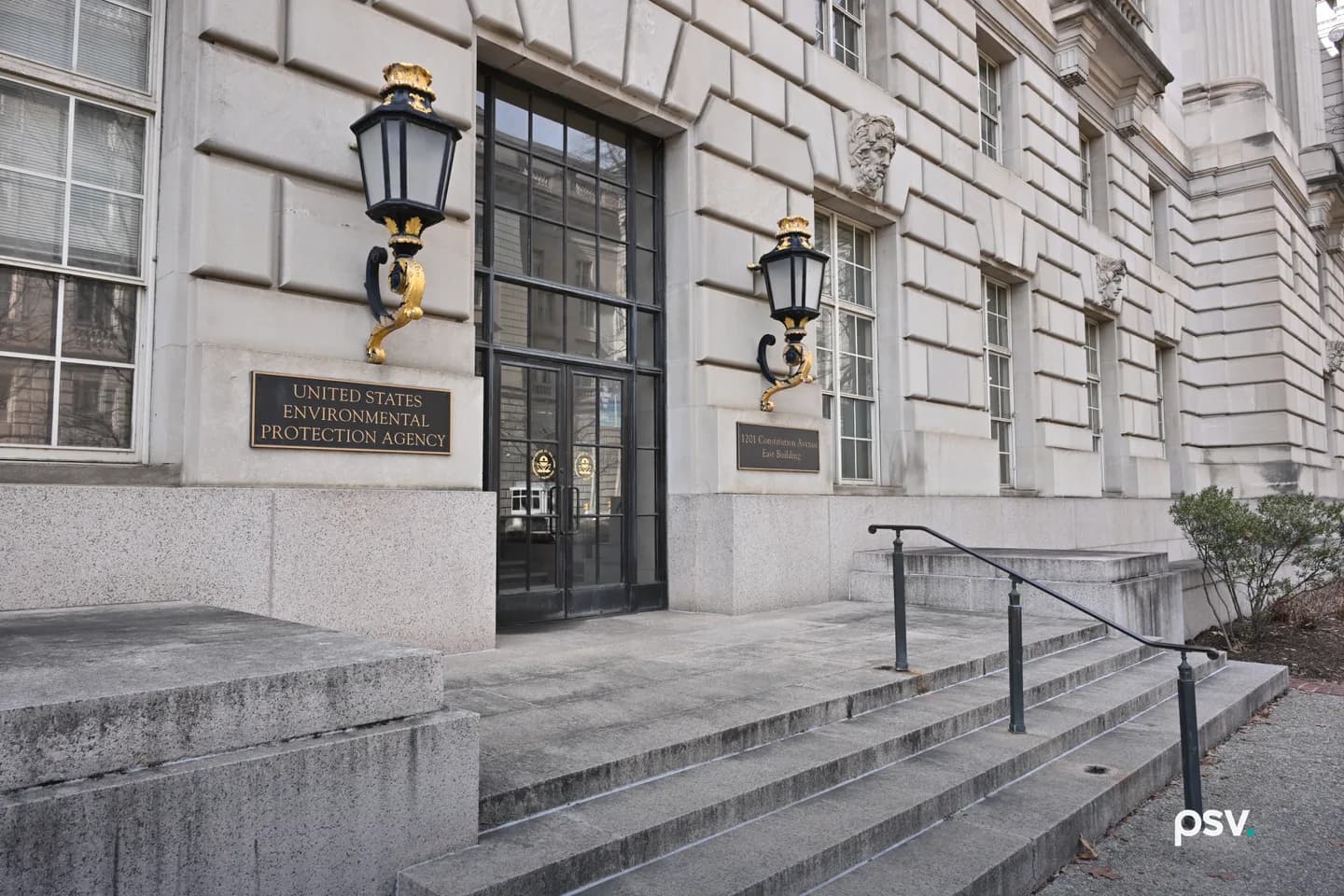
- Wikimedia Commons, “EPA east building entrance Constitution Ave Washington DC 2025-02-07” by G. Edward Johnson, CC BY 4.0 (source of the lead photograph)
Topics
Related PSV analysis
CRE POLICY NEWS
Six Federal Cases Are Testing Where a Data Center Can Sit
Five federal class actions filed since April accuse data center operators of pushing unreasonable noise onto neighboring homes, and a sixth case runs the other direction: a developer suing Nashville over a permit moratorium. PSV read all six dockets. Two of the five have already ended, neither of them on the merits, and the pattern is not the one the trade press is describing.
CRE POLICY NEWS
New York’s Hyperscale Data Center Moratorium: The CRE Read
Governor Kathy Hochul signed Executive Order 62 on July 14, pausing state environmental permits for new hyperscale data centers of 50 megawatts or more for up to one year while New York writes a statewide environmental study and new development standards. It is the first statewide freeze in the country, and it lands on the hottest development pipeline in commercial real estate.
CRE POLICY NEWS
Pennsylvania’s Data Center Order Turns on One Number
Governor Josh Shapiro signed Executive Order 2026-05 on August 18, directing Commonwealth agencies to hold every data center proposal with peak demand over 25 megawatts to the Governor’s Responsible Infrastructure Development Requirements. Data centers come out of the Permit Fast Track Program entirely, and the Department of Environmental Protection will not issue a permit until a project has its local and municipal approvals in hand.
Related guides
Cornerstone PSV guides on the workflows in this article.
Claude for Real Estate Developers
The ground-up developer field guide: site selection through IC memo, built on a real development deal.
Read the guideWhat is CRE AI?
The definitional guide to commercial real estate AI: the core workflows, how it differs from a chatbot, and how to learn it.
Read the guideby PSVLiveYou read the operator view. Now learn to run the workflow.
The AI MBA for commercial real estate: the workflows these briefs describe, taught end to end on real deal files, with live builds and a community of CRE operators.