CRE CAPITAL NEWS
Google Signed for 396 Megawatts Before It Named a Building
Fervo Energy filed an 8-K on Tuesday morning disclosing that a wholly owned subsidiary signed a 15-year power purchase agreement with Google Energy for 396 megawatts of enhanced geothermal capacity at Cape Station in Beaver County, Utah, plus an option that would take the total to roughly 950 megawatts. Fervo calls the power a building block for a potential Utah data center. No building has been announced. PSV read the filing and the statute behind it.
Direct answer
Direct answer to Fervo Google 396 MW geothermal PPA
Google contracted the electricity first and left the real estate open. The filing commits 396 megawatts in four successive 99 megawatt sub-tranches with target commercial operation beginning in the third quarter of 2028, under a Utah statute that lets a generator serve a large load through a closed private generation system outside a utility’s transmission. For a commercial real estate operator the lesson is sequencing: on a constrained grid, the power contract now precedes site selection rather than following it.
What Fervo filed, and what the two records each carry
Fervo Energy Company filed a Form 8-K with the Securities and Exchange Commission on September 1, 2026, accepted at 8:05 a.m. Eastern time, under Item 8.01, Other Events, and Item 9.01. Item 8.01 states that on August 26, 2026, Cape Generating Station 6 LLC, a wholly owned Fervo subsidiary, entered into a power purchase agreement with Google Energy LLC, a subsidiary of Alphabet Inc., for the sale of energy products from a 396 megawatt enhanced geothermal systems project at Cape Station in Beaver County, Utah. The project is to be delivered in four successive 99 megawatt sub-tranches with target commercial operation dates beginning in the third quarter of 2028, and the agreement carries a 15-year delivery term, which runs the contract to roughly 2043 on the first tranche. Fervo has provided a parent company guaranty behind the seller’s obligations and Alphabet has provided a parent company guaranty behind the buyer’s. Fervo has also agreed to offer Google a capacity expansion option of approximately 600 megawatts at Cape Station, which would take total contracted enhanced geothermal capacity to not less than approximately 950 megawatts with a guaranteed commercial operation date no later than June 2030. That expansion is not signed: the filing states it is subject to Google’s acceptance of the offer and the negotiation of a mutually acceptable definitive agreement.
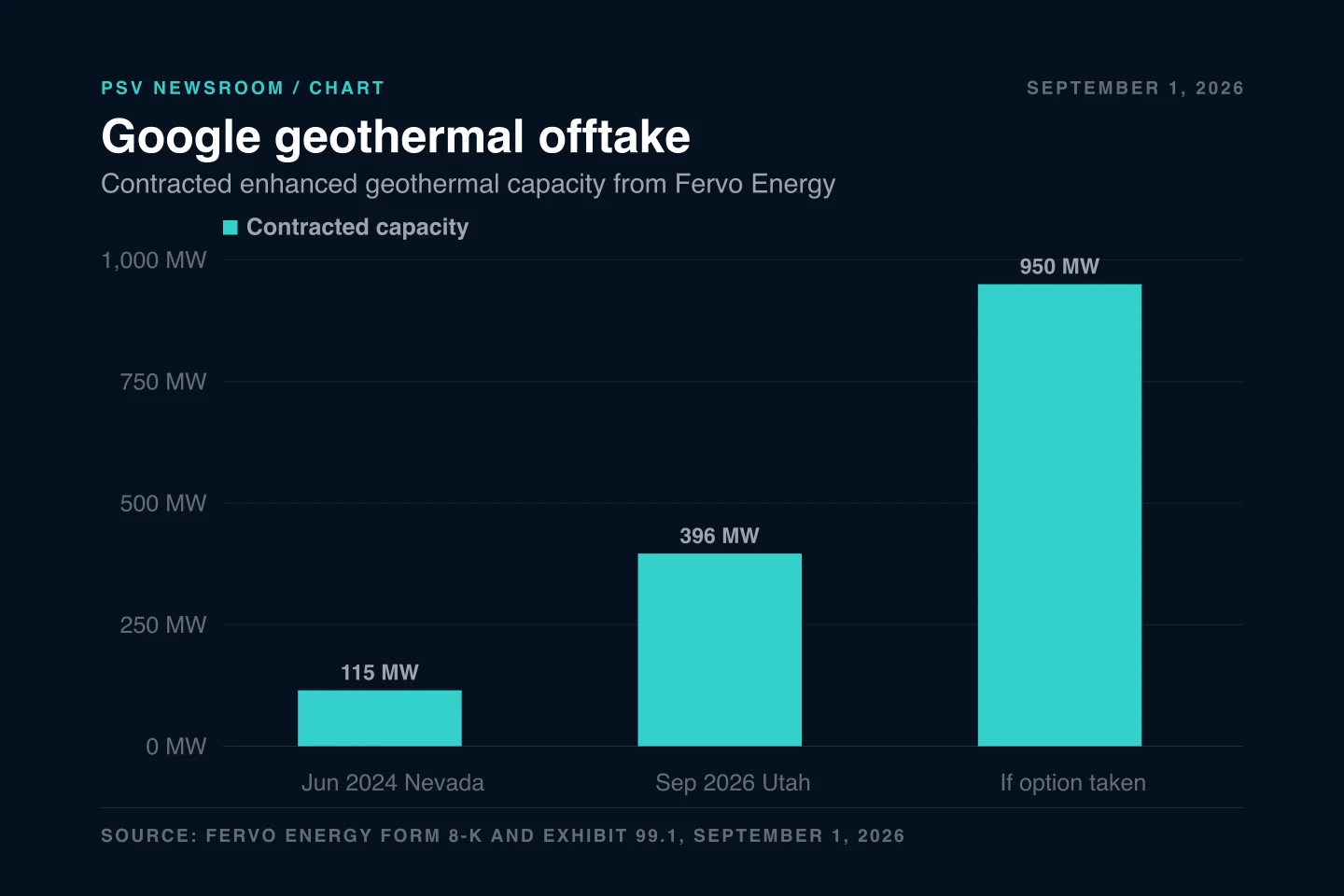
The two records in the filing are not interchangeable, and the difference is where the useful detail sits. The Exhibit 99.1 press release, issued the same morning, is the promotional record: it calls this the world’s largest enhanced geothermal power purchase agreement to date, says Google will purchase carbon-free energy “designed to serve as a foundational building block for a potential data center in Utah,” states that the deal unlocks around-the-clock capacity at no cost to existing ratepayers, and quotes Tim Latimer, Fervo’s chief executive and co-founder, and Michael Terrell, Google’s head of advanced energy. It also supplies the history: a Nevada commercial pilot called Project Red that came online in 2023, and a 115 megawatt power purchase agreement signed with Google and NV Energy in June 2024 that Fervo says helped pioneer the Clean Transition Tariff. Against that 115 megawatts, the new 396 megawatts computes to roughly 3.4 times, and the roughly 950 megawatt option would be more than eight times. The Item 8.01 body carries what the press release does not: the counterparty entity, the sub-tranche structure, the term, both guaranties, and a reimbursement obligation that runs the other way, under which Fervo must repay Google for amounts previously paid in respect of deemed delivered energy if Fervo fails to make the required expansion offer, an amount the company says depends on the deemed delivered volume and the spread between market price and the contract price and is not currently estimable. Every characterization in this paragraph is drawn from those records rather than from any PSV test.
Why a power contract with no building is a real estate story
The sequence is the story. A 15-year offtake was signed on August 26 for capacity that begins arriving in the third quarter of 2028, and the thing it would serve is described in the company’s own words as a potential data center whose final plans remain subject to engineering feasibility, state and local approvals and commercial conditions. That is the opposite of the order commercial real estate is used to. The conventional sequence is site, entitlement, then power. Here the electrons were contracted first, with a parent guaranty behind them, and the building is the open item. PSV has covered the pressure that produces this inversion from the grid side repeatedly: ERCOT paused approvals to energize large loads in Texas while it verifies interconnection paperwork, and utilities from PJM to the Tennessee Valley Authority have been rewriting the terms on which a large load gets served at all. When the queue is the binding constraint, whoever holds firm contracted capacity holds the position, and land near that capacity reprices around it. The chart above tracks that arc using only figures the two records give: 115 megawatts contracted in Nevada in June 2024, 396 megawatts contracted in Utah now, and roughly 950 megawatts if the option is taken by June 2030.
The route around the queue is statutory, and it is worth reading rather than paraphrasing. Fervo states the project is being developed in a manner intended to use the flexible power delivery pathways authorized under Utah Senate Bill 132, subject to receiving the relevant regulatory approvals under that law. S.B. 132, “Electric Utility Amendments,” passed in Utah’s 2025 General Session with Senator Scott D. Sandall as chief sponsor and Representative Colin W. Jack as House sponsor, and it enacts a new Chapter 26 of Title 54 of the Utah Code titled Large-Scale Electric Service Requirements. The statute defines a “closed private generation system” as generating facilities and associated transmission infrastructure that is not connected to and operates independently from the transmission system of a qualified electric utility, cooperative, municipal or other utility, that serves one or more customers with a minimum cumulative electrical demand of 100 megawatts, and that serves one or more large load customers through direct connection. Its stated provisions also exempt service under the chapter from certain rate regulation requirements while maintaining safety and reliability standards, and impose accounting and operational transparency requirements intended to protect retail customers. Fervo’s filing says its enhanced geothermal generation, supplemented by additional energy resources, would deliver capacity through such a closed private generation system, which may be configured for either front-of-the-meter or behind-the-meter interconnection to serve data center load, subject to further engineering feasibility and agency approvals, with target commercial operation for that expanded delivery capability in the first half of 2030. The practical translation for a developer is that Utah has written a lane for large loads to be served outside the utility’s transmission, and that lane has its own approvals rather than none.
The workflow PSV would run on a power-first site
When power is contracted before the building, the diligence file changes shape, and the workflow this argues for is a contracted-capacity map for whatever market you are shopping. The inputs are documents that already exist and are mostly public: the generator’s and offtaker’s SEC filings, where power purchase agreements of this size are disclosed under Item 1.01 or Item 8.01; the state commission docket and any tariff or special contract filings; the state statute or rule the parties name, read in full rather than through a press release; the interconnection queue position reports the regional operator publishes; the county assessor and recorder records for land assembly around the generation; and the local planning and zoning agenda and minutes for the jurisdiction that would approve the load. The output is one table with a row per contracted or announced generation project in the market: the generator, the offtaker, the megawatts, whether the megawatts are signed or optioned, the stated commercial operation date and the date it was stated, the delivery term, the legal pathway named, the approvals that pathway still requires, the guarantor on each side, and a citation to the filing and item number every field was read from. Two derived columns carry the finding. One separates signed capacity from optioned capacity, because those are different assets. The other flags any project whose delivery date has moved between successive filings.
The reviewer is whoever owns land strategy in that market, working with counsel on the statutory pathway, and the approval gate is that no site is bid or optioned on a power thesis until a named person signs the table’s power assumptions. Three things should not be delegated to an assistant here. It should not read a statute and conclude a given project qualifies under it, because that is a legal determination against facts the filing does not disclose. It should not convert a target commercial operation date into a delivery assumption, because a target in a forward-looking statement is not a commitment and the filing here says so at length. And it should not treat an option as capacity, because the expansion in this filing explicitly depends on Google accepting an offer and the parties negotiating a definitive agreement that does not yet exist. PSV has run no test of Fervo’s technology, has verified no engineering claim, and is describing a records review built on filings and statutes anyone can pull. No cost, schedule or return outcome is promised.
What stays with a person, and what the record does not settle
The operator read
Finish with the judgment call.
The reported facts are above. Enter your email for PSV's operator conclusion and a year of access to every newsroom brief.
Free. No card. Privacy policy. Unsubscribe anytime.
 by PSVLive
Build the workflow behind this analysis. Train with the operators doing it.
Real deal files, live builds, and production-ready CRE AI workflows inside the CRE AI Institute.











Clear answers
Common questions about Fervo Google 396 MW geothermal PPA
How much power did Google contract from Fervo Energy?
396 megawatts, with an option that would take the total to roughly 950 megawatts. Fervo Energy Company filed a Form 8-K on September 1, 2026 under Item 8.01 stating that on August 26, 2026 its wholly owned subsidiary Cape Generating Station 6 LLC entered into a power purchase agreement with Google Energy LLC, a subsidiary of Alphabet Inc., for the sale of energy products from a 396 megawatt enhanced geothermal systems project at Cape Station in Beaver County, Utah. The project is to be delivered in four successive 99 megawatt sub-tranches with target commercial operation dates beginning in the third quarter of 2028, and the agreement carries a 15-year delivery term. Fervo has provided a parent company guaranty behind the seller and Alphabet has provided one behind the buyer. Fervo separately agreed to offer Google a capacity expansion option of approximately 600 megawatts at Cape Station, which would bring total contracted enhanced geothermal capacity to not less than approximately 950 megawatts with a guaranteed commercial operation date no later than June 2030. That expansion is not signed: the filing states it depends on Google accepting the offer and the parties negotiating a mutually acceptable definitive agreement. Fervo’s accompanying press release describes the deal as the world’s largest enhanced geothermal power purchase agreement to date.
Is Google building a data center in Utah?
The records do not say that. Fervo’s Exhibit 99.1 press release, issued September 1, 2026, states that Google will purchase carbon-free energy designed to serve as a foundational building block for a potential data center in Utah, and adds that final data center plans remain subject to a variety of factors including engineering feasibility, state and local approvals, and commercial conditions. Neither the press release nor the Form 8-K names a site, an acreage, a parcel, a county approval or a construction timeline for any building, and PSV located no separate Google announcement of its own, so every characterization of Google’s intent reaches the reader through Fervo’s filing rather than from the buyer directly. What is contracted is electricity, not real estate. The practical read for a commercial real estate operator is sequencing rather than certainty: a 15-year offtake with a parent guaranty behind it was signed for capacity arriving from the third quarter of 2028, while the facility it would serve remains an open item. On a constrained grid, contracted firm power increasingly precedes site selection instead of following it.
What is Utah SB 132 and how does it apply to data centers?
S.B. 132, “Electric Utility Amendments,” passed in Utah’s 2025 General Session with Senator Scott D. Sandall as chief sponsor and Representative Colin W. Jack as House sponsor, and enacts a new Chapter 26 of Title 54 of the Utah Code titled Large-Scale Electric Service Requirements. Its stated provisions establish alternative processes for providing electric service to customers with large electrical loads, exempt service under the chapter from certain rate regulation requirements while maintaining safety and reliability standards, create procedures for submitting, evaluating and contracting for large-scale service requests, impose accounting and operational transparency requirements to protect retail customers, establish a framework for closed private generation systems and connected generation systems, require the Public Service Commission to investigate the feasibility of a large load flexible tariff, and require periodic commission review and reports to the Legislature. The statute defines a closed private generation system as generating facilities and associated transmission infrastructure that is not connected to and operates independently from the transmission system of a qualified electric utility, cooperative, municipal or other utility, that serves customers with a minimum cumulative electrical demand of 100 megawatts, and that serves one or more large load customers through direct connection. Fervo’s 8-K states the Cape Station project is being developed in a manner intended to use those pathways, that its generation supplemented by additional resources would deliver capacity through a closed private generation system configured either front-of-the-meter or behind-the-meter to serve data center load, and that all of this remains subject to engineering feasibility and the relevant SB 132 regulatory approvals, with target commercial operation for the expanded delivery capability in the first half of 2030.
Primary source record
These records support the reported facts in this brief. PSV’s CRE workflow interpretation and test plan are original analysis.
- Fervo Energy Company, Form 8-K filed September 1, 2026 (Item 8.01, Other Events; Item 9.01), reporting an August 26, 2026 power purchase agreement between Cape Generating Station 6 LLC and Google Energy LLC (chart source)
- Fervo Energy Company, Form 8-K Exhibit 99.1, “Fervo Energy and Google Sign 396 MW PPA,” September 1, 2026 (chart source)
- Utah S.B. 132, “Electric Utility Amendments,” 2025 General Session, enrolled copy, enacting Utah Code Chapter 54-26, Large-Scale Electric Service Requirements
- Fervo Energy Company, Form 8-K Exhibit 99.1, “Fervo Energy Reports Second Quarter 2026 Results,” August 12, 2026 (source of the 1.1 gigawatt 2030 development target)
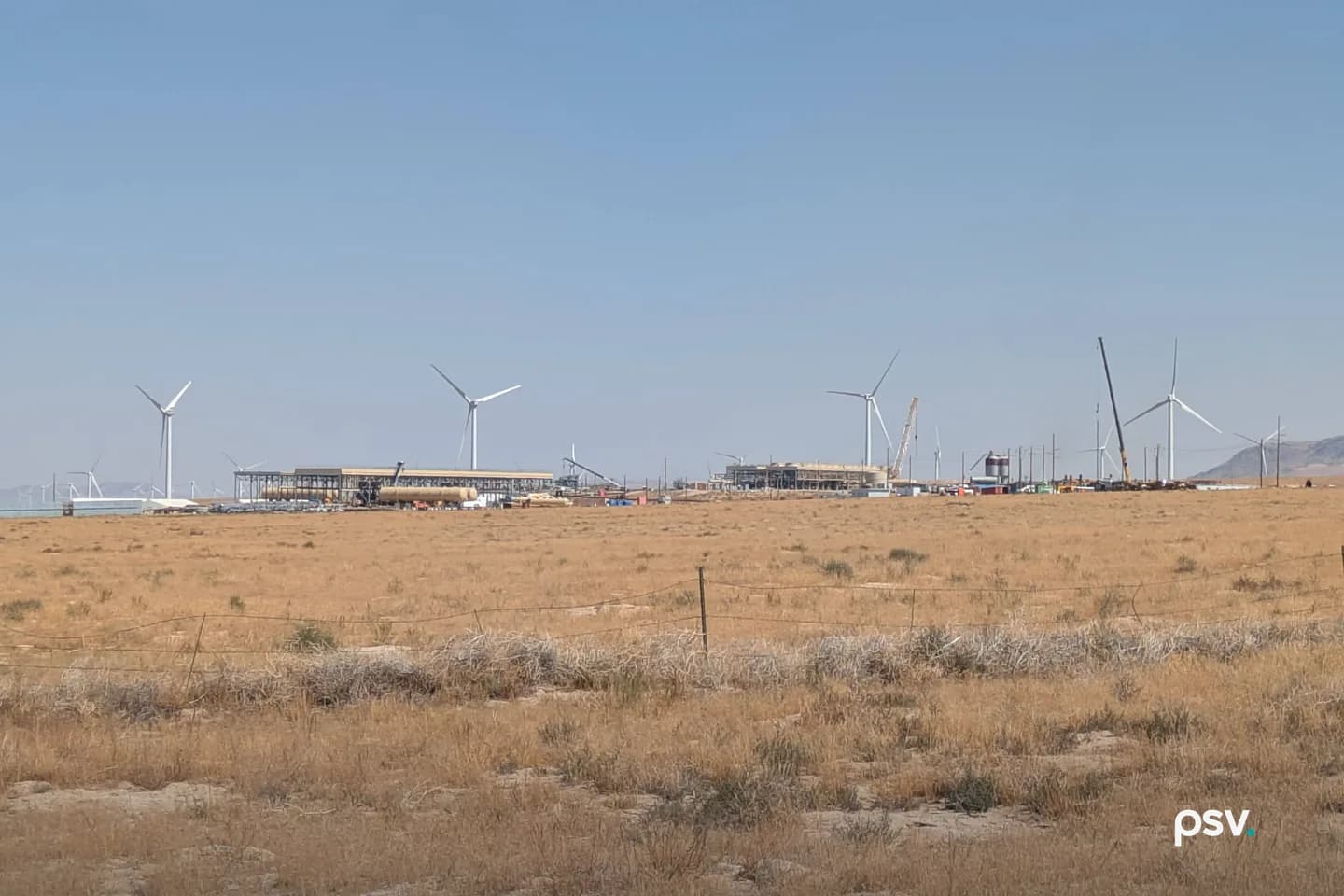
- Braddah n8, “Fervo Cape Station” (Wikimedia Commons, CC0 1.0 public domain dedication; lead photograph source)
Topics
Related PSV analysis
CRE POLICY NEWS
Texas Paused the Data Center Grid Queue, and the Gate Is Paperwork
Governor Greg Abbott directed a verification and audit of every data center advancing through ERCOT’s interconnection process on August 3. The Public Utility Commission of Texas made it operative on August 20, granting ERCOT good cause exceptions that suspend Batch Zero classification deadlines. ERCOT then told the market it intends to issue conditional classifications by August 31. PSV read the letter, the order and ERCOT’s filed presentation.
CRE POLICY NEWS
TVA Repriced Data Center Power. The Tariff Isn’t Public.
The TVA Board voted in Memphis on August 20 to move data centers out of the manufacturing rate class and onto a rate of their own. Officials at the meeting described an October 1 start, a roughly 10 percent increase, a three-year phase-in for existing sites, and an upfront capacity commitment charge on new load above 5 megawatts. TVA’s own release names none of those terms.
CRE POLICY NEWS
PJM Moves to Curtail Data Centers: The CRE Read on Firm Power
The PJM Board of Managers issued a decisional letter on July 27 directing two filings to FERC by the end of July. One creates a Reliability Backstop Procurement to backfill a 6,831 megawatt capacity shortfall. The other creates an Interim Resource Adequacy Service, under which new large loads that have not brought their own new capacity by June 1, 2027 are cut before anybody else is.
Related guides
Cornerstone PSV guides on the workflows in this article.
Claude Engineering Partner for CRE
What it means to run Claude with an engineering partner: the operating model, the controls, and who owns what.
Read the guideClaude for Real Estate Developers
The ground-up developer field guide: site selection through IC memo, built on a real development deal.
Read the guideAI Engineering for CRE
PSV builds custom AI employees for commercial real estate. Every number cites its source document, and the citation holds from deal to IC memo.
Read the guideby PSVLiveYou read the operator view. Now learn to run the workflow.
The AI MBA for commercial real estate: the workflows these briefs describe, taught end to end on real deal files, with live builds and a community of CRE operators.