CRE PROPTECH NEWS
ICON Raises $200M Series D to Build Its Titan Printers
ICON, the Austin construction 3D printing company, announced a $200 million Series D on October 13, 2026, co-led by Baillie Gifford and funds managed by BlackRock. The money goes to manufacturing Titan, a multi-story printing system sold to outside builders. ICON’s SEC Form D, filed in August, shows how much of the round had closed by then.
Direct answer
Direct answer to ICON Series D
ICON is turning from a builder that prints its own projects into a manufacturer that sells printers to other builders, and this round pays for the factory. Developers should treat the cost and speed figures as ICON’s targets, not results, until Titan systems reach outside builders, which ICON expects in early 2027. The SEC filing shows $114.9 million of the $200 million sold by late August.
What ICON announced on October 13
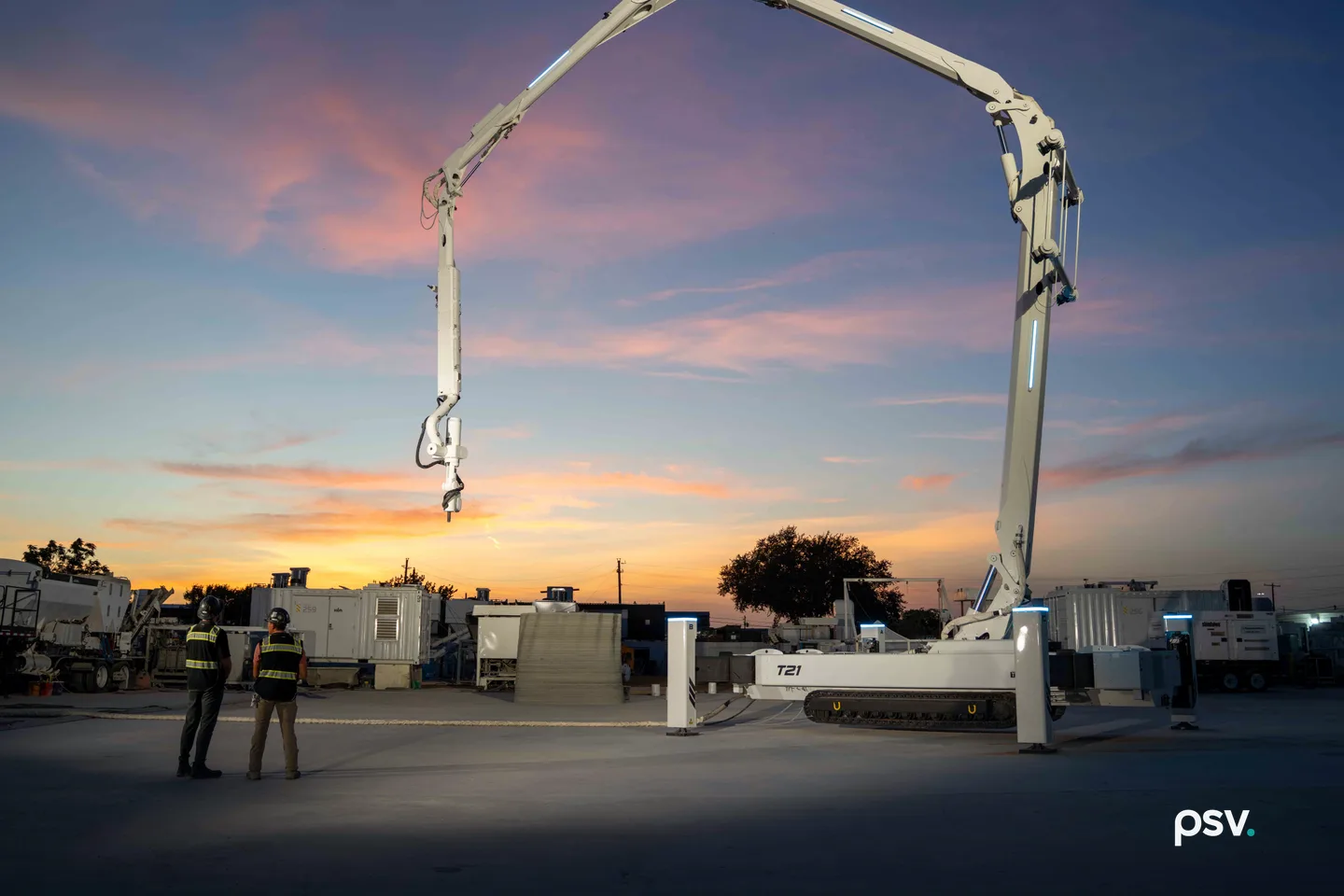
On October 13, 2026, ICON Technology, Inc. of Austin, Texas announced a $200 million Series D financing co-led by Baillie Gifford and funds managed by BlackRock, with participation from Capital Factory, CAZ Investments, Moderne Ventures, Moonshots Capital, Norwest, Overmatch, The Syndicate and Tiger Global, among others. The company says the money will fund manufacturing and deployment of its robotic construction systems, a large-scale research and development facility in Austin, its next-generation Titan and Olympus technologies, and expansion across Texas, Florida, Washington, D.C. and new U.S. markets. The release says the financing will start production of Titan, ICON’s multi-story robotic construction system, at its Austin factory.
The operating claims in the release are ICON’s, not PSV findings. ICON says it is on pace for four times revenue growth in 2026, has built more than 270 homes and structures across five states and two countries, and that ICON Prime, its defense and space division, has been awarded more than $370 million in government contracts. It says Titan is engineered to cut the construction time of an average home by six weeks at 40 percent lower cost than the national average, a figure its footnote attributes to internal cost modeling against a National Association of Home Builders report. The release does not state a valuation. The $1.4 billion figure in trade coverage of the round does not appear in ICON’s release or in its SEC filing, and PSV has not verified it.
What the SEC filing adds, and why the shift to selling printers matters
ICON filed a Form D with the SEC on August 26, 2026 for an equity offering with a total offering amount of $200,000,000, a date of first sale of August 11, 2026, and $114,887,843 sold to 18 investors as of the filing, signed August 25. That leaves $85,112,157 shown as remaining, and the sold amount computes to about 57 percent of the round. This reconciles a number this desk reported on October 12: CRETI’s third quarter proptech tally counted ICON at approximately $114.9 million, which matches the Form D’s sold amount, not the $200 million announced in October. A Form D records sales by the filing date, so the gap is timing, not a contradiction, and the filing does not say when the rest closed.
The bigger change is the business model. ICON’s March 11, 2026 release opened the Titan Program, under which builders and construction companies can acquire ICON’s robotics, software, materials, designs, training and service for the first time, with a $5,000 reservation deposit, financing offered, customer training expected to begin in the third quarter of 2026 and first system deliveries anticipated in early 2027. That release said Titan is engineered to deliver multi-story wall systems for roughly $20 per square foot, and its own footnote says the cost figures are engineering targets and internal projections, not guarantees of performance. For a developer, that means a printed project may soon be built by a local general contractor that owns a Titan rather than by ICON itself, which changes who carries schedule, warranty and code risk.
The workflow PSV would run before a printed project enters a pro forma
The useful tool is a claims-to-evidence ledger for construction method risk. Inputs are the manufacturer’s releases and footnotes, any Form D or other filings, the builder’s Titan purchase or service agreement, the local building department’s approval record for the wall system, and delivered-project records such as ICON’s July 28, 2026 Fort Bliss release, which reports ten barracks with 5,772 square feet of conditioned space each under a $62.8 million Army contract. Every cost, speed or durability figure goes in one row with its source, whether it is a target or a delivered result, and the conditions the footnote attaches to it.
The output is a short memo that separates what was delivered from what was projected, so the construction budget carries a printed wall cost only when a delivered comparable supports it. The reviewer is the development lead or construction manager, and the approval gate is that no target figure from a vendor release enters an investment committee model as a base case. A target can sit in a sensitivity case, labeled as the vendor’s, until the builder has a signed price and a permit.
What stays with a person, and what the records leave open
The operator read
Finish with the judgment call.
The reported facts are above. Enter your email for PSV's operator conclusion and a year of access to every newsroom brief.
Free. No card. Privacy policy. Unsubscribe anytime.
 by PSVLive
Build the workflow behind this analysis. Train with the operators doing it.
Real deal files, live builds, and production-ready CRE AI workflows inside the CRE AI Institute.











Clear answers
Common questions about ICON Series D
How much did ICON raise in its Series D?
ICON announced a $200 million Series D on October 13, 2026, co-led by Baillie Gifford and funds managed by BlackRock. Its Form D filed with the SEC on August 26, 2026 lists a $200,000,000 equity offering with $114,887,843 sold to 18 investors by the filing, about 57 percent, and first sale on August 11. ICON’s release does not state a valuation.
What is ICON Titan and when can builders get one?
Titan is ICON’s multi-story robotic construction system. Under the Titan Program announced March 11, 2026, builders can acquire the printer with software, materials, designs, training and service, after a $5,000 reservation deposit. ICON said training would begin in the third quarter of 2026 and first deliveries are anticipated in early 2027. The Series D funds Titan production at ICON’s Austin factory.
Does 3D printing cut construction costs by 40 percent?
That is ICON’s target, not a measured result. ICON says Titan is engineered for roughly $20 per square foot multi-story wall systems and 40 percent lower cost, and its own footnotes call these internal modeling and engineering projections, not guarantees. A developer should carry them as a sensitivity case until a builder has a signed price and a permit.
Primary source record
These records support the reported facts in this brief. PSV’s CRE workflow interpretation and test plan are original analysis.
- ICON, “ICON Raises $200M Series D To Transform How The World Builds,” October 13, 2026 (source of the round, investors, use of funds, operating claims and lead photograph)
- ICON Technology, Inc., Form D, filed August 26, 2026 (total offering amount, date of first sale, amount sold and number of investors)
- ICON, “ICON Announces First Commercial Rollout of its 3D-Printing Construction Technology for Builders,” March 11, 2026 (Titan Program terms, delivery timing, wall cost target and its footnote)
- ICON, “ICON Delivers Largest Robotic Construction Deployment in DoW History at Fort Bliss,” July 28, 2026 (barracks count, conditioned area and contract value)
Topics
Related PSV analysis
CRE PROPTECH NEWS
Seven Companies Took 58% of Proptech Funding in the Third Quarter, CRETI Reports
CRETI, a real estate technology research group, reported on October 5, 2026 that proptech companies raised about $2.21 billion in the third quarter and that the seven largest financings took about $1.28 billion of it. The seven are EliseAI, Kahua, Invenergy, Buildots, TerraFirma, ICON and Habitat. The company releases PSV checked do not match the tally on every detail.
CRE AI NEWS
Contractor Backlog Is Thin Everywhere But Data Centers
Associated Builders and Contractors reported on August 11 that its Construction Backlog Indicator fell to 8.0 months in July, down 0.8 months from both a month and a year ago and the lowest reading since January. Every industry, region and company size declined. The 12 percent of ABC contractors under contract to work on a data center carry 11.4 months of backlog. The other 88 percent carry 7.5.
CRE POLICY NEWS
The ROAD to Housing Act Is Law: What Changes for CRE Investors
The broadest federal housing law in years took effect on July 11 without a presidential signature. It restricts large-scale purchases of single-family homes while exempting build-to-rent development, and it ships a supply-side stack most coverage is skipping.
Related guides
Cornerstone PSV guides on the workflows in this article.
Claude Engineering Partner for CRE
What it means to run Claude with an engineering partner: the operating model, the controls, and who owns what.
Read the guideClaude for Real Estate Developers
The ground-up developer field guide: site selection through IC memo, built on a real development deal.
Read the guideAI for Real Estate Investing
How commercial real estate investors use AI across the deal lifecycle: sourcing, underwriting, due diligence, and asset management, grounded in real documents.
Read the guideby PSVLiveYou read the operator view. Now learn to run the workflow.
The AI MBA for commercial real estate: the workflows these briefs describe, taught end to end on real deal files, with live builds and a community of CRE operators.