CRE PROPTECH NEWS
Seven Companies Took 58% of Proptech Funding in the Third Quarter, CRETI Reports
CRETI, a real estate technology research group, reported on October 5, 2026 that proptech companies raised about $2.21 billion in the third quarter and that the seven largest financings took about $1.28 billion of it. The seven are EliseAI, Kahua, Invenergy, Buildots, TerraFirma, ICON and Habitat. The company releases PSV checked do not match the tally on every detail.
Direct answer
Direct answer to proptech funding Q3 2026
The total barely moved. The split did. Seven financings are 58 percent of the quarter by CRETI’s count, against 49.6 percent for the eleven rounds of $100 million or more in the first half. For an owner that is a vendor question, not a venture one: find which of your software vendors sit on the funded side, and write the contract term, the renewal date and the data export clause beside each. A large raise is not evidence that a tool works.

What CRETI reported on October 5
The Center for Real Estate Technology & Innovation, known as CRETI, published its State of Proptech Venture Capital report for the third quarter of 2026 on October 5. The page shows a revision on October 8. The report puts the money raised by proptech companies in the quarter at approximately $2.21 billion and names the seven largest financings: EliseAI at $350 million, Kahua at $250 million, Invenergy at $215 million, Buildots at $130 million, TerraFirma at $115 million, ICON at approximately $114.9 million and Habitat at approximately $104.1 million. CRETI says the seven total approximately $1.28 billion, or 58 percent of the quarter. By PSV’s addition the seven come to $1.279 billion, which computes to 57.9 percent of $2.21 billion and leaves about $0.93 billion for every other company in the count.
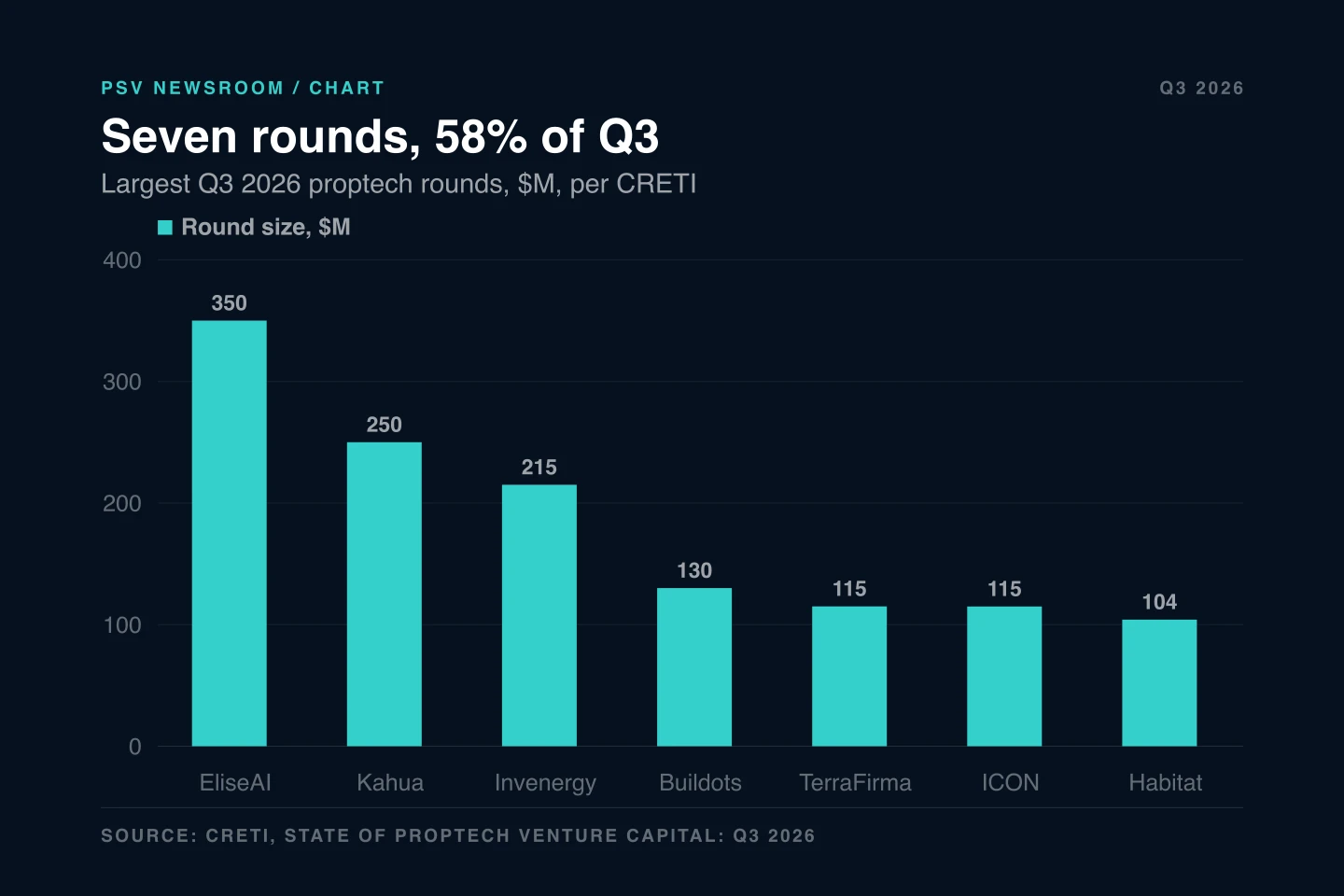
The report says the $2.21 billion is not venture capital alone. It includes venture rounds, private equity, debt, seed capital and later growth rounds; CRETI labels the Kahua financing a private equity investment and cites a debt financing of approximately $50 million for a company called Rize. Below the top seven it lists construction companies Monumental at $32 million, Adaptive at $30 million, Gritt and CivilGrid at $26 million each and Digs at $25.3 million, and AI workflow companies Henry at $16.5 million, Sela AI at $15 million and Uniti AI at $12 million. The third quarter report gives no count of rounds and no median. CRETI’s first half report, published July 8, gave both: $4.53 billion across 231 rounds, a median round of $6.75 million, and 11 rounds of $100 million or more that totaled $2.25 billion, or 49.6 percent of disclosed capital.
Why the split matters more than the total
The total is flat. The first half figure computes to an average of about $2.27 billion a quarter, and $2.21 billion is about 2 percent below that. What moved is the share at the top: 49.6 percent for eleven rounds across six months, then 58 percent for seven financings in three. The two figures are not built the same way. The first half number counts every round of $100 million or more. The third quarter number counts the seven largest, each above $100 million, and the report does not say whether any other round crossed that line. CRETI’s own reading is that the middle of the market may get harder for companies without early momentum or demonstrated scale. That is CRETI’s interpretation, not a PSV finding.
An owner or developer does not buy venture rounds. They buy software from these companies and from the ones that did not raise. Two things follow. A vendor with new capital widens its scope: EliseAI said in its September 29 release that it would use its $350 million to automate more of its customers’ operations, so a contract signed for leasing inquiries becomes a renewal conversation about maintenance and renewals too. And a vendor in the squeezed middle is a continuity question, which PSV’s brief on HouseCanary’s Chapter 11 filing walked through for a data vendor. CRETI places four of the seven in construction: Kahua, Buildots, TerraFirma and ICON. It says construction tools should be judged on project duration, cost predictability and margin, and it says plainly that a nine-figure financing does not establish return, readiness or fit. PSV agrees with that caution.
The workflow PSV would run: a vendor funding and contract register
The work is one row per software vendor the firm pays. The inputs are the accounts payable ledger for the last twelve months, to find every vendor and what it costs; the signed contract and order forms for each; and each vendor’s most recent disclosed financing, taken from the company’s own release or a regulatory filing. The output is a register with eight columns: what the tool does and which properties use it, annual cost, contract end date, renewal notice deadline, the data export clause, the assignment or change of control clause, the last financing with its date, amount and type, and the link to the record that financing came from. A row with no financing record says so. It does not borrow a figure from an aggregator.
The reviewer is the head of operations or technology for the business columns and counsel for the two contract clauses, with the asset management lead signing the register each quarter. The approval gate: no renewal and no new multi-year software contract is signed until that vendor’s row is complete and the export clause has been read by counsel. An assistant can pull the vendor list from the ledger, extract dates and clauses from the contracts with a page reference for each, and draft the financing column from public releases. Every extracted clause is checked against the page before it is relied on. PSV built no register for any firm in this brief, tested none of the products named, and promises no saving, no vendor outcome and no return.
What stays with a person, and where the records differ
The operator read
Finish with the judgment call.
The reported facts are above. Enter your email for PSV's operator conclusion and a year of access to every newsroom brief.
Free. No card. Privacy policy. Unsubscribe anytime.
 by PSVLive
Build the workflow behind this analysis. Train with the operators doing it.
Real deal files, live builds, and production-ready CRE AI workflows inside the CRE AI Institute.











Clear answers
Common questions about proptech funding Q3 2026
How much did proptech companies raise in the third quarter of 2026?
CRETI’s State of Proptech Venture Capital report, published October 5, 2026, puts the quarter at approximately $2.21 billion. The figure includes venture rounds, private equity, debt, seed capital and growth rounds, not venture capital alone. CRETI’s first half report counted $4.53 billion across 231 rounds, which computes to an average of about $2.27 billion a quarter, so the third quarter total is roughly flat. The third quarter report gives no count of rounds and no median round size.
Which proptech companies raised the most in Q3 2026?
CRETI lists seven: EliseAI at $350 million, Kahua at $250 million, Invenergy at $215 million, Buildots at $130 million, TerraFirma at $115 million, ICON at approximately $114.9 million and Habitat at approximately $104.1 million. CRETI says they total approximately $1.28 billion, or 58 percent of the quarter. Two company releases differ from the tally: Kahua’s announces a minority growth investment from Bain Capital and states no dollar amount, and Buildots’ release uses no series letter where CRETI says Series E.
Does a large funding round mean a proptech vendor is safe to rely on?
No. Funding shows that investors committed capital. It does not show profitability, and CRETI’s own report says a nine-figure financing does not establish return, implementation readiness or operating fit. What an owner controls is the contract: the term, the renewal notice deadline, the right to export data, and what happens if the vendor is sold. PSV’s suggested register puts those beside each vendor’s last disclosed financing, sourced to the company’s own release.
Primary source record
These records support the reported facts in this brief. PSV’s CRE workflow interpretation and test plan are original analysis.
- CRETI, “State of Proptech Venture Capital: Q3 2026,” published October 5, 2026, revised October 8 (source of the $2.21 billion total, the seven largest financings and their amounts and labels, the $1.28 billion and 58 percent figures, the smaller rounds listed, the funding structure note, and CRETI’s interpretation and caution)
- CRETI, “Proptech Venture Capital Report: H1 2026,” published July 8, 2026 (source of the $4.53 billion first half total, 231 rounds, the $6.75 million median, and the 11 rounds of $100 million or more totaling $2.25 billion, or 49.6 percent)
- Kahua, “Kahua Secures Strategic Growth Investment from Bain Capital at a Valuation Above $1 Billion,” September 29, 2026 (source of the minority growth investment description, the investor and the valuation; states no investment amount)
- Buildots, “Buildots Raises $130M to Bring AI to the $16T Construction Industry and Power the Global Data Center Buildout,” PR Newswire, September 14, 2026 (source of the $130 million amount, the lead investor and the $297 million total raised; uses no series letter)
- EliseAI, “EliseAI Raises $350 Million at $4 Billion Valuation to Bring AI Deeper Into Housing and Healthcare Operations,” GlobeNewswire, September 29, 2026 (source of the $350 million amount and the stated use of funds)
- 4300streetcar, “53 Pleasant Street Watertown MA construction site December 2025,” Wikimedia Commons, CC BY 4.0 (lead photograph source)
Topics
Related PSV analysis
CRE PROPTECH NEWS
EliseAI Raises $350 Million to Push AI Deeper Into Apartment Operations
EliseAI, which sells AI agents for apartment leasing, resident service, maintenance and renewals, raised $350 million at a $4 billion valuation on September 29, led by Andreessen Horowitz and Bessemer Venture Partners with Ontario Teachers’ Pension Plan participating. It says the money goes to automating more of its customers’ operations, weeks after launching an agent that can act anywhere in its platform.
CRE PROPTECH NEWS
HouseCanary’s Chapter 11 and the AI Valuation Vendor Question
HouseCanary, the AI valuation and property data company whose customers include mortgage lenders, government-sponsored enterprises and single-family rental REIT operators, filed Chapter 11 in New Jersey on September 22, the day its lender had set to auction its operating assets. The court has approved $3 million of interim financing. The filings show a vendor whose model is pledged to its financiers.
AI AGENTS
When Your AI Vendor 10x’s the Price, This Is What Saves You
What happens if the vendor goes public and decides to 10x the usage cost? A principal asked PSV that question about an AI stack built on Claude, and it applies equally to ChatGPT, Copilot, and every workflow tool on top of them. It deserves a better answer than reassurance. Prices move, vendors get acquired, models deprecate. The firms that survive repricing without drama share one property, and it is not a clever contract. It is an architecture decision made on day one, and it costs nothing extra to make.
Related guides
Cornerstone PSV guides on the workflows in this article.
Proptech AI
What proptech AI means, where artificial intelligence actually works in real estate, and what separates useful proptech AI from the hype.
Read the guideBest AI Tools for Commercial Real Estate
The pillar guide to choosing CRE AI tools by workflow fit and control, not vendor hype.
Read the guideAI for Real Estate Investing
How commercial real estate investors use AI across the deal lifecycle: sourcing, underwriting, due diligence, and asset management, grounded in real documents.
Read the guideby PSVLiveYou read the operator view. Now learn to run the workflow.
The AI MBA for commercial real estate: the workflows these briefs describe, taught end to end on real deal files, with live builds and a community of CRE operators.