CRE POLICY NEWS
Massachusetts’ Data Center Order Puts a Contract Before the Permit
Governor Maura Healey signed Executive Order No. 658 on September 8, barring MassDEP, the Energy Facilities Siting Board, the MEPA Office and other permitting agencies from issuing any permit to a data center above 25 megawatts of peak demand until it conforms with her June 25 framework and files a community benefits agreement reviewed by the state’s environmental justice office. It also orders a clean energy mandate with a payment alternative.
Direct answer
Direct answer to Massachusetts data center executive order
The Governor’s office calls it local approval. The operative text is more specific: no state permit issues until a community benefits agreement, reviewed by the Office of Environmental Justice and Equity, is on file. The heavier obligation sits in Section 5. A covered project must procure new clean electricity equal to its annual consumption or pay into a Ratepayer Protection Fund, at a rate MassDEP has until December 31 to act on.
What Executive Order No. 658 actually says
Governor Maura Healey signed Executive Order No. 658, “Establishing Requirements for Responsible Data Center Development and Operations in Massachusetts to Protect and Support Ratepayers, Communities, and the Environment,” on September 8, 2026. It took effect on signing and stays in force until amended, superseded or revoked. The operative command is Section 1. The Department of Environmental Protection, the Energy Facilities Siting Board, the Massachusetts Environmental Policy Act Office and other relevant permitting-related agencies may not issue any permit or authorization associated with a data center project with peak electricity demand exceeding twenty-five megawatts unless the applicant has done two things: demonstrated conformance with the Statement of Expectations for Responsible Data Center Development and Operations the Governor published on June 25, 2026, including its expectations on air quality and public health, water use and community engagement; and submitted a community benefits agreement “with key stakeholders as identified in and aligned with” the Standards and Guidelines for Community Benefits Plans and Agreements set by the Office of Environmental Justice and Equity inside the Executive Office of Energy and Environmental Affairs. The sequence is spelled out. The applicant consults that office before filing an agreement, gives it the agreement for review and comment before submitting it to agencies, and files the office’s written feedback alongside the agreement. The office is the state entity that determines conformance, and applicants are not required to submit the agreement to any other permitting agency for feedback or comment. The same section prohibits permitting-related agencies from using non-disclosure agreements with a data center project, except as otherwise provided by law.
The coverage line and the money are in the back half. Section 13 adopts the data center definition in 400 CMR 9.00 and applies the order to one built or expanded after the effective date that exceeds twenty-five megawatts of peak electric demand, or, for an expansion, adds twenty-five megawatts. The Secretaries of Energy and Environmental Affairs and of Economic Development may jointly exempt a data center directly tied to an accredited college or university engaged in academic research, the provision of medical care, or a state-sponsored program. Section 5 directs MassDEP to develop protocols ensuring covered projects have procured sufficient incremental new clean electricity generation to meet their annual electric consumption, eligible under the Clean Energy Standard at 310 CMR 7.75, and, by December 31, 2026, to take action to establish an alternative compliance payment for data centers that fall short. Those payments are credited to a Ratepayer Protection Fund used to mitigate electricity supply costs for all ratepayers. Section 3 says the Department of Public Utilities should continue its large load rate schedules under Executive Order 654 so other ratepayers do not pay for distribution upgrades, and Section 4 says the Department should direct the electric distribution companies to clear speculative data center projects above twenty-five megawatts out of interconnection queues through fees, deposits or other requirements. The remaining sections order water protocols, annual reporting with attestations filed alongside permit applications, a Municipal Guidance Document for Data Center Development by December 31, 2026, encouragement of project labor agreements, and an annual report to the Governor starting in September 2027. The recitals add one fact that belongs in any Massachusetts pro forma: on June 25, 2026 the Governor paused acceptance of applications for the data center sales and use tax exemption under Section 6(zz) of Chapter 64H.
The press release says local approval. The order says a benefits agreement.
The Governor’s office announced the order under the headline “No Data Centers Without Local Approval,” and its release states that if a data center does not have local approval, state permitting agencies will not advance the project, and that data centers will need a community benefits agreement “with the host community” that meets state standards. Governor Healey is quoted saying, “Unless a community says yes to a data center, we are saying no.” The order’s own text describes a different mechanism. The phrase “local approval” does not appear in it. Section 1 does not require a vote by a city council, select board or town meeting, and it names the counterparty to the required agreement as “key stakeholders” identified in the environmental justice office’s standards rather than the host municipality. What the text requires is a filed agreement, a documented consultation and a written review. The release is the administration’s description of its policy. The order is what binds the agencies, and on this point PSV reports what each says rather than merging them.
That distinction is the real estate fact. A municipal approval is a public decision with a date and a vote count. A community benefits agreement is a negotiated contract whose parties, terms and value are set in a room, and the standard it must align with was written for something else. The environmental justice office’s own page describes its March 2026 Standards and Guidelines as best practices for communities hosting energy infrastructure, issued under the 2024 Climate Act to complement the Siting Board’s and the Department of Energy Resources’ clean energy siting regulations. Executive Order 658 borrows that instrument for data centers. Local zoning does not go away: the June 25 framework states that it supplements, and does not replace, existing state and local siting, permitting and regulatory requirements, including local zoning, building, traffic and noise rules. So the permit path now runs through a municipality’s existing land use authority and, separately, a benefits negotiation reviewed by a state office. This desk read Pennsylvania’s Executive Order 2026-05 on August 19, and the comparison is useful precisely because the threshold is identical: Pennsylvania also drew its line at twenty-five megawatts of peak demand, but held the state permit for local and municipal approvals in hand. Two states, three weeks apart, same number, different instrument.
The workflow PSV would run on a state siting order
The useful artifact is a permit gate register, one row per Massachusetts site a firm owns, is chasing or is expanding, built only from public records and the firm’s own site data. Inputs: the order’s text; the June 25 framework, which lists the disclosures a project should make, including location, footprint, expected annual and peak electric and gas demand, annual and peak water consumption and sourcing, and whether the project has more than one grid interconnection request; the environmental justice office’s community benefits standards; each candidate municipality’s zoning bylaw and any local moratorium on record; and the firm’s load forecast by phase. Output: columns that decide something. Peak demand at each phase against the twenty-five megawatt line, with expansions measured as additions. Whether the project is built or expanded after September 8, 2026. Exemption eligibility under Section 13 and the two secretaries whose joint approval it needs. The community benefits agreement’s counterparties, the date of the consultation, the date the draft went to the office, and whether its written feedback is in hand. Framework conformance evidence for air and public health, water use and community engagement. Annual consumption in megawatt hours against contracted incremental clean supply eligible under 310 CMR 7.75, with the shortfall carried and its cost left blank until MassDEP sets the payment. An inventory of any confidentiality agreement with a state agency, flagged as ending. Every populated cell carries a citation to a section of the order or a page of the framework.
The reviewer is the development lead, with land use counsel on the benefits agreement and whoever owns power procurement on the clean energy rows. The approval gate is concrete because Section 1 makes it concrete: no state permit application is filed until a named person signs that the agreement, the consultation record and the office’s written feedback are all attached. An assistant is well suited to the volume here: extracting obligations section by section, diffing a press release against the order it announces, which is how the gap between “local approval” and “key stakeholders” surfaced in this brief, tracking the two December 31, 2026 deadlines, and watching for the regulation amendments Section 2 directs agencies to make. Three things it should not do. It should not decide whether a given set of counterparties satisfies “key stakeholders,” which is a legal and relationship judgment. It should not treat the “should” directions to the Department of Public Utilities in Sections 3 and 4 as if they were the “shall” commands in Sections 1, 5 and 7. And it should not estimate an alternative compliance payment that does not yet exist. PSV ran no model on this record, tested no product, and promises no cost, schedule or permitting outcome.
What stays with a person, and what the order leaves open
The operator read
Finish with the judgment call.
The reported facts are above. Enter your email for PSV's operator conclusion and a year of access to every newsroom brief.
Free. No card. Privacy policy. Unsubscribe anytime.
 by PSVLive
Build the workflow behind this analysis. Train with the operators doing it.
Real deal files, live builds, and production-ready CRE AI workflows inside the CRE AI Institute.










Clear answers
Common questions about Massachusetts data center executive order
Does Massachusetts require local approval for data centers?
The Governor’s office says so, and the order’s text describes the mechanism more precisely. The September 8, 2026 press release, headlined “No Data Centers Without Local Approval,” states that if a data center does not have local approval, state permitting agencies will not advance the project. Executive Order No. 658 itself does not use the phrase. Section 1 bars MassDEP, the Energy Facilities Siting Board, the MEPA Office and other permitting-related agencies from issuing any permit or authorization to a data center project above twenty-five megawatts of peak electricity demand until the applicant has demonstrated conformance with the June 25, 2026 Statement of Expectations and submitted a community benefits agreement with key stakeholders as identified in the Office of Environmental Justice and Equity’s standards. The applicant must consult that office before filing, give it the agreement for review and comment, and file its written feedback alongside the agreement. The order does not require a municipal vote. Separately, the framework says it does not replace local zoning, building, traffic and noise requirements, so a municipality’s existing land use authority still applies. NBC Boston reported that Lowell and Mansfield approved data center moratoriums and Holyoke a citywide ban; PSV did not verify those municipal actions.
What is the Massachusetts Ratepayer Protection Fund for data centers?
It is where a covered data center’s payments go if it does not buy enough new clean power. Section 5 of Executive Order No. 658 directs MassDEP to develop protocols ensuring that data center projects above twenty-five megawatts of peak electricity demand have procured sufficient incremental new clean electricity generation to meet their annual electric consumption, with that electricity eligible under the Clean Energy Standard at 310 CMR 7.75. By December 31, 2026, MassDEP must take action to establish an alternative compliance payment mechanism for data centers that fall short, and the payments are credited to a Ratepayer Protection Fund used to mitigate electricity supply costs for all ratepayers. The order sets no payment rate, and taking action to establish a mechanism by that date could mean a proposed rule rather than a final one, so the cost of a shortfall cannot yet be modeled. Two related directions are softer: Section 3 says the Department of Public Utilities should continue developing large load rate schedules under Executive Order 654 so other ratepayers do not pay for distribution upgrades, and Section 4 says it should direct utilities to clear speculative projects from interconnection queues through fees or deposits.
Which data centers does Massachusetts Executive Order 658 apply to?
New and expanding ones above a twenty-five megawatt line. Section 13 adopts the data center definition in 400 CMR 9.00, a building or series of buildings housing the servers, storage, networking and related computing infrastructure needed to store, process and distribute data and applications, and applies the order to one built or expanded after the September 8, 2026 effective date that exceeds twenty-five megawatts of peak electric demand, or that adds twenty-five megawatts in an expansion. Existing facilities that do not expand are outside it. The Secretaries of Energy and Environmental Affairs and of Economic Development may jointly approve an exemption for a data center directly tied to an accredited college or university engaged in academic research, the provision of medical care, or a state-sponsored program. The order’s text contains no rule combining nearby facilities into a single project and does not describe how it treats projects already mid-permitting on the signing date. Pennsylvania’s Executive Order 2026-05, signed August 18, 2026, uses the same twenty-five megawatt peak demand threshold.
Primary source record
These records support the reported facts in this brief. PSV’s CRE workflow interpretation and test plan are original analysis.
- Commonwealth of Massachusetts, Executive Order No. 658, “Establishing Requirements for Responsible Data Center Development and Operations in Massachusetts to Protect and Support Ratepayers, Communities, and the Environment,” signed September 8, 2026 (source of the twenty-five megawatt threshold, the Section 1 permit condition and consultation sequence, the non-disclosure agreement prohibition, the Section 5 clean energy protocols, alternative compliance payment and Ratepayer Protection Fund, the Section 13 definition and exemption, the December 31, 2026 and September 2027 dates, and the June 25, 2026 pause on the sales and use tax exemption)
- Office of Governor Maura Healey and Lt. Governor Kim Driscoll, “Governor Healey: No Data Centers Without Local Approval,” press release, September 8, 2026 (source of the administration’s local approval and host community characterization and the Governor’s quote)
- Executive Office of Energy and Environmental Affairs, Healey-Driscoll Administration Statement of Expectations for Responsible Data Center Development and Operations in Massachusetts, published June 25, 2026 (source of the 100 percent clean energy expectation, the disclosure list, and the statement that the framework supplements and does not replace local zoning and existing siting requirements)
- Office of Environmental Justice and Equity, Community Benefit Plans and Agreements (source of the March 2026 release of the Standards and Guidelines and their scope as guidance for communities hosting energy infrastructure under the 2024 Climate Act)
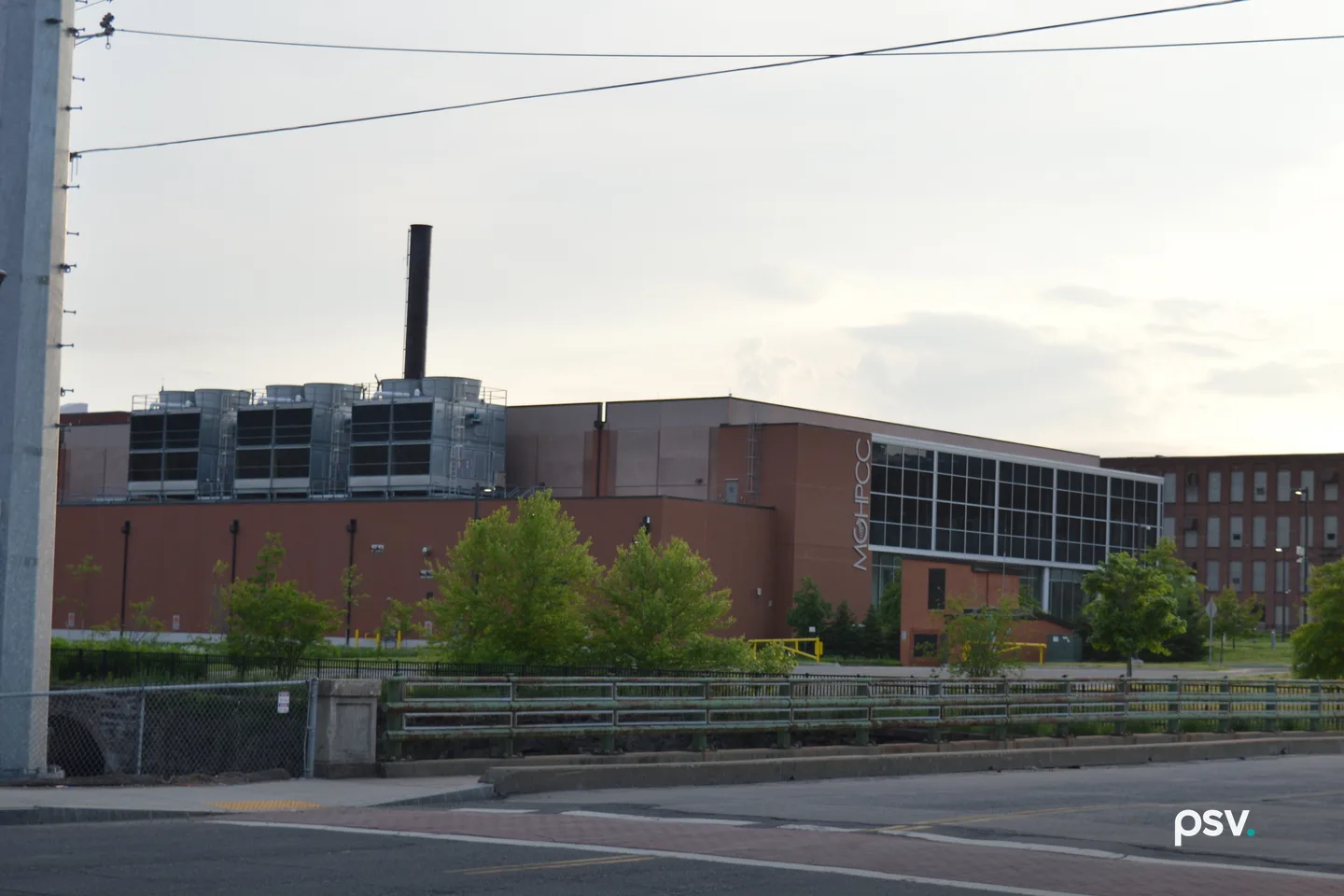
- Simtropolitan, “MGHPCC Holyoke,” Wikimedia Commons, CC0 (lead photograph source)
Topics
Related PSV analysis
CRE POLICY NEWS
Pennsylvania’s Data Center Order Turns on One Number
Governor Josh Shapiro signed Executive Order 2026-05 on August 18, directing Commonwealth agencies to hold every data center proposal with peak demand over 25 megawatts to the Governor’s Responsible Infrastructure Development Requirements. Data centers come out of the Permit Fast Track Program entirely, and the Department of Environmental Protection will not issue a permit until a project has its local and municipal approvals in hand.
CRE POLICY NEWS
New York’s Hyperscale Data Center Moratorium: The CRE Read
Governor Kathy Hochul signed Executive Order 62 on July 14, pausing state environmental permits for new hyperscale data centers of 50 megawatts or more for up to one year while New York writes a statewide environmental study and new development standards. It is the first statewide freeze in the country, and it lands on the hottest development pipeline in commercial real estate.
CRE POLICY NEWS
Wisconsin Made Its 100 Megawatt Customers Sign for the Power
WEC Energy Group filed a Form 8-K on September 4 attaching the investor deck that finally puts numbers on Wisconsin’s Very Large Customer tariff. The Public Service Commission approved it in docket 6630-TE-113 and made it mandatory for any customer with 100 megawatts or more of annual demand. WEC now forecasts 3.9 gigawatts of new electric demand through 2030, and two data center campuses are all of it.
Related guides
Cornerstone PSV guides on the workflows in this article.
AI for Real Estate Investing
How commercial real estate investors use AI across the deal lifecycle: sourcing, underwriting, due diligence, and asset management, grounded in real documents.
Read the guideEnterprise AI for Institutional CRE
PSV trains your whole firm on Claude and ChatGPT, builds your agents live inside your own environment, and stays on as your embedded AI team. What we build for you is yours.
Read the guideWhat is CRE AI?
The definitional guide to commercial real estate AI: the core workflows, how it differs from a chatbot, and how to learn it.
Read the guideby PSVLiveYou read the operator view. Now learn to run the workflow.
The AI MBA for commercial real estate: the workflows these briefs describe, taught end to end on real deal files, with live builds and a community of CRE operators.