CRE POLICY NEWS
Wisconsin Made Its 100 Megawatt Customers Sign for the Power
WEC Energy Group filed a Form 8-K on September 4 attaching the investor deck that finally puts numbers on Wisconsin’s Very Large Customer tariff. The Public Service Commission approved it in docket 6630-TE-113 and made it mandatory for any customer with 100 megawatts or more of annual demand. WEC now forecasts 3.9 gigawatts of new electric demand through 2030, and two data center campuses are all of it.
Direct answer
Direct answer to Wisconsin Very Large Customer tariff data center
Arizona’s utility has not committed to serve a new large load since 2024. Wisconsin wrote a rulebook instead, and the rulebook is strict: a fifteen year term, dedicated generation the customer subscribes to, a minimum bill set at the customer’s own forecast, and posted collateral unless the customer carries an A- rating. Oracle sued over the collateral in June and withdrew in August. None of this promises the buildings get built.
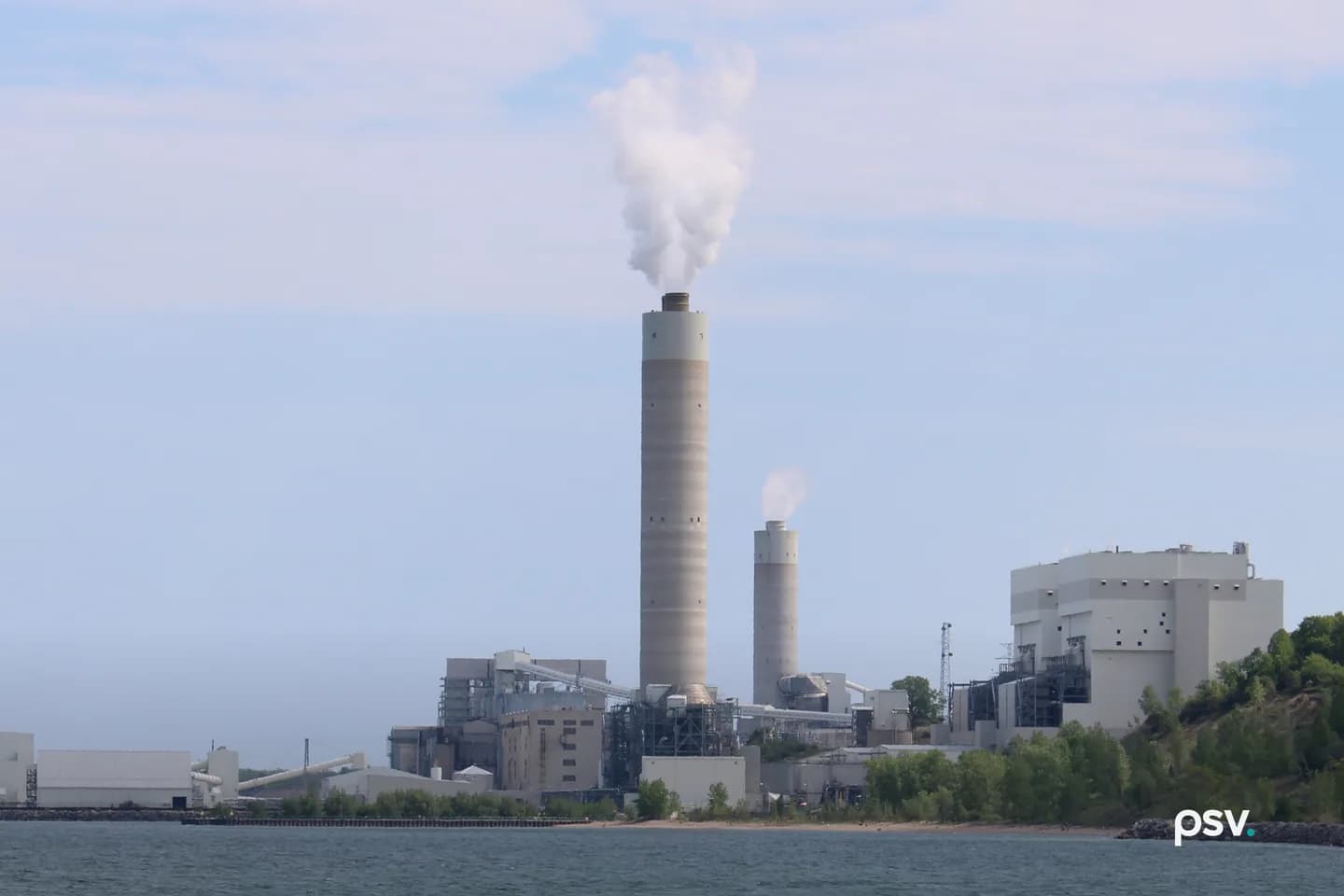
What WEC filed on September 4, and what the Commission ordered in April
WEC Energy Group, Inc., a Wisconsin corporation with principal offices at 231 West Michigan Street in Milwaukee, filed a Form 8-K on September 4, 2026. The filing is a Regulation FD disclosure under Item 7.01, and its substance is Exhibit 99.1: the slide deck company representatives will use in upcoming investor meetings. The deck is where the numbers behind Wisconsin’s large load framework become public in one place. It states that the Very Large Customer tariff applies to customers with 100 megawatts or more of forecasted new load, that the customer subscribes to a portion of one or more dedicated new generation resources, that subscription terms run twenty years for wind and solar and the depreciable life for natural gas and battery storage assets, and that the return on equity is fixed for the entire term in a range of 10.48 percent to 10.98 percent against an equity ratio of 57 percent, with the specific return inside that range agreed with each customer. It adds three things that matter more than the rate: revenues and costs recovered through the tariff are excluded from future rate case proceedings and from the earnings sharing mechanisms, an early termination obliges the customer to pay the remaining net book value to the extent the investment cannot be repurposed, and a customer rated below A- by S&P or below A3 by Moody’s, or one that fails a tangible net worth or liquidity test, must post financial security covering the net book value of the investments made to serve it. The deck says the written order arrived on May 21, 2026. Every figure in this paragraph is WEC’s own characterization of a tariff it applied for, filed as an exhibit to a securities filing rather than audited.
The order behind it is a public record and PSV read it rather than the summary. In docket 6630-TE-113, “Application of Wisconsin Electric Power Company for Approval of its Very Large Customer and Bespoke Resources Tariffs,” the Public Service Commission of Wisconsin met on Friday, April 24, 2026 with Chairperson Strand and Commissioners Nieto and Hawkins present, and recorded thirty-nine determinations. Several of them are sharper than the investor deck. The Commission approved a term length of fifteen years and a 100 megawatt eligibility threshold, and it found it reasonable to require the tariff to be mandatory for all customers with 100 megawatts or greater annual demand, which means a qualifying load does not get to shop for a friendlier schedule. It required the tariff to state that subscriptions to Bespoke Resources must be sufficient to avoid long-term reliance on Fleet Firm Service or Market Firm Service resources. It approved recovery of transmission costs through a transmission service charge using a load ratio share allocation, and then directed the utility to revise the tariff and the service agreement to include a minimum billing demand charge equal to 100 percent of a very large customer’s initially forecasted load or its actual demand in the billing period, whichever is higher, with the initial forecast defined as the one the customer provided on the Load Interconnection Request Form and Load Impact Study, inclusive of any ramp period. It approved an Insufficient Capacity Charge with a 100 megawatt variance, made the assessment mandatory, and clarified that the charge activates following a shortage beyond that variance in any season for each of three consecutive years. On credit, the Commission struck the sentence reserving the company “sole discretion to waive any of the Financial Support Requirements” and tightened the exception, requiring both an A- from S&P and an A3 from Moody’s plus either tangible net worth of two times the required security or liquidity greater than ten times it. It declined to allow capacity-only resources in the Bespoke tariff, allowed subscriptions to resources outside MISO Load Resource Zone 2, set an Act 141 assessment at 1.2 percent of very large customer bills, and required that all customer facilities served under the tariff be served by dedicated distribution facilities or distribution the customer owns. It also attached a waiver: a customer taking service “voluntarily and permanently waives and disclaims any right to petition the Commission for a determination that the customer is a Large Energy Customer” under Wis. Stat. 196.374(5)(b), and gives up Focus on Energy grants and benefits equal to its class’s contributions. The Commission approved both tariffs with modifications and directed the Division of Energy Regulation and Analysis to draft the order.
Why a mandatory tariff is a site selection fact
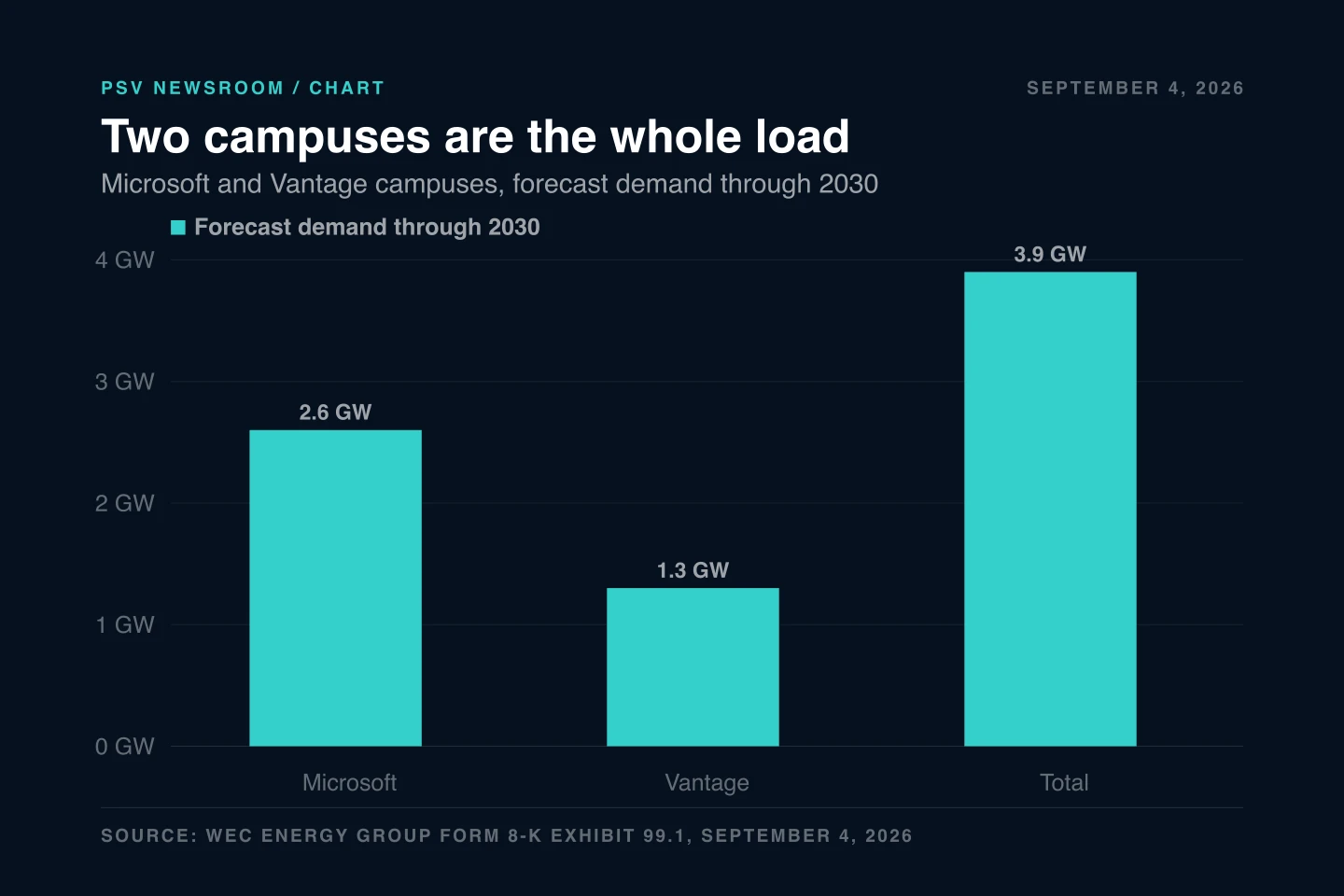
The deck states that WEC expects to add 3.9 gigawatts of electric demand, about 45 percent, between 2026 and 2030, and that its Wisconsin segment electric sales growth forecast for 2028 through 2030 runs 6.0 percent to 8.0 percent year over year against 0.7 percent to 1.0 percent for gas. Then it names where the electricity goes. Microsoft’s Mount Pleasant campus along the Interstate 94 corridor between Milwaukee and Chicago accounts for 2.6 gigawatts of forecasted demand through 2030; the deck puts Microsoft’s announced investment above $20 billion, of which $7.3 billion covers phases one and two and $13 billion is additional, describes fifteen further data centers beyond those phases, states that more than 2,200 acres have been purchased to date, and says phase one commenced operations in April 2026. The Vantage Data Centers campus in Port Washington accounts for another 1.3 gigawatts through 2030; the deck describes four buildings under construction on 670 acres of an approximately 1,900 acre site, expected investment above $15 billion, more than 4,000 construction jobs and more than 1,000 permanent ones, and site potential up to 3.5 gigawatts over time. Those two figures add to the whole 3.9 gigawatts, which is PSV arithmetic on two numbers in the same deck rather than a total WEC printed. The Port Washington campus is the Midwest site in OpenAI and Oracle’s Stargate expansion, and the October 22, 2025 announcement from Vantage and its parent puts the same $15 billion and 670 acres on the record with roughly a gigawatt of AI capacity and a 2028 completion target. For scale in the other direction, the same WEC deck shows data centers at 1 percent of the utility’s 2025 Wisconsin retail megawatt-hour deliveries. This is a load that barely exists today and is forecast to be most of the growth.
For a commercial real estate operator the consequence is that in this territory the power question has a written answer, and the answer has a price and a signature attached. The minimum billing demand charge is the term to read twice: because the floor is set at the customer’s own initially forecasted load, a developer who forecasts high to reserve capacity and then ramps slowly pays for the forecast, not the meter. The dedicated distribution requirement moves a distribution build into the project scope. The permanent waiver of Large Energy Customer status is a statutory right surrendered at signing. And the credit test is where a real party pushed back: Oracle, which is the offtaker behind the Port Washington campus, filed suit against the Commission in Ozaukee County Circuit Court in June 2026 challenging the financial security requirement, and withdrew that suit in August 2026. PSV did not obtain the Ozaukee County docket and reports the litigation as it was publicly reported rather than as a verified filing. What is in the primary record is WEC’s own September 4 statement that Oracle remains committed to the project, is paying its full share of energy, is providing the financial support needed so that there is no risk to other Wisconsin customers, and has met the financial security requirements in line with the Commission’s. Read the arc plainly: a state regulator wrote a collateral rule strict enough that an investment grade counterparty went to court over it, and then complied. That is the useful precedent, and it is the opposite of the Arizona record this desk covered on September 4, where parties told the Arizona Corporation Commission that APS has been unable to commit to serve any new large load customer since January 1, 2024.
The workflow PSV would run on a large load tariff
A tariff is a document, and most teams treat it as somebody else’s document until the interconnection meeting. The workflow this argues for is a standing large load tariff register, one row per market a firm is actually shopping, built from records that are all public. The inputs: the state commission’s docket, which in Wisconsin means the open meeting minutes and the final written order in the numbered case, and which is the only place the binding conditions appear in full; the utility’s own investor materials, because a Form 8-K under Item 7.01 with a slide deck attached is where a utility states its load forecast, its capital plan and its named customers in one document, and those decks are filed on a schedule; the customer contracts themselves, which in this docket the Commission ordered the utility to file with it; and the firm’s own site list with each parcel’s forecast load. The output is one row per market with columns that decide something: the eligibility threshold and whether the tariff is mandatory or elective; the contract term; whether a generation subscription is required and for how long; how the minimum bill is set and off which forecast; what the early termination obligation is; the credit rating and collateral test and what it costs a BBB counterparty; whether distribution facilities fall to the utility or the customer; the utility’s stated forecast headroom in gigawatts; and a citation to the docket item or filing page every cell came from. The value is comparative. A row for Wisconsin next to a row for Arizona next to a row for Kansas or Tennessee is the artifact that answers where a project can actually get power, and none of the three reads the same.
The reviewer is whoever owns the site selection decision, with the development lead on anything touching distribution scope and utility counsel on the waiver and collateral language, because a permanent waiver of a statutory customer classification is a legal question and not a summary. The approval gate is that no parcel enters or leaves the shortlist, and no load forecast goes onto a Load Interconnection Request Form, until a named person signs the row, which matters more here than usual because in Wisconsin that forecast becomes the minimum bill. An assistant carries most of the volume and carries it well: pulling a commission’s open meeting minutes and order PDFs and extracting the numbered determinations into cells, reading an Item 7.01 exhibit for load forecast, capital plan and named customers, diffing a utility’s investor deck against the commission’s own order to find where the summary is softer than the condition, which is exactly how the mandatory-participation and minimum-bill terms surfaced here, and keeping the register current as dockets move. Three things it should not do. It should not treat an investor deck as the tariff, because the deck is a summary written for a different audience. It should not conclude what a waiver or an assignment clause means. And it should not convert a utility’s forecast into a schedule your pro forma can rely on, because a forecast filed under Regulation FD is a forward-looking statement and is labeled as one. PSV ran no model here, tested no product, and promises no cost, schedule or approval outcome.
What stays with a person, and what the record does not settle
The operator read
Finish with the judgment call.
The reported facts are above. Enter your email for PSV's operator conclusion and a year of access to every newsroom brief.
Free. No card. Privacy policy. Unsubscribe anytime.
 by PSVLive
Build the workflow behind this analysis. Train with the operators doing it.
Real deal files, live builds, and production-ready CRE AI workflows inside the CRE AI Institute.










Clear answers
Common questions about Wisconsin Very Large Customer tariff data center
What is Wisconsin’s Very Large Customer tariff?
It is the rate schedule Wisconsin Electric Power Company applied for in Public Service Commission of Wisconsin docket 6630-TE-113, and the Commission approved it with modifications at its open meeting on Friday, April 24, 2026. Per the Commission’s recorded determinations, the term length is fifteen years, the eligibility threshold is 100 megawatts, and the tariff is mandatory for all customers with 100 megawatts or greater annual demand rather than elective. A customer taking service under it must also subscribe to Bespoke Resources, dedicated generation whose subscription term runs no less than the depreciable life of the resource, with wind and solar set at no less than twenty years or the duration of the resource contract, and the tariff must state that subscriptions be sufficient to avoid long-term reliance on Fleet Firm Service or Market Firm Service. WEC Energy Group’s September 4, 2026 investor presentation, filed as Exhibit 99.1 to a Form 8-K, adds that the return on equity is fixed for the entire term in a range of 10.48 percent to 10.98 percent against a 57 percent equity ratio, that revenues and costs under the tariff are excluded from future rate case proceedings and from the earnings sharing mechanisms, that early termination obliges the customer to pay remaining net book value to the extent it cannot be repurposed, and that the written order was received on May 21, 2026. The Commission also required all facilities served under the tariff to be served by dedicated distribution facilities or distribution the customer owns, and set an Act 141 assessment at 1.2 percent of very large customer bills.
How much data center load is WEC forecasting in Wisconsin?
3.9 gigawatts of added electric demand between 2026 and 2030, which WEC Energy Group’s September 4, 2026 investor presentation describes as roughly a 45 percent increase, and two campuses account for all of it. The deck attributes 2.6 gigawatts of forecast demand through 2030 to Microsoft’s Mount Pleasant campus on the Interstate 94 corridor between Milwaukee and Chicago, where it puts Microsoft’s announced investment above $20 billion, comprising $7.3 billion for phases one and two and $13 billion additional, describes fifteen further data centers beyond those phases, states that more than 2,200 acres have been purchased to date, and says phase one commenced operations in April 2026. It attributes another 1.3 gigawatts through 2030 to the Vantage Data Centers campus in Port Washington, describing four buildings under construction on 670 acres of an approximately 1,900 acre site, expected investment above $15 billion, more than 4,000 construction jobs and more than 1,000 permanent jobs, and site potential up to 3.5 gigawatts over time. The 2.6 and 1.3 gigawatt figures sum to the 3.9 gigawatt total, which is arithmetic on two numbers in the same deck rather than a total WEC printed. The same deck shows data centers at 1 percent of the utility’s 2025 Wisconsin retail megawatt-hour deliveries, so this is a load class that is small today and forecast to be nearly all of the growth. Wisconsin segment electric sales growth is forecast at 6.0 percent to 8.0 percent year over year for 2028 through 2030. All of these are company forecasts filed under Regulation FD, not results.
Why did Oracle sue the Wisconsin Public Service Commission?
Over the collateral. In docket 6630-TE-113 the Commission approved credit support measures with modifications, and two of those modifications tightened the screw. It removed the language reserving Wisconsin Electric Power Company the “sole discretion to waive any of the [VLC/Bespoke Resource] Financial Support Requirements,” and it raised the bar for the exception that lets a customer skip posting security, requiring credit ratings on long-term senior unsecured non-credit-enhanced indebtedness of not lower than A- from S&P and A3 from Moody’s, plus either tangible net worth net of commitments and contingent liabilities of two times the required security amount or liquidity greater than ten times it. Oracle, the offtaker behind the Vantage campus in Port Washington, filed suit against the Commission in Ozaukee County Circuit Court in June 2026 challenging that requirement, and withdrew the suit in August 2026. PSV did not obtain the Ozaukee County docket and reports the litigation as it was publicly reported rather than as a verified court filing. What is in a primary record is WEC’s own statement in its September 4, 2026 investor presentation that Oracle remains committed to the project, is paying its full share of energy, is providing the financial support needed so that there is no risk to other Wisconsin customers, and has met the financial security requirements in line with the Commission’s. The sequence is the useful part for an operator: a state regulator wrote a collateral rule strict enough to draw a court challenge from an investment grade counterparty, and the rule held.
Primary source record
These records support the reported facts in this brief. PSV’s CRE workflow interpretation and test plan are original analysis.
- WEC Energy Group, Inc., Form 8-K, filed September 4, 2026 (Item 7.01 Regulation FD Disclosure and Item 9.01, transmitting the investor presentation as Exhibit 99.1)
- WEC Energy Group, Inc., Form 8-K Exhibit 99.1, September 2026 investor presentation (source of the Very Large Customer tariff terms, the 10.48 to 10.98 percent return on equity range and 57 percent equity ratio, the May 21, 2026 written order date, the 3.9 gigawatt 2026-2030 demand forecast, the 2.6 gigawatt Microsoft and 1.3 gigawatt Vantage figures, the $37.5 billion capital plan, the Oracle financial security statement and the 1 percent 2025 data center share of Wisconsin retail deliveries)
- Public Service Commission of Wisconsin, Minutes and Informal Instructions of the Open Meeting of Friday, April 24, 2026, docket 6630-TE-113, PSC REF# 590312 (source of the thirty-nine determinations including the fifteen year term, the mandatory 100 megawatt participation requirement, the minimum billing demand charge, the Insufficient Capacity Charge, the credit support modifications and the Large Energy Customer waiver language)
- Public Service Commission of Wisconsin, Case Management System docket detail for 6630-TE-113, “Application of Wisconsin Electric Power Company for Approval of its Very Large Customer and Bespoke Resources Tariffs” (docket caption and status)
- DigitalBridge Group, Inc. investor newsroom, “OpenAI, Oracle and Vantage Data Centers Announce Stargate Data Center Site in Wisconsin,” October 22, 2025 (source of the $15 billion Port Washington investment, the roughly 670 acres, the four data centers, the close to one gigawatt of AI capacity, the 2028 completion target and the construction and permanent job counts)
- Michael Barera, “Bender Park May 2026 05 (Oak Creek Power Plant) (cropped),” Wikimedia Commons, CC BY-SA 4.0 (lead photograph source)
Topics
Related PSV analysis
CRE POLICY NEWS
APS Has Not Committed to Serve a New Large Load Since 2024
Closing briefs in the Arizona Public Service rate case were docketed on August 27, and they carry a fact no site selection memo in metro Phoenix can ignore. Microsoft, an intervenor, told the Arizona Corporation Commission that APS has been unable to commit to serve any new large load customer since January 1, 2024. APS’s own brief describes a large queue of uncommitted customers. PSV read the briefs.
CRE POLICY NEWS
TVA Repriced Data Center Power. The Tariff Isn’t Public.
The TVA Board voted in Memphis on August 20 to move data centers out of the manufacturing rate class and onto a rate of their own. Officials at the meeting described an October 1 start, a roughly 10 percent increase, a three-year phase-in for existing sites, and an upfront capacity commitment charge on new load above 5 megawatts. TVA’s own release names none of those terms.
CRE POLICY NEWS
Texas Paused the Data Center Grid Queue, and the Gate Is Paperwork
Governor Greg Abbott directed a verification and audit of every data center advancing through ERCOT’s interconnection process on August 3. The Public Utility Commission of Texas made it operative on August 20, granting ERCOT good cause exceptions that suspend Batch Zero classification deadlines. ERCOT then told the market it intends to issue conditional classifications by August 31. PSV read the letter, the order and ERCOT’s filed presentation.
Related guides
Cornerstone PSV guides on the workflows in this article.
AI for Real Estate Investing
How commercial real estate investors use AI across the deal lifecycle: sourcing, underwriting, due diligence, and asset management, grounded in real documents.
Read the guideWhat is CRE AI?
The definitional guide to commercial real estate AI: the core workflows, how it differs from a chatbot, and how to learn it.
Read the guideby PSVLiveYou read the operator view. Now learn to run the workflow.
The AI MBA for commercial real estate: the workflows these briefs describe, taught end to end on real deal files, with live builds and a community of CRE operators.