CRE POLICY NEWS
PJM’s Firm Power Exemption Is a 10 Year Commitment
PJM told this desk’s readers in July what its Board had directed. The filings themselves are now at the Federal Energy Regulatory Commission, in dockets ER26-3380-000 and ER26-3515-000, and the comment window closed on September 3. They contain terms the Board letter never stated, and the most consequential one is what a site has to promise to keep firm power.
Direct answer
Direct answer to PJM Bring Your Own New Capacity firm power
Bring Your Own New Capacity is the only way a new large load in PJM keeps the firm service every other customer gets. PJM’s filing says the paired resource must be a price taker in capacity auctions for ten years, cannot be transferred to a different large load, and if it fails to come online the building takes curtailment anyway. That is a decade-long obligation attached to a site, not a permit fee.

What is actually on file at FERC, and when it gets decided
This desk covered the PJM Board of Managers’ July 27 decisional letter on July 29, when the two filings it directed were still forthcoming. Both have since been made, and a filing says more than a letter about it. On July 31, 2026, PJM Interconnection, L.L.C. filed “Reliability Backstop Procurement to Address Resource Adequacy Concerns Stemming from Large Loads” in Docket No. ER26-3380-000, accession number 20260731-5214. On August 13, 2026, PJM filed “Proposal of PJM Interconnection, L.L.C. to Establish Interim Resource Adequacy Service and a Large Load Registry to Address System Reliability” in Docket No. ER26-3515-000. The second filing asks the Commission to accept the proposed Tariff and Reliability Assurance Agreement revisions effective October 12, 2026, which PJM notes is sixty days from the date of filing, and states that the service itself becomes available with the 2027/2028 Delivery Year beginning June 1, 2027. The first is on a tighter clock: PJM wrote that the procurement window will open if and when the Commission accepts the framework, and that to the extent it is accepted by September 29, 2026, and absent significant revisions, PJM intends to open the window on September 30, 2026. PJM added that if the Commission accepts subject to modification it will commence as soon as practicable and the date may not hold. The comment and intervention deadline in the Interim Resource Adequacy Service docket was reported as September 3; PSV did not retrieve the Commission’s notice or the served comments, because FERC’s eLibrary search returned no results to an automated session on the day of publication, and the docket numbers and filing dates above come from PJM’s own filed documents rather than from the Commission’s docket sheet.
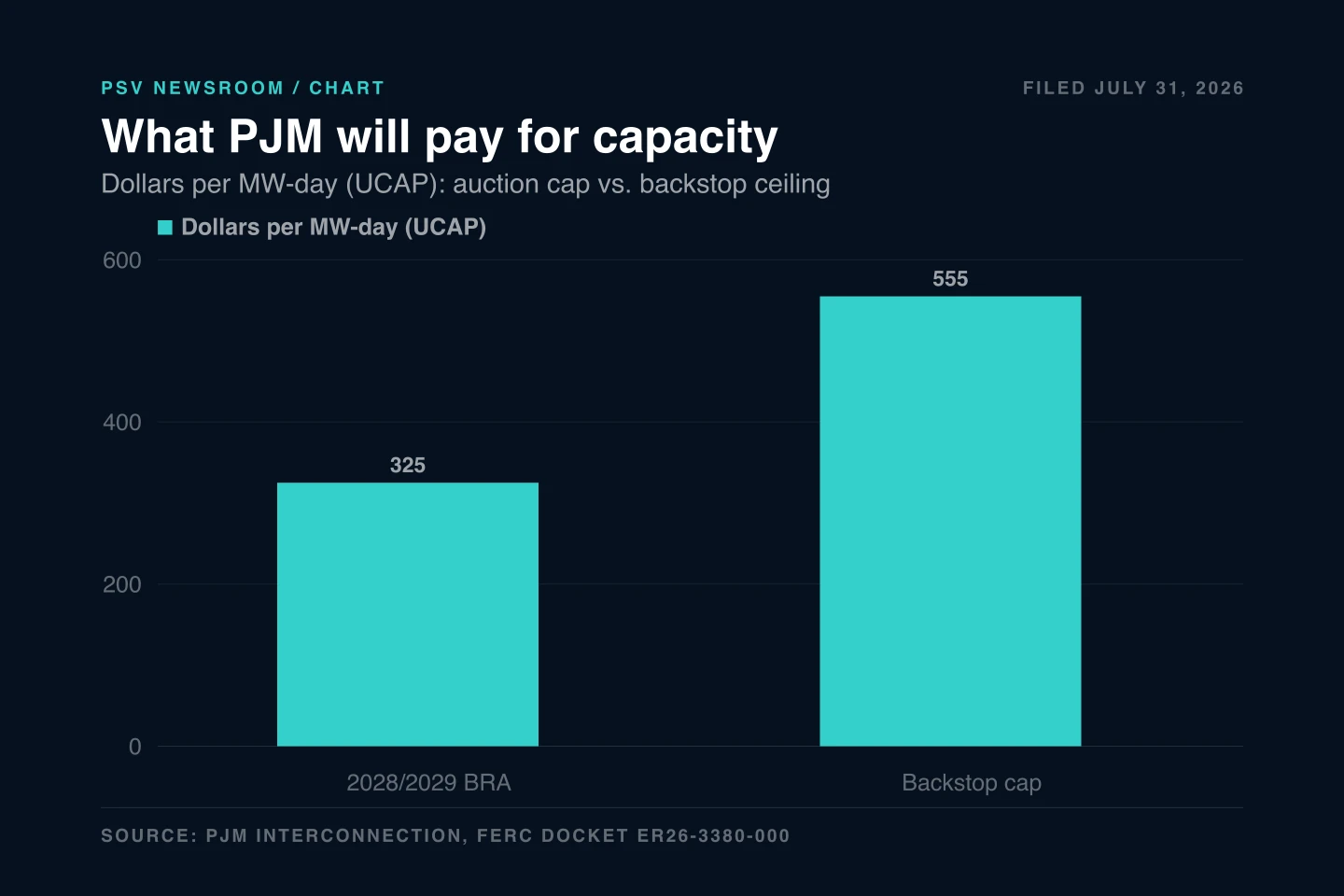
The numbers behind the two filings come from the same auction. PJM’s Reliability Backstop filing states that the Base Residual Auction for the 2028/2029 Delivery Year, which ran from June 30, 2026 to July 7, 2026, cleared 6,831.3 megawatts of unforced capacity short of the RTO-wide reliability requirement at the market price cap of $325 per megawatt-day, and that this was the second consecutive year the auction cleared short. It quotes the 2028/2029 auction report for the underlying figure: total procured capacity in the RTO including both the capacity market and Fixed Resource Requirement entities was 149,181.6 megawatts of unforced capacity, or 6,831.3 megawatts below the reliability requirement, with Fixed Resource Requirement entities committing 10,863.8 megawatts. That 6,831.3 megawatt figure becomes the Initial RBP Target, reduced by capacity that new load brings voluntarily and by two limited opt-outs. On price, PJM proposes that the megawatt-weighted average of the levelized procurement cost of all selected offers not exceed $555 per megawatt-day of unforced capacity, and explains where that number comes from: it is Point 1 on the Variable Resource Requirement curve for the 2028/2029 auction, and PJM writes that but for the collared price cap, $555 per megawatt-day would have been the cap for that auction. Commitments run up to fifteen years, with none extending beyond the 2042/2043 Delivery Year, and clearing is pay as bid.
Why the exemption, not the curtailment, is the real estate fact
The July coverage focused on the curtailment: a new large load that does not bring capacity takes Interim Resource Adequacy Service, gets reduced ahead of Pre-Emergency Load Management, and the transmission owner initiates and completes that reduction within ten minutes. That remains the headline. But the August filing and the Board’s published framework describe the way out in far more detail than the letter did, and the way out is where the real estate consequence lives. Bring Your Own New Capacity is not a fee and it is not a one-time showing. PJM’s framework states that for generation and storage, maintaining the status means the resource cannot submit a must-offer exception associated with external sales and must be a price taker in capacity auctions for ten years; for demand response and distributed energy resources, the initial-year megawatts must be demonstrated for ten years and the resource must likewise be a price taker for ten years. A price taker forgoes the right to withhold at a price it dislikes, for a decade. That is an economic commitment made by a generation asset on behalf of a building, and somebody has to be willing to make it.
Three further terms turn that commitment into a diligence problem rather than a line in a budget. First, assignment: the framework states that Bring Your Own New Capacity cannot be transferred to a different large load unless the original large load no longer exists, though it may be used for a portfolio of large loads and excess may be reserved for future loads or for a ramp. Second, counterparty risk that runs the wrong direction: if the capacity resource paired with the exemption fails to materialize for the delivery year, the framework says the resource becomes subject to capacity deficiency charges and the large load becomes subject to Interim Resource Adequacy Service. The building’s service level depends on a third party finishing a power plant. Third, location: PJM writes that because its capacity market and transmission planning are conducted RTO-wide there is no locational requirement for the paired capacity, so the resource may sit in a different zone entirely, while acknowledging that some stakeholders disagree and noting that states or electric distributors may add their own locational requirements. There is one release valve worth reading: the framework provides that the exemption and the associated must-offer requirements need not be maintained if Interim Resource Adequacy Service is not triggered for three consecutive delivery years. And the threshold that pulls a site into all of this is deliberately hard to engineer around. PJM proposes to define a large load as end-use customer load with a cumulative peak of fifty megawatts or greater at a single electrical site behind one or more points of interconnection, with all affiliated load facilities within a one-mile radius treated as a single electrical site. PJM told the Commission why in plain words: to avoid gamesmanship from splitting a large load into smaller loads within the same area, and to stop an owner from escaping the threshold by siting a number of smaller data centers close together. PJM notes the Commission has applied a one-mile test before, in the qualifying facility context.
The workflow PSV would run on a grid operator’s tariff filing
The mistake most firms make with a filing like this is to read the trade coverage and wait for the order. The workflow this argues for is a standing tariff exposure register, one row per site a firm owns or is chasing inside an affected market, built entirely from records that are public. The inputs are the grid operator’s own filed documents rather than its summaries, because on this story the difference is material: PJM’s Board letter did not state the ten-year price-taker obligation, the non-transferability of the exemption, or the March 1 proof deadline, and all three are in the framework and filings. So the inputs are the transmittal letter and proposed tariff sheets in each docket, the operator’s published stakeholder framework, the auction report the filing cites for its shortfall figure, and the firm’s own site list with each site’s peak load and ramp schedule. The output is one row per site with columns that decide something: measured peak load today and at full ramp; whether affiliated facilities within a mile push the site over the threshold; the in-service date relative to the June 1, 2027 line; whether an exemption arrangement exists and who owns the paired resource; the ten-year obligation attached to that resource and who bears it; the registration deadline that applies, which for loads in service before June 1, 2027 is March 1, 2027; the proof and verification dates, which the framework sets at March 1 and April 1 before the effective delivery year; on-site backup capacity and fuel type, which the registry asks for; and a citation to the page of the filing every cell came from.
The reviewer is whoever owns the site, with development on anything touching backup generation scope and counsel on the assignment and must-offer language, because whether a ten-year price-taker obligation survives a sale of either the building or the generator is a contract question and not a summary. The approval gate is that no load forecast goes onto a registration and no site enters an exemption arrangement until a named person signs the row, which matters here because the registry asks for a load quantity and ramp schedule and those numbers are the ones the system will hold a site to. An assistant carries the volume well: pulling a several hundred page filing and extracting the operative terms into cells, diffing a board letter against the filing it produced to find the terms the summary omitted, which is exactly how the ten-year obligation surfaced here, tracking docket dates, and keeping the register current as the Commission acts. Three things it should not do. It should not treat a proposed tariff as an effective one, because everything described here is a proposal the Commission has not yet ruled on. It should not conclude what an assignment or must-offer clause means for a specific contract. And it should not convert a proposed effective date into a schedule a pro forma relies on. PSV ran no model here, tested no product, and promises no cost, schedule, reliability or approval outcome.
What stays with a person, and what the record does not settle
The operator read
Finish with the judgment call.
The reported facts are above. Enter your email for PSV's operator conclusion and a year of access to every newsroom brief.
Free. No card. Privacy policy. Unsubscribe anytime.
 by PSVLive
Build the workflow behind this analysis. Train with the operators doing it.
Real deal files, live builds, and production-ready CRE AI workflows inside the CRE AI Institute.











Clear answers
Common questions about PJM Bring Your Own New Capacity firm power
What is Bring Your Own New Capacity in PJM?
It is the arrangement that exempts a new large load in PJM from Interim Resource Adequacy Service, the proposed emergency action that would reduce uncovered large loads ahead of Pre-Emergency Load Management. PJM’s published framework, dated July 27, 2026, sets the terms. New unforced capacity qualifies if it is offered into the 2027/2028 Third Incremental Auction or a later auction and has not cleared before then, and eligible categories include new build, uprates, capacity interconnection rights transferred from a resource deactivated or announced for deactivation as of April 10, 2026, repowering of generators retired as of that date, surplus interconnection and certain fuel switching. Restoration of prior deficiencies, resources under a Reliability Must-Run agreement or a Federal Power Act section 202(c) order, and delayed retirements do not qualify. Demand response and distributed energy resources can qualify on their own terms. The obligations are the part operators underestimate: for generation and storage the resource cannot submit a must-offer exception associated with external sales and must be a price taker in capacity auctions for ten years, and for demand response the initial year megawatts must be demonstrated for ten years with the same ten year price taker obligation. Proof must reach PJM and the electric distributor by March 1 before the effective delivery year, with verification by April 1. Everything here is proposed and not yet approved by the Commission.
What counts as a large load under PJM’s proposal?
End-use customer load with a cumulative peak load of fifty megawatts or greater at a single electrical site behind one or more points of interconnection, where all affiliated load facilities within a one-mile radius are treated as a single electrical site. PJM stated the reason in its August 13, 2026 filing in Docket No. ER26-3515-000: the cumulative test is meant to avoid gamesmanship from splitting a large load into smaller loads within the same area, and the one-mile radius is meant to stop an owner from escaping the threshold by siting a number of smaller data centers close together. PJM notes the Commission has applied a one-mile test before in the qualifying facility context. The practical effect for a real estate operator is that a campus is one electrical site whether or not it is one parcel, and phasing a build below the line does not by itself avoid the threshold, because PJM’s framework counts ramps: its own example is a thirty megawatt load growing to sixty megawatts, where the thirty new megawatts count as new large load megawatts. Large loads in service before June 1, 2027 must register by March 1, 2027, and registration is required before the in-service date of a new large load.
When does FERC decide on PJM’s large load filings?
There are two dockets on two clocks, and as of publication the Commission had ruled on neither. In Docket No. ER26-3380-000, the Reliability Backstop Procurement filed July 31, 2026, PJM wrote that the procurement window opens if and when the Commission accepts the framework, and that to the extent it is accepted by September 29, 2026 and absent significant revisions or developments, PJM intends to open the window on September 30, 2026. PJM added that if the Commission accepts the filing subject to modification it will commence as soon as practicable and the date may not hold. In Docket No. ER26-3515-000, the Interim Resource Adequacy Service and Large Load Registry filing made August 13, 2026, PJM asked the Commission to accept the proposed Tariff and Reliability Assurance Agreement revisions effective October 12, 2026, which it notes is sixty days from the date of filing, while the service itself would become available with the 2027/2028 Delivery Year beginning June 1, 2027. PJM told the Commission the earlier effective date matters because it lets PJM begin building the Large Load Registry and gives data center developers the regulatory certainty they said they need before finalizing contracts for the generation that would offset their new load. The comment and intervention deadline in the second docket was reported as September 3, 2026, which PSV reports as reported rather than verified against the Commission’s own notice.
Primary source record
These records support the reported facts in this brief. PSV’s CRE workflow interpretation and test plan are original analysis.
- PJM Interconnection, L.L.C., “Reliability Backstop Procurement to Address Resource Adequacy Concerns Stemming from Large Loads,” FERC Docket No. ER26-3380-000, filed July 31, 2026, accession 20260731-5214 (source of the 6,831.3 megawatt shortfall, the $325 per megawatt-day 2028/2029 clearing cap, the 149,181.6 and 10,863.8 megawatt auction figures, the $555 per megawatt-day maximum willingness to pay and its VRR Point 1 derivation, the fifteen year commitment term, the September 29 and September 30, 2026 dates, and the cost allocation to electric distributor zones and the states)
- PJM Interconnection, L.L.C., “Proposal of PJM Interconnection, L.L.C. to Establish Interim Resource Adequacy Service and a Large Load Registry to Address System Reliability,” FERC Docket No. ER26-3515-000, filed August 13, 2026 (source of the Large Load definition, the one-mile radius aggregation rule and PJM’s stated anti-gamesmanship rationale, the requested October 12, 2026 effective date, and the June 1, 2027 availability date)
- PJM Interconnection, L.L.C., “CIFP Framework for Service During Periods of Insufficient Resource Adequacy – PJM Proposal,” public disclosure dated July 27, 2026 (source of the Bring Your Own New Capacity ten year price taker and must-offer terms, the non-transferability and portfolio rules, the March 1 and April 1 proof and verification dates, the March 1, 2027 registration deadline, the ten minute reduction requirement, the registry contents, the three consecutive delivery year release, the absence of a locational requirement, and the fifty percent Performance Assessment Interval compensation rate)
- PJM Inside Lines, “PJM Proposes Framework To Connect Data Centers Without Compromising Reliability, Affordability,” August 13, 2026 (PJM’s own announcement of the Interim Resource Adequacy Service filing)
- Theodore Christopher, “Data centers in Ashburn,” Wikimedia Commons, CC0 (lead photograph source)
Topics
Related PSV analysis
CRE POLICY NEWS
PJM Moves to Curtail Data Centers: The CRE Read on Firm Power
The PJM Board of Managers issued a decisional letter on July 27 directing two filings to FERC by the end of July. One creates a Reliability Backstop Procurement to backfill a 6,831 megawatt capacity shortfall. The other creates an Interim Resource Adequacy Service, under which new large loads that have not brought their own new capacity by June 1, 2027 are cut before anybody else is.
CRE POLICY NEWS
Wisconsin Made Its 100 Megawatt Customers Sign for the Power
WEC Energy Group filed a Form 8-K on September 4 attaching the investor deck that finally puts numbers on Wisconsin’s Very Large Customer tariff. The Public Service Commission approved it in docket 6630-TE-113 and made it mandatory for any customer with 100 megawatts or more of annual demand. WEC now forecasts 3.9 gigawatts of new electric demand through 2030, and two data center campuses are all of it.
CRE POLICY NEWS
APS Has Not Committed to Serve a New Large Load Since 2024
Closing briefs in the Arizona Public Service rate case were docketed on August 27, and they carry a fact no site selection memo in metro Phoenix can ignore. Microsoft, an intervenor, told the Arizona Corporation Commission that APS has been unable to commit to serve any new large load customer since January 1, 2024. APS’s own brief describes a large queue of uncommitted customers. PSV read the briefs.
Related guides
Cornerstone PSV guides on the workflows in this article.
by PSVLiveYou read the operator view. Now learn to run the workflow.
The AI MBA for commercial real estate: the workflows these briefs describe, taught end to end on real deal files, with live builds and a community of CRE operators.