CRE PROPTECH NEWS
Procore Paid $845 Million to See the Jobsite
Procore closed its acquisition of DroneDeploy on September 9, forty-four days after signing, for approximately $845 million in cash. The construction software company that holds the RFIs, submittals and inspections now owns the drone and camera record of the physical build too, and it paid with $950 million of zero-coupon convertible notes. PSV read the three 8-Ks and Procore’s own announcement.
Direct answer
Direct answer to Procore DroneDeploy acquisition
The system of record for construction bought the system that photographs it. Procore consummated its merger with DroneDeploy on September 9, 2026 for approximately $845.0 million in cash, subject to adjustments, funded in part by $950 million of 0.00 percent convertible notes due 2031. For owners, lenders and developers the consequence is that the paperwork of a build and the dated imagery of the build now sit with one vendor, which changes how progress gets verified and who holds the evidence.
What Procore filed, from signing to close
Procore Technologies, Inc. filed a Form 8-K on September 9, 2026 stating that it consummated its merger with DroneDeploy, Inc. that day and acquired the company for a purchase price of approximately $845.0 million in cash, subject to certain adjustments for working capital, transaction expenses, cash and indebtedness. DroneDeploy survives as a wholly owned subsidiary of Procore. The deal had been signed on July 27, 2026, when Procore entered an Agreement and Plan of Merger with DF Merger Sub, Inc., DroneDeploy and Fortis Advisors LLC as stockholder representative, and the July 29 8-K that disclosed it set the conditions: adoption by DroneDeploy’s stockholders, the expiration or termination of the Hart-Scott-Rodino waiting period, and other customary terms, with completion anticipated by the end of 2026. It closed forty-four days after signing. That same filing describes DroneDeploy as a software company that provides cloud-control software for drones and other robots, including automated flight safety checks, workflows, and real-time mapping and data processing. Two terms sit outside the headline price. Procore agreed to create a retention pool of equity awards, or cash where equity cannot be granted, for certain DroneDeploy service providers, in addition to the purchase price and in an amount the filing does not state. And Procore obtained a representations and warranties insurance policy for the transaction.
The financing is spelled out more fully than the price. At signing, Goldman Sachs Bank USA committed up to $700.0 million under a 364-day senior secured bridge loan facility, and the 8-K states the merger was not conditioned on that or any other financing. Procore went to the convertible market instead. It announced a proposed $750.0 million private offering on August 3, priced an upsized $825.0 million the same day, and on August 6 completed an offering of $950 million aggregate principal amount of 0.00 percent Convertible Senior Notes due August 15, 2031, after the initial purchasers exercised their full option for an additional $125 million. The initial conversion price is approximately $82.89 per share, a 50 percent premium over the $55.26 closing price on August 3, and Procore bought capped calls with a cap price of $110.52 to limit dilution. Procore reports net proceeds of approximately $926.6 million, of which it used approximately $59.1 million for the capped calls and approximately $175 million to repurchase approximately 3.17 million shares, with the remainder going to a portion of the DroneDeploy cash consideration and general corporate purposes. That remainder computes to roughly $692.5 million, or about 82 percent of the headline price. The filings do not say how much of it was actually applied to the purchase or whether the bridge facility was ever drawn, so no one should state a debt-funded share of the deal from the record.
Why a construction software deal is a real estate story
What Procore bought is the picture of the build. Its July 29 announcement, filed as Exhibit 99.1, says DroneDeploy is used on over 3 million jobsites across more than 180 countries and captures three-dimensional ground and aerial imagery through drones, ground-deployed robots, and mobile, fixed and wearable cameras, covering active construction sites and operational assets. The release sets the two datasets side by side: Procore’s record of construction decision-making, which it puts at nearly 400 million photos, over 126 million drawings and over 10 million RFIs, submittals and inspections in the last year alone, and DroneDeploy’s visual record, which it puts at approximately 20 trillion square feet of visual data, tens of millions of user-generated annotations and more than 100,000 labeled safety issues. Those figures are the companies’ own claims, not PSV findings. Chief Executive Officer Ajei Gopal said Procore plans to cross-sell DroneDeploy into its customer base immediately after closing and, longer term, to deliver what the company calls digital coworkers that track what is happening on a project, make sense of it, and act to change the outcome. In a post published on closing day, Gopal described the mechanism more concretely: cameras and robots continuously scanning a site, with digital coworkers comparing what they see against the project’s BIM model and schedule.
That comparison is the part a real estate operator should read twice, because it is the same comparison a construction lender pays for every month. A draw request asserts percent complete against a schedule of values, and someone, usually a lender’s construction consultant on a site walk, decides whether the claim is true. A single platform holding the schedule, the drawings, the inspections and dated imagery of the site puts the evidence for that decision in one place, and puts it with the software vendor rather than with the owner, the lender or the consultant. Scale explains why this matters beyond construction trade press. Procore reported second quarter 2026 revenue of $375 million, up 16 percent, a 95 percent gross revenue retention rate, and 2,871 organic customers contributing more than $100,000 of annual recurring revenue. Its full-year 2026 revenue outlook of $1,510 million to $1,514 million excludes any contribution from DroneDeploy, and the approximately $845 million price computes to roughly 56 percent of that range’s midpoint. Procore has not disclosed DroneDeploy’s revenue, so unlike Autodesk’s MaintainX purchase in August, no revenue multiple can be computed from the record. The pattern is the same, though: in one quarter, two major built-world software companies each paid cash for a layer of data about physical buildings that they did not previously own.
The workflow PSV would run on a construction draw
The workflow this deal points at is draw verification: reconciling what a pay application claims against what the site record shows, before money moves. The inputs are documents a development team already produces each month. The contractor’s application for payment with its continuation sheet, meaning the schedule of values with scheduled value, work completed to date and percent complete per line; the approved budget and every executed change order; the current construction schedule; the prior month’s construction consultant report; the stored materials invoices and delivery tickets; the conditional lien waivers; and the month’s site capture, whether that is a drone orthomosaic, a set of dated photos by location, or both. The output is one table with a row per schedule of values line: the claimed percent complete, the prior approved percent, the change this period, the specific image or document offered as evidence with its capture date and location, a plain statement of what that evidence shows, and a flag on every line where the claim has no dated evidence at all. That last flag is the deliverable. The value is not confirming the lines that reconcile, it is finding, say, the curtain wall line billed at 60 percent when the most recent capture of that elevation is five weeks old.
The reviewer is the owner’s project manager, working with the lender’s construction consultant, and the approval gate is that the table informs the draw but never funds it: a named inspector or consultant certifies percent complete, and the lender releases money on that certification, not on a reconciliation. Two things an assistant should not decide. It should not certify completion from imagery, because a photograph of installed ductwork does not show whether it passed inspection, and percent complete is an engineering judgment about cost to finish rather than a reading of a picture. And it should not rule on change order entitlement, which is a contract question. One structural step is worth taking whichever vendor you use: keep a copy of the site imagery you commissioned, with capture dates intact, in storage your company controls, because the reason to build this evidence is that it outlasts the software contract. PSV has not tested Procore or DroneDeploy, is describing a workflow it would run on documents a development team already holds, and is not claiming any time or cost result from it.
What stays with a person, and what the record does not settle
The operator read
Finish with the judgment call.
The reported facts are above. Enter your email for PSV's operator conclusion and a year of access to every newsroom brief.
Free. No card. Privacy policy. Unsubscribe anytime.
 by PSVLive
Build the workflow behind this analysis. Train with the operators doing it.
Real deal files, live builds, and production-ready CRE AI workflows inside the CRE AI Institute.











Clear answers
Common questions about Procore DroneDeploy acquisition
Did Procore complete the DroneDeploy acquisition?
Yes. Procore Technologies, Inc. filed a Form 8-K on September 9, 2026 stating that it consummated its merger with DroneDeploy, Inc. that day and acquired the company for a purchase price of approximately $845.0 million in cash, subject to certain adjustments for working capital, transaction expenses, cash and indebtedness. DroneDeploy continues as a wholly owned subsidiary of Procore. The Agreement and Plan of Merger had been signed on July 27, 2026 with DF Merger Sub, Inc., DroneDeploy and Fortis Advisors LLC as stockholder representative, and the July 29, 2026 8-K conditioned closing on DroneDeploy stockholder adoption and the expiration or termination of the Hart-Scott-Rodino waiting period, among other customary terms, with completion anticipated by the end of 2026. The deal closed forty-four days after signing. In addition to the purchase price, Procore agreed to create a retention pool of equity awards, or cash where equity cannot be granted, for certain DroneDeploy service providers, in an amount the filing does not state.
How did Procore pay for DroneDeploy?
In cash, with a convertible note offering behind it. At signing, Goldman Sachs Bank USA committed up to $700.0 million under a 364-day senior secured bridge loan facility, and Procore’s 8-K states the merger was not conditioned on any financing. On August 6, 2026 Procore completed an offering of $950 million aggregate principal amount of 0.00 percent Convertible Senior Notes due August 15, 2031, including the initial purchasers’ full $125 million option, with an initial conversion price of approximately $82.89 per share, a 50 percent premium over the $55.26 closing price on August 3, and capped calls with a $110.52 cap price. Procore reports net proceeds of approximately $926.6 million, of which approximately $59.1 million paid for the capped calls and approximately $175 million repurchased approximately 3.17 million shares, with the remainder going to a portion of the DroneDeploy consideration and general corporate purposes. That remainder computes to roughly $692.5 million, about 82 percent of the headline price, but the filings do not say how much was applied to the purchase or whether the bridge was drawn.
What does Procore buying DroneDeploy mean for commercial real estate?
It puts the paperwork of a build and the dated imagery of the build with one vendor. Procore’s July 29, 2026 announcement says DroneDeploy is used on over 3 million jobsites across more than 180 countries and captures three-dimensional ground and aerial imagery of active construction sites and operational assets through drones, robots and mobile, fixed and wearable cameras, and that Procore holds nearly 400 million photos, over 126 million drawings and over 10 million RFIs, submittals and inspections from the last year alone. Those are company claims. Procore’s stated plan, in a September 9 post by Chief Executive Officer Ajei Gopal, is for digital coworkers to compare continuous site scans against the BIM model and the schedule. For owners and construction lenders that is the same comparison behind every monthly draw, so the practical questions are who can see the imagery, whether it can be exported with capture dates intact, and what it will cost under Procore ownership, which none of the filings address. Percent complete still has to be certified by a person the lender relies on.
Primary source record
These records support the reported facts in this brief. PSV’s CRE workflow interpretation and test plan are original analysis.
- Procore Technologies, Inc., Form 8-K filed September 9, 2026, Item 8.01 (source of the September 9, 2026 consummation of the merger, the approximately $845.0 million cash purchase price and its adjustments, and DroneDeploy’s survival as a wholly owned subsidiary)
- Procore Technologies, Inc., Form 8-K filed July 29, 2026, Item 1.01, Agreement and Plan of Merger dated July 27, 2026 with DF Merger Sub, Inc., DroneDeploy, Inc. and Fortis Advisors LLC (source of the closing conditions and anticipated timing, the retention pool, the representations and warranties insurance policy, DroneDeploy’s business description, and the $700.0 million Goldman Sachs Bank USA bridge commitment)
- Procore Technologies, Inc., Form 8-K filed July 29, 2026, Exhibit 99.1, “Procore to Acquire DroneDeploy, Creating Next-Generation Platform That Sees, Understands, and Acts on the Jobsite” (source of the jobsite, country and dataset figures, the Ajei Gopal and Mike Winn statements, and the exclusion of DroneDeploy from Procore’s outlook)
- Procore Technologies, Inc., Form 8-K filed August 6, 2026, with Exhibits 99.1 and 99.2 (source of the $950 million 0.00% Convertible Senior Notes due 2031, the $82.89 conversion price and $55.26 reference price, the $110.52 cap price, the approximately $926.6 million net proceeds, the $59.1 million capped call cost, the $175 million repurchase of approximately 3.17 million shares, and the 11,460,990 underlying shares)
- Procore Technologies, Inc., Form 8-K filed July 29, 2026, Exhibit 99.1, “Procore Announces Second Quarter 2026 Financial Results” (source of the $375 million quarterly revenue, 95 percent gross revenue retention, 2,871 customers above $100,000 of ARR, the $1,510 million to $1,514 million full-year outlook and the basic weighted average share count)
- Ajei Gopal, “Procore acquires DroneDeploy to bring visual intelligence to every jobsite,” Procore blog, September 9, 2026 (source of the closing-day description of continuous scanning compared against the BIM model and schedule)
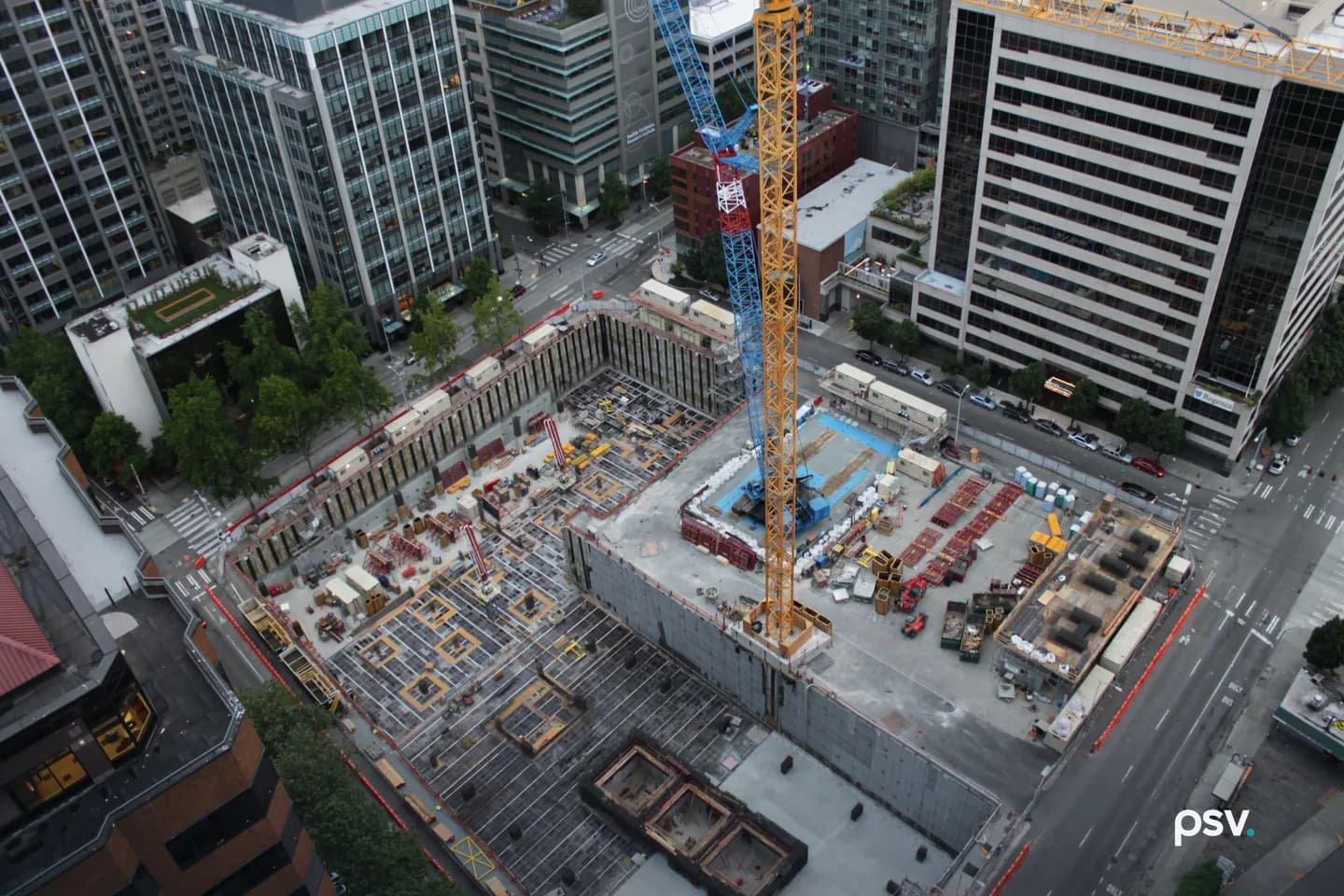
- SounderBruce, “8th & Howell hotel project under construction, aerial view, July 2016,” Wikimedia Commons, CC BY-SA 2.0 (lead photograph source)
Topics
Related PSV analysis
CRE PROPTECH NEWS
Autodesk Paid $3.53 Billion to Own the Work Order
Autodesk closed its acquisition of MaintainX on August 3 and filed the price and the debt behind it on August 28. The company that sells the drawings for a building now sells the maintenance record too, and its Architecture, Engineering, Construction and Operations family just crossed half of quarterly revenue. PSV read the merger 8-K, the earnings release and the 10-Q.
CRE PROPTECH NEWS
CoStar Closed on Zonda. The Number That Matters Isn’t $800M.
CoStar Group completed its $800 million all-cash acquisition of Zonda on August 21 and furnished the press release to the SEC the same day on a Form 8-K. Zonda brings a lot-level new home construction database, homebuilder software, more than 3,000 customers, and the NewHomeSource.com and Livabl marketplaces. In 2025 it generated approximately $170 million of revenue at a 23 percent Adjusted EBITDA margin, the company says.
CRE PROPTECH NEWS
RealPage Acquires Cherre: The CRE Data Consolidation Read
RealPage says it has acquired Cherre, the data intelligence platform institutional owners use to resolve more than 4 billion entities across roughly $4 trillion in real assets. Terms were not disclosed. The companies promise operational independence and an open platform. For operators, the durable question is contractual: who now owns the pipes your portfolio data runs through, and on what terms.
Related guides
Cornerstone PSV guides on the workflows in this article.
Best AI Tools for Commercial Real Estate
The pillar guide to choosing CRE AI tools by workflow fit and control, not vendor hype.
Read the guideClaude Engineering Partner for CRE
What it means to run Claude with an engineering partner: the operating model, the controls, and who owns what.
Read the guideProptech AI
What proptech AI means, where artificial intelligence actually works in real estate, and what separates useful proptech AI from the hype.
Read the guideby PSVLiveYou read the operator view. Now learn to run the workflow.
The AI MBA for commercial real estate: the workflows these briefs describe, taught end to end on real deal files, with live builds and a community of CRE operators.