CRE CAPITAL NEWS
Prologis’ $18.8B SEGRO Deal: Power Is the Asset
Prologis agreed on August 4 to acquire SEGRO plc in a recommended share offer with a partial cash alternative, valuing SEGRO at approximately $18.8 billion. The press release sells European scale: 368 million square feet and a 126 percent larger European land bank. The Rule 2.7 announcement filed with the SEC names the thing scale does not describe, which is 2.5 GVA of power.
Direct answer
Direct answer to Prologis SEGRO acquisition data centre power rights
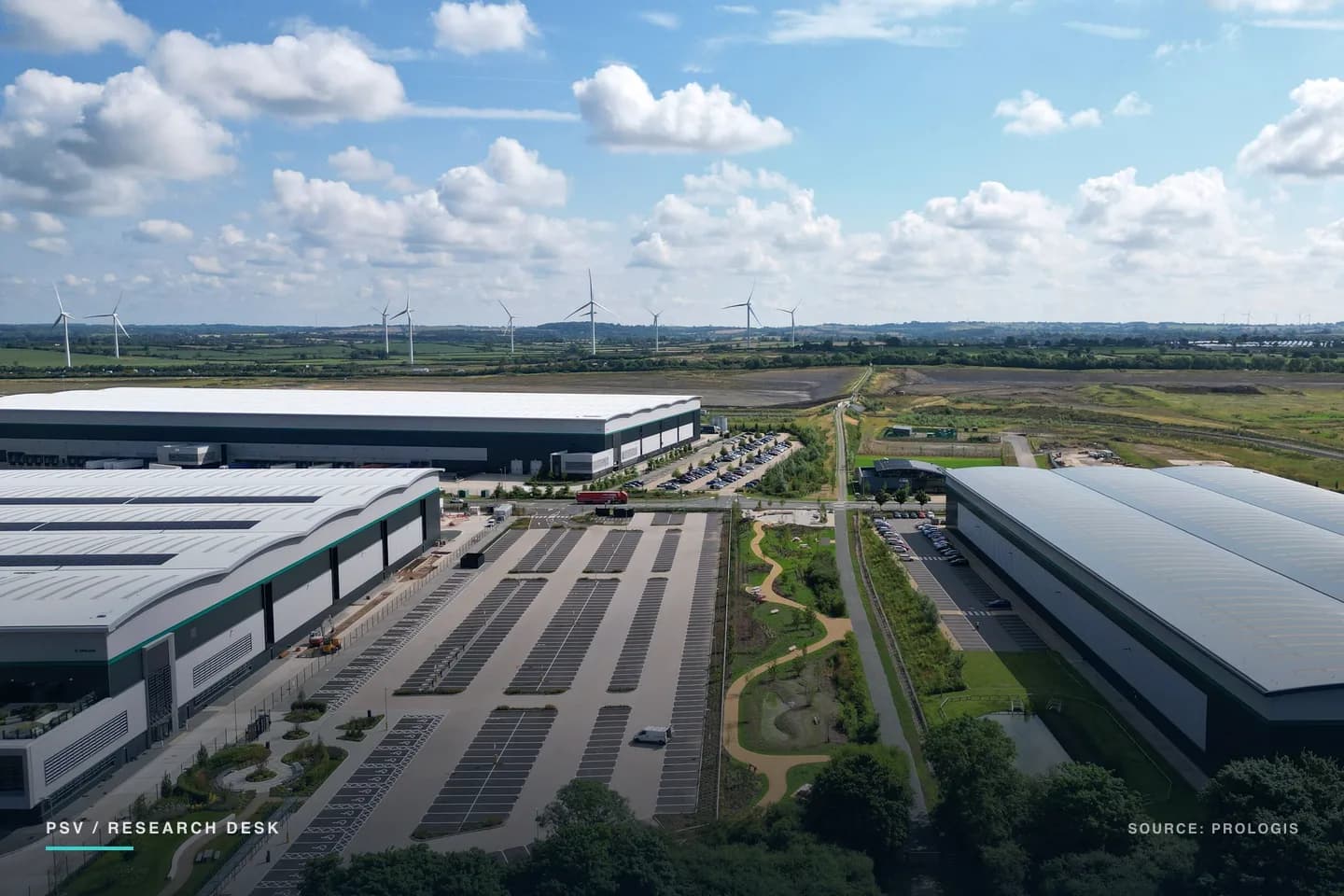
SEGRO carries a 1.4 GVA medium-term data centre pipeline plus 1.1 GVA of reserved power, and Europe’s largest data centre cluster sits on its Slough Trading Estate. Prologis is buying a 117 million square foot industrial portfolio and a grid queue position in the same trade. Prologis’ own deal documents list power rights as an asset category alongside standing buildings and land. Almost no rent roll has a field for it.
What Prologis and SEGRO announced
On August 4, 2026, Prologis, Inc. (NYSE: PLD) told the SEC in a Form 8-K that it had issued an announcement under Rule 2.7 of the United Kingdom City Code on Takeovers and Mergers setting out the terms of a recommended offer for the entire issued and to be issued share capital of SEGRO plc (LSE: SGRO), and that the two companies had signed a co-operation agreement the same day. SEGRO shareholders receive 0.0920 new Prologis shares for each SEGRO share, with a partial cash alternative capped at £3,509,777,110.70. The basic entitlement is 25 percent of a fixed price of 1,031.7 pence per SEGRO share, so a holder taking only the basic entitlement receives 258 pence in cash and 0.0690 new Prologis shares. On the announcement’s own figures that values SEGRO’s entire issued and to be issued ordinary share capital at approximately £14.0 billion, or approximately £14.3 billion including the 2026 final dividend shareholders keep. Prologis’ press release puts it at approximately $18.8 billion, and £14.0 billion at the 1.3438 exchange rate the announcement uses computes to roughly $18.81 billion, so the two records agree. One small inconsistency sits in the primary record itself: the Prologis press release page is headed “Published on August 3, 2026” while the release is datelined August 4 and the 8-K reports the announcement as made on August 4.
The price took six weeks and three rejections to reach. Prologis made an indicative all-share proposal on June 16, 2026 at 0.084 new shares per SEGRO share, implying about 925 pence, which the SEGRO board rejected, and two further proposals were rejected before the board recommended the one Prologis announced as best and final on July 22. At 1,031.7 pence the consideration is a premium of approximately 39.0 percent to SEGRO’s 742 pence close on June 23, 2026, the day before the offer period opened, and approximately 14.4 percent to SEGRO’s EPRA net tangible assets of 902 pence per share at June 30, 2026. That headline was struck on July 21 prices, and the announcement is candid that it had already moved: using the August 3 Prologis close of $144.15 and the same exchange rate, it computes the package at 998.1 pence for a holder electing the basic cash entitlement. PSV’s own arithmetic on those inputs reproduces the figure, at 0.0690 shares worth $9.95 or roughly 740 pence plus 258 pence of cash, and the all-share election on the same day computes to roughly 987 pence. SEGRO holders would end up with approximately 8.9 percent of the combined company. Completion is expected in the first half of 2027, subject to SEGRO shareholder approvals, sanction of the scheme by the court, regulatory clearances, and admission of Prologis shares to a secondary listing on the London Stock Exchange. Prologis shareholders do not vote.
The cash side is already funded, and the filings show how. Prologis says the partial cash alternative will be paid from a committed term loan facility together with existing liquidity and other available sources. Separately, inside the same week, Prologis sold 15,000,000 shares of common stock in an underwritten offering that closed on August 5, with J.P. Morgan Securities taking 8,250,000 shares and BofA Securities 6,750,000. The prospectus supplement puts net proceeds at approximately $2.1 billion, or approximately $2.4 billion if the underwriters exercised their option in full, and states the proceeds go to general corporate purposes “including to fund potential acquisitions such as SEGRO.” On August 6 Prologis told the SEC that the underwriters had exercised that option for the full 2,250,000 additional shares, for approximately $312.2 million of net proceeds, closing August 7. Those figures compute to roughly $138.80 per share after the underwriting discount, and they lift shares outstanding from 933,081,098 before the offering to 950,331,098. Against a maximum cash alternative of £3.5 billion, which at 1.3438 computes to roughly $4.7 billion, the equity raise covers a little over half.
Why a CRE operator should care
The press release sells square footage. The combination would hold approximately $269 billion of assets under management, create a European operating portfolio of 368 million square feet, expand Prologis’ European footprint by 47 percent, establish a combined European development pipeline of 13 million square feet, and increase Prologis’ European land bank by 126 percent. Those disclosures check out against each other: 368 million divided by 1.47 computes to roughly 250 million square feet of existing Prologis European space, and SEGRO’s 117 million square feet, which SEGRO reports as 10.9 million square metres, closes the gap almost exactly. But the line that matters in the highlights list is the last one, which says the deal will “expand long-term growth opportunities across logistics, energy and digital infrastructure.” The press release puts no numbers behind it. The Rule 2.7 announcement does.
SEGRO’s portfolio is 65 percent weighted to urban locations, and the announcement says that includes “8 per cent in a growing data centre portfolio which includes Europe’s largest data centre cluster on the Slough Trading Estate.” Eight percent of the £21.7 billion of assets under management SEGRO reported at June 30, 2026 computes to roughly £1.7 billion of standing data centre assets, which by itself is not a reason to pay a 39 percent premium. The pipeline is. The announcement’s sourcing notes state that SEGRO’s medium-term pipeline is 1.4 GVA and its long-term pipeline is 2.5 GVA, the difference being an additional 1.1 GVA of reserved power, both taken from SEGRO’s half year results. Read that as roughly two to three gigawatt-class campuses’ worth of grid position in the most supply-constrained data centre market in Europe. One caution on the unit, because operators and press releases blur it: GVA is gigavolt-amperes, a measure of apparent power, and it is not interchangeable with gigawatts. The real power a site can deliver depends on power factor and is lower.
The buyer is built for this, and says so in the same document. Prologis discloses a dedicated data center team of more than 75 people, a development team of more than 250, an in-house energy team of more than 175 and a procurement team of more than 35, alongside a land bank it puts at $40.6 billion of total expected investment potential that it says includes redevelopment into data centres. Then comes the sentence to sit with. Prologis says its Post-Completion Review, which it intends to finish within roughly six months of closing, will evaluate SEGRO’s “industrial, logistics and data center portfolio (including standing assets, land bank and power rights).” Power rights appear in the deal documents of the largest logistics REIT in the world as a distinct category of asset, listed beside buildings and land. Very few rent rolls, valuation models or asset management systems have a field for it, which means most owners cannot currently answer, from their own records, how many megavolt-amperes they control and when those connections energise.
The workflow PSV would run
If power rights are an asset category, they need a file, and almost nobody has one. This is the work PSV would build for an owner, a bidder or a lender looking at any European or US industrial portfolio where part of the upside runs through data centre conversion. The inputs are records rather than opinions: the utility connection offer or capacity agreement for each site with its stated MVA and its expiry, network operator queue registers and connection-date allocations, substation and feeder capacity filings, planning consents and the conditions attached to them, wayleaves and easements for cable routes and water, existing lease encumbrances and any covenant that blocks a change of use, and the site’s own metered demand history. The output is one evidence card per site that answers four questions and nothing else: how many MVA are contracted, how many are reserved, what the energisation date is, and what conditions still sit between the site and that date, with every attribute linked to the document it came from and the date it was pulled. The reviewer is the development or investment lead. The approval gate is that no site advances to a bid, a valuation adjustment or a term sheet until a person has confirmed the connection position directly with the network operator in writing, because reserved capacity is the fastest-decaying number in the file.
The second workflow is the unglamorous one this deal makes urgent, which is portfolio integration. A combination on this scale puts two lease databases, two development pipelines, two sets of energy contracts and two valuation conventions into the same reporting stack, against a stated review clock of about six months. What PSV would run there is extraction and reconciliation with citations: pull the commercial terms out of both lease sets and both sets of power agreements, normalise them into one schema, and produce an exception report of every field where the two systems disagree, with a link to the underlying document on each side. The output is not a merged database. It is a queue of disagreements ranked by dollar exposure, for a person to resolve. Anyone who has integrated a portfolio knows the failure mode is not missing data. It is that both systems were confidently wrong in different ways, and nobody could see it until a rent review or a connection deadline landed.
What stays human, and what is still unknown
The operator read
Finish with the judgment call.
The reported facts are above. Enter your email for PSV's operator conclusion and a year of access to every newsroom brief.
Free. No card. Privacy policy. Unsubscribe anytime.
 by PSVLive
Build the workflow behind this analysis. Train with the operators doing it.
Real deal files, live builds, and production-ready CRE AI workflows inside the CRE AI Institute.











Clear answers
Common questions about Prologis SEGRO acquisition data centre power rights
What are the terms of the Prologis acquisition of SEGRO?
Prologis told the SEC on August 4, 2026 that it had issued a Rule 2.7 announcement under the UK City Code setting out a recommended offer for the entire issued and to be issued share capital of SEGRO plc, and that the parties signed a co-operation agreement the same day. SEGRO shareholders receive 0.0920 new Prologis shares for each SEGRO share, with a partial cash alternative capped at £3,509,777,110.70. The basic entitlement is 25 percent of a fixed price of 1,031.7 pence per share, so a holder taking only the basic entitlement receives 258 pence in cash plus 0.0690 new Prologis shares. That values SEGRO at approximately £14.0 billion, or approximately £14.3 billion including the 2026 final dividend, which Prologis states as approximately $18.8 billion and which computes to roughly $18.81 billion at the 1.3438 exchange rate the announcement uses. The consideration is a premium of approximately 39.0 percent to SEGRO’s 742 pence close on June 23, 2026 and approximately 14.4 percent to EPRA net tangible assets of 902 pence at June 30, 2026. SEGRO holders would own approximately 8.9 percent of the combined company, and completion is expected in the first half of 2027 subject to SEGRO shareholder approvals, court sanction, regulatory clearances and a London Stock Exchange secondary listing. Prologis shareholders do not vote.
How much data centre power does SEGRO have, and why does it matter to the deal?
The Rule 2.7 announcement says SEGRO’s portfolio is 65 percent weighted to urban locations, including 8 percent in a growing data centre portfolio that contains Europe’s largest data centre cluster on the Slough Trading Estate. Its sourcing notes state that SEGRO’s medium-term pipeline is 1.4 GVA and its long-term pipeline is 2.5 GVA, the difference being an additional 1.1 GVA of reserved power, both figures drawn from SEGRO’s half year results. Eight percent of the £21.7 billion of assets under management SEGRO reported at June 30, 2026 computes to roughly £1.7 billion of standing data centre assets, so the standing portfolio alone does not explain the premium and the pipeline is the strategic piece. One unit caution: GVA is gigavolt-amperes, a measure of apparent power, and it is not interchangeable with gigawatts, since real power depends on power factor and is lower. Prologis says its Post-Completion Review will evaluate SEGRO’s industrial, logistics and data center portfolio including standing assets, land bank and power rights, which puts power rights in the deal documents as a distinct asset category alongside buildings and land.
How is Prologis paying for the SEGRO acquisition?
Prologis says the cash consideration under the partial cash alternative will be funded through a committed term loan facility together with existing liquidity and other available sources of funding. Separately, in the same week, Prologis sold 15,000,000 shares of common stock in an underwritten offering that closed on August 5, 2026, with J.P. Morgan Securities taking 8,250,000 shares and BofA Securities 6,750,000. The prospectus supplement puts net proceeds at approximately $2.1 billion, or approximately $2.4 billion with the underwriters’ option exercised in full, for general corporate purposes including to fund potential acquisitions such as SEGRO. Prologis told the SEC on August 6 that the underwriters exercised that option in full for 2,250,000 additional shares, for approximately $312.2 million of net proceeds, closing August 7. Those figures compute to roughly $138.80 per share after the underwriting discount and lift shares outstanding from 933,081,098 before the offering to 950,331,098. Against a maximum cash alternative of £3.5 billion, which computes to roughly $4.7 billion at 1.3438, the equity raise covers a little over half. Prologis says it expects to maintain A2 and A credit ratings.
Primary source record
These records support the reported facts in this brief. PSV’s CRE workflow interpretation and test plan are original analysis.
- Prologis, Inc., Form 8-K reporting the Rule 2.7 announcement and co-operation agreement, filed August 4, 2026
- Prologis and SEGRO, Rule 2.7 firm intention announcement, Exhibit 2.1 to the Form 8-K
- Prologis, “Prologis Announces Recommended Acquisition of SEGRO plc”, August 2026
- Prologis, Inc., prospectus supplement for the 15,000,000 share common stock offering, filed August 5, 2026
- Prologis, Inc., Form 8-K on exercise of the underwriters’ option, filed August 6, 2026
Topics
Related PSV analysis
CRE CAPITAL NEWS
Brookfield’s Record $77B Quarter: Real Estate Took 5.6 Percent
Brookfield Asset Management furnished its second quarter results to the SEC on August 6, reporting a record $77 billion raised in the quarter and more than $1 trillion of assets under management. Read the segment lines and the story changes. Real estate strategies took $4.3 billion of that, roughly 5.6 percent, while credit took $51 billion and AI infrastructure got a fund of its own.
CRE CAPITAL NEWS
Csquare Raised $1.05B. The Data Center Market Is Asking for Proof.
Brookfield-backed Csquare priced its initial public offering at $21 a share, below its marketed $23 to $27 range, raising $1.05 billion rather than the $1.35 billion implied at the top end. The result does not erase demand for digital infrastructure. It does put a sharper public-market price on leverage, delivery, and the difference between a data center story and a data center cash flow.
CRE POLICY NEWS
New York’s Hyperscale Data Center Moratorium: The CRE Read
Governor Kathy Hochul signed Executive Order 62 on July 14, pausing state environmental permits for new hyperscale data centers of 50 megawatts or more for up to one year while New York writes a statewide environmental study and new development standards. It is the first statewide freeze in the country, and it lands on the hottest development pipeline in commercial real estate.
Related guides
Cornerstone PSV guides on the workflows in this article.
AI for Real Estate Investing
How commercial real estate investors use AI across the deal lifecycle: sourcing, underwriting, due diligence, and asset management, grounded in real documents.
Read the guideIndustrial & Logistics AI Underwriting
Custom AI employees for industrial real estate underwriting. WALT analysis, tenant credit, clear-height and power modeling, and lender packages.
Read the guideClaude for Real Estate Developers
The ground-up developer field guide: site selection through IC memo, built on a real development deal.
Read the guideby PSVLiveYou read the operator view. Now learn to run the workflow.
The AI MBA for commercial real estate: the workflows these briefs describe, taught end to end on real deal files, with live builds and a community of CRE operators.