CRE POLICY NEWS
SpaceX’s Terafab Suit Tests What a Texas Incentive File Keeps Secret
SpaceX has sued Texas Attorney General Ken Paxton and Grimes County to stop the county releasing records behind the incentives for Terafab, its planned chip plant, including its tax abatement application. Much of the deal is already public: eight state JETI filings with an estimated $1.66 billion in school tax benefit, and county agreements that set its county tax payments at $20 million a year for a decade, then cap them there through 2061.
Direct answer
Direct answer to SpaceX Terafab public records lawsuit
The fight is over the negotiating file, not the deal. The executed terms are posted: Grimes County abates 100 percent of county taxes on the plant for 2027 through 2036 in exchange for fixed $20 million payments, and SpaceX can walk on 30 days’ notice. Texas law stops protecting information about an incentive once the agreement is made, and a company’s own figures stay sealed only if the company proves the harm.
What SpaceX is fighting over, and what is already public
Space Exploration Technologies Corp. has sued Texas Attorney General Ken Paxton, in his official capacity, and Grimes County to keep the county from releasing records about Terafab, the semiconductor plant SpaceX plans to build there. The Texas Lawbook reported the case as Cause No. D-1-GN-26-008509 in Travis County district court, and KBTX reported that the petition asks for a temporary restraining order and an injunction over SpaceX’s complete tax abatement application, its term proposals and negotiating correspondence, project design information, site location and land acquisition records, and cost and financial data. Outlets date the filing between September 8 and September 10. PSV did not obtain the petition, so its contents here are as reported. The rulings it answers are public. In Open Records Letter No. OR2026-032116, dated July 28, 2026, the Attorney General’s office answered Grimes County on four requests from two requestors for information regarding tax abatements. The ruling let the county withhold marked attorney-client communications under Section 552.107 and ordered the rest released, including a public meeting agenda. It declined to consider the county’s trade secret and proprietary information arguments under Sections 552.110 and 552.1101, because those exceptions protect private parties that provide information, not the governmental body. It rejected anticipated litigation under Section 552.103 and the deliberative process privilege under Section 552.111, noting that a governmental body shares no privity of interest with a party it is negotiating a contract with. And it found the county had not shown the remaining records reveal an incentive being offered under Section 552.131(b), a protection it said belongs to governmental bodies and ends once an agreement is made. A second ruling, OR2026-037351, dated August 24, reached the same result on a request the county received June 3 and added that the county had missed its 15 business day deadline to submit the records, which under Section 552.302 makes them presumptively public. Neither ruling names SpaceX or Terafab or records any submission from the company, so tying them to this suit rests on their dates, their subject and the reporting. Bisnow reported that SpaceX argues it was not told of the requests until July 2, which goes to the good faith notice Section 552.305(d) says a governmental body must attempt within 10 business days.
The deal itself is on the public record in two places. At the state level, TeraFab AI, LLC filed eight applications under the Texas Jobs, Energy, Technology and Innovation Act, one per school district for each of four phases: J0035 to J0038 in Anderson-Shiro CISD and J0039 to J0042 in Iola ISD, posted by the Comptroller on June 8, 2026. The application describes a vertically integrated semiconductor manufacturing and advanced computing campus led by a consortium including Tesla, SpaceX and xAI Corp., calls it an investment in “advanced artificial intelligence (AI) infrastructure,” and puts total capital investment for the four phases between $55 billion and $119 billion. On June 15, Deputy Comptroller Lisa Craven signed letters recommending approval of a 50 percent limitation on school district maintenance and operations taxable value for each application, and the executed agreements were posted between August 21 and August 25. The Comptroller’s estimates of gross tax benefit run from $82,255,197 for Phase 1 in Iola ISD to $335,835,404 for each of Phases 2 and 3 in Anderson-Shiro CISD, and the eight sum to $1,660,434,060, which is PSV’s arithmetic on the eight recommendation packets. At the county level, Grimes County posted a fully executed Chapter 312 tax abatement agreement and a Section 381.004 economic development agreement with Space Exploration Technologies Corp., both effective June 3, 2026. The abatement is 100 percent of county ad valorem taxes on the improvements and on new tangible personal property for tax years 2027 through 2036. In exchange SpaceX pays a $10 million nonrefundable upfront payment and annual payments in lieu of taxes of $20 million for each of those ten years, due regardless of the assessed value, and commits to invest at least $5 billion by December 31, 2030 and create 1,800 full-time equivalent jobs by December 31, 2035, with a default only below 90 percent of either. The companion agreement then pays SpaceX an annual grant from 2037 through 2061 equal to the county taxes it pays minus $20 million, not less than zero.
The operator read: an incentive file is public by default
Texas draws the line in a place most development teams do not plan around, and the two rulings apply it plainly. Section 552.131 of the Government Code excepts a business prospect’s trade secrets, and its commercial or financial information when specific factual evidence shows disclosure would cause substantial competitive harm, but information about an incentive being offered is excepted only until an agreement is made; after that, information about an incentive offered by the governmental body is no longer excepted. Grimes County’s agreements with SpaceX took effect June 3, the same day the county received the request decided in August. The company’s own protection has to be claimed by the company. Section 552.305 lets a governmental body holding a third party’s information ask the Attorney General for a decision, requires it to make a good faith attempt to notify that party within 10 business days, and lets the party submit its own reasons. Section 552.1101 says only the vendor or contractor itself may assert the proprietary information exception, and the July ruling set aside the county’s trade secret arguments on exactly that ground. If the company then sues to withhold, Section 552.325 puts the suit against the Attorney General in Travis County district court and entitles the requester to intervene. The same summer shows the timing rule cutting the other way: on August 20, in OR2026-036686, the Attorney General let Grimes County withhold information about an unnamed project under Section 552.131(b) because its negotiations had not produced a final agreement. The state file sits under different rules again. Section 403.621, part of the JETI statute, makes a trade secret an applicant provides under that subchapter to the Comptroller, the Governor or a school district confidential and outside the Public Information Act. It does not name counties, and PSV found no clause on public information requests in either county agreement. The Comptroller’s packet shows how the applicant used the state route: it records that “supporting documentation was provided as confidential information for the competitive site selection,” and lists financial models showing IRR sensitivity to property taxes, third-party site selection consultant reports and executive affidavits among the confidential material.
For an operator, the consequence runs both ways. On the buy side, the executed documents say more than the coverage. Grimes County’s abatement is 100 percent on its face but is priced as a fixed payment: $20 million a year whatever the plant is assessed at, followed by a grant structure that caps the county’s net take at $20 million a year through 2061. If every payment is made in full, the county’s receipts compute to as much as $710 million over 35 years, PSV’s arithmetic, and less in any grant year when county taxes fall below $20 million. Section 10.13 lets SpaceX terminate at any time on 30 days’ written notice, after which it owes payments for years already begun, repays abated taxes for no more than three years net of those payments, and owes no 2027 payment if it leaves before June 1, 2027. Anyone valuing land, housing or industrial space around a megaproject should underwrite against that exit right, not against a $119 billion ceiling. On the development side, the lesson is procedural. Anything a company hands a county during an incentive negotiation should be assumed to become readable once the agreement is made, unless the company has marked it, argued it and, if needed, litigated it. The public JETI application already shows what leaks without that effort: the applicant wrote that the school tax limitation would cut its effective tax burden by about 48 percent. That is a company claim in a public filing, not a PSV finding, and every competing site and future counterparty can now read it.
The workflow PSV would run on an incentive negotiation file
The useful artifact is a disclosure register kept alongside every incentive negotiation a firm runs, one row per document handed to a public body. Inputs: the draft and executed agreements; every application, supplement and exhibit, with the date and the body that received it, since for a Texas deal the Comptroller, the Governor’s office, each school district and each county are separate holders under separate rules; the correspondence log; and the text of Sections 552.131, 552.305, 552.1101, 552.325 and 403.621. Output: columns that decide something. The holder. The statute the document was provided under. Whether it contains a trade secret, commercial or financial information, or information about an incentive, with the specific factual evidence of competitive harm drafted in advance rather than after a request arrives. Whether the agreement has been made, because that date changes what Section 552.131 protects. Whether the holder has committed in writing to notify the company of a request, with the 10 business day notice window from Section 552.305(d) calculated for each. And a public version of each record, drafted before anyone asks for it. For a counterparty reading someone else’s deal, the same register runs in reverse, built from the Comptroller’s JETI application pages and the county’s posted agreements: payment schedules, investment and job floors, cure thresholds, termination rights and recapture terms, each extracted clause by clause and cited to page.
The reviewer is development counsel, with the deal lead signing each confidentiality designation. The approval gate is concrete: nothing goes to a county, district or agency until its register row exists and a named person has signed what is marked confidential and why. An assistant handles the volume well: reading 200 page recommendation packets, pulling the summary figures across eight applications, transcribing scanned county agreements, and diffing an executed agreement against the way it was reported, which is how the gap between a 100 percent abatement and a fixed $20 million payment surfaced in this brief. It should not decide whether a figure is a trade secret, whether disclosure would cause substantial competitive harm, or whether to sue; those are legal judgments that need a record behind them. PSV ran no model on this record, tested no product, and promises no tax, schedule or litigation outcome. The county agreements are posted as scanned images and PSV read them through machine transcription, so any figure quoted from them should be checked against the signed page before anyone relies on it.
What stays with a person, and what is still open
The operator read
Finish with the judgment call.
The reported facts are above. Enter your email for PSV's operator conclusion and a year of access to every newsroom brief.
Free. No card. Privacy policy. Unsubscribe anytime.
 by PSVLive
Build the workflow behind this analysis. Train with the operators doing it.
Real deal files, live builds, and production-ready CRE AI workflows inside the CRE AI Institute.











Clear answers
Common questions about SpaceX Terafab public records lawsuit
What tax incentives did SpaceX get for Terafab in Texas?
Two sets, from two levels of government, and both are posted. Grimes County’s Chapter 312 tax abatement agreement with Space Exploration Technologies Corp., effective June 3, 2026, abates 100 percent of county ad valorem taxes on the plant’s improvements and new tangible personal property for tax years 2027 through 2036. In exchange SpaceX pays a $10 million nonrefundable upfront payment and $20 million a year in payments in lieu of taxes for those ten years, due regardless of assessed value, and must invest at least $5 billion by December 31, 2030 and create 1,800 full-time equivalent jobs by December 31, 2035. A companion Section 381.004 agreement then grants SpaceX, each year from 2037 through 2061, the county taxes it pays minus $20 million, not less than zero. SpaceX may terminate the abatement on 30 days’ notice. At the state level, TeraFab AI, LLC holds eight agreements under the Texas Jobs, Energy, Technology and Innovation Act, one per phase in each of Anderson-Shiro CISD and Iola ISD, each limiting school district maintenance and operations taxable value by 50 percent for ten years. The Comptroller’s June 15, 2026 recommendation packets estimate the gross tax benefit of each, and the eight sum to $1,660,434,060 on PSV’s arithmetic. Those are estimates built from values the applicant supplied, and the county figures here were read from scanned documents by machine transcription.
Are economic development incentive records public in Texas?
Some are and some are not, and the dividing line is the signature. Section 552.131 of the Texas Government Code excepts information about a financial or other incentive being offered to a business prospect only until an agreement is made, and the Attorney General’s office has said that protection belongs to the governmental body, not the company. A company’s trade secrets and commercial or financial information can still be withheld, but under Sections 552.110 and 552.1101 those exceptions protect the private party that supplied the information, so the company has to assert them; in its July 28, 2026 ruling to Grimes County on tax abatement records, the Attorney General declined to consider the county’s arguments under both for that reason. Section 552.305 requires the governmental body to make a good faith attempt to notify the company within 10 business days of a request, and Section 552.325 sends any suit to withhold to Travis County district court. Deadlines bind the public body too: in an August 24 ruling, the county’s late submission made the records presumptively public. At the state level, Section 403.621 of the JETI statute makes trade secrets an applicant gives the Comptroller, the Governor or a school district confidential outright, and the Comptroller’s Terafab packet records that the applicant’s site selection documentation was provided confidentially.
Why is SpaceX suing Ken Paxton and Grimes County?
To stop Grimes County from releasing records SpaceX considers competitively sensitive. As reported by KBTX and The Texas Lawbook, the petition in Cause No. D-1-GN-26-008509 in Travis County district court names Attorney General Ken Paxton in his official capacity and the county, seeks a temporary restraining order and an injunction, and covers SpaceX’s complete tax abatement application, term proposals and negotiating correspondence, project design, site and land acquisition records, and cost and financial data. Bisnow reported that SpaceX says it was not notified of the requests until July 2. PSV did not obtain the petition. The rulings it follows are public. On July 28, 2026, in OR2026-032116, the Attorney General’s office let the county withhold some attorney-client communications on four tax abatement requests and ordered the rest released, rejecting the county’s litigation, deliberative process and economic development arguments and declining to consider its trade secret arguments because those belong to the business. On August 24, in OR2026-037351, it reached the same result on another request and found the county had missed its deadline to submit the records. Neither ruling names SpaceX or records a submission from it.
Primary source record
These records support the reported facts in this brief. PSV’s CRE workflow interpretation and test plan are original analysis.
- Texas Comptroller of Public Accounts, JETI Application Details, J0035, Anderson-Shiro CISD, TeraFab AI, LLC (posting dates for the application, supplements, recommendation packet and agreement; J0036 to J0042 carry the same structure)
- TeraFab AI, LLC, JETI Application J0035, Project Description, posted June 8, 2026 (source of the Tesla, SpaceX and xAI consortium, the “advanced artificial intelligence (AI) infrastructure” description, the four phases, the $55 billion to $119 billion range, the eight applications and the approximately 48 percent effective tax burden claim)
- Texas Comptroller of Public Accounts, Recommendation Packet for Application J0035, letter dated June 15, 2026 (source of the 50 percent limitation, Phase 1 construction and incentive years, the $129,797,081 gross tax benefit, the rescission condition, the county population figure, and the confidential site selection documentation and Arizona claim)
- Texas Comptroller of Public Accounts, Recommendation Packet for Application J0039, Iola ISD, letter dated June 15, 2026 (one of the eight packets summed for the $1,660,434,060 total; the others are posted at the same path for J0036 to J0038 and J0040 to J0042)
- Grimes County, Tax Abatement Agreement between Grimes County, Texas and Space Exploration Technologies Corp., fully executed, effective June 3, 2026 (source of the 100 percent abatement for 2027 through 2036, the $20 million annual payments, the $10 million upfront payment, the $5 billion and 1,800 job requirements, the 90 percent default threshold and the Section 10.13 termination right)
- Grimes County, Section 381.004 Economic Development Program and Agreement with Space Exploration Technologies Corp., fully executed, effective June 3, 2026 (source of the 2037 through 2061 grants equal to county taxes paid minus $20 million)
- Office of the Attorney General of Texas, Open Records Letter No. OR2026-032116 to Grimes County, July 28, 2026 (source of the four tax abatement requests, the Section 552.107 withholding, the release order, and the treatment of Sections 552.103, 552.110, 552.1101, 552.111, 552.131 and 552.153)
- Office of the Attorney General of Texas, Open Records Letter No. OR2026-037351 to Grimes County, August 24, 2026 (source of the June 3, 2026 request, the missed 15 business day deadline and Section 552.302 presumption, and the release order)
- Office of the Attorney General of Texas, Open Records Letter No. OR2026-036686 to Grimes County, August 20, 2026 (source of the Section 552.131(b) withholding for an unnamed project without a final agreement)
- Office of the Attorney General of Texas, Public Information Act Decision Database (source of the Grimes County request records, their asserted exceptions and dates, and the three Grimes County requests still open)
- Texas Government Code, Chapter 552, Public Information (Sections 552.131, 552.305, 552.325 and 552.1101)
- Texas Government Code, Chapter 403, Subchapter T, Texas Jobs, Energy, Technology and Innovation Act (Section 403.621, confidentiality of certain business information)
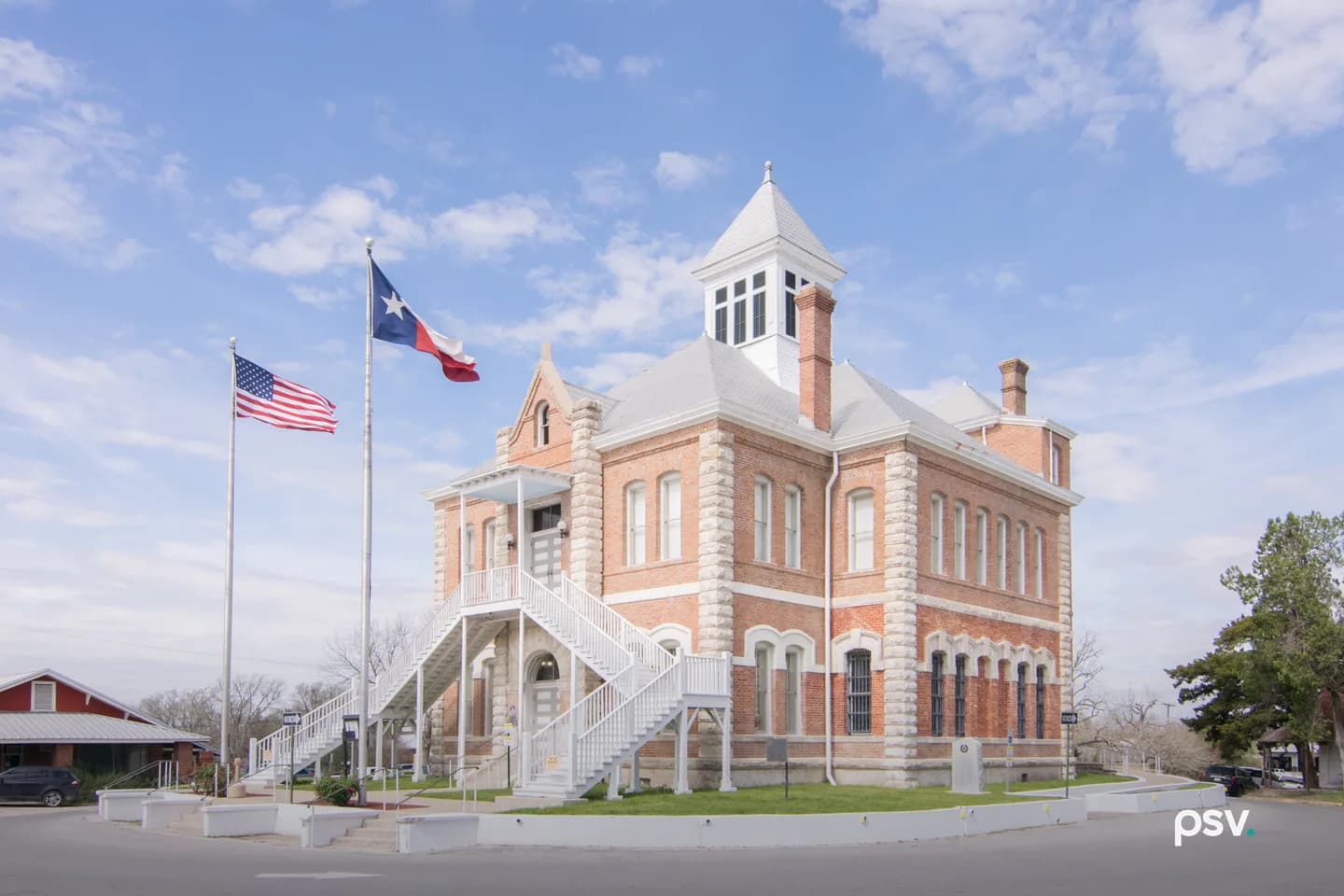
- Patrick Feller, “Grimes County Courthouse, Anderson, Texas,” Wikimedia Commons, CC BY 2.0 (lead photograph source)
Topics
Related PSV analysis
CRE POLICY NEWS
Massachusetts’ Data Center Order Puts a Contract Before the Permit
Governor Maura Healey signed Executive Order No. 658 on September 8, barring MassDEP, the Energy Facilities Siting Board, the MEPA Office and other permitting agencies from issuing any permit to a data center above 25 megawatts of peak demand until it conforms with her June 25 framework and files a community benefits agreement reviewed by the state’s environmental justice office. It also orders a clean energy mandate with a payment alternative.
CRE POLICY NEWS
Texas Paused the Data Center Grid Queue, and the Gate Is Paperwork
Governor Greg Abbott directed a verification and audit of every data center advancing through ERCOT’s interconnection process on August 3. The Public Utility Commission of Texas made it operative on August 20, granting ERCOT good cause exceptions that suspend Batch Zero classification deadlines. ERCOT then told the market it intends to issue conditional classifications by August 31. PSV read the letter, the order and ERCOT’s filed presentation.
CRE POLICY NEWS
Pennsylvania’s Data Center Order Turns on One Number
Governor Josh Shapiro signed Executive Order 2026-05 on August 18, directing Commonwealth agencies to hold every data center proposal with peak demand over 25 megawatts to the Governor’s Responsible Infrastructure Development Requirements. Data centers come out of the Permit Fast Track Program entirely, and the Department of Environmental Protection will not issue a permit until a project has its local and municipal approvals in hand.
Related guides
Cornerstone PSV guides on the workflows in this article.
Claude for Real Estate Developers
The ground-up developer field guide: site selection through IC memo, built on a real development deal.
Read the guideAI for Real Estate Investing
How commercial real estate investors use AI across the deal lifecycle: sourcing, underwriting, due diligence, and asset management, grounded in real documents.
Read the guideWhat is CRE AI?
The definitional guide to commercial real estate AI: the core workflows, how it differs from a chatbot, and how to learn it.
Read the guideby PSVLiveYou read the operator view. Now learn to run the workflow.
The AI MBA for commercial real estate: the workflows these briefs describe, taught end to end on real deal files, with live builds and a community of CRE operators.