CRE CAPITAL NEWS
CenterPoint Wrote Data Centers Into Its Covenants
On September 9, 2026 CenterPoint Energy and three subsidiaries replaced four revolving credit facilities with new ones totaling $4.6 billion. The new agreements add a defined term the December 2022 versions did not contain anywhere: Data Center Development Indebtedness, which is subtracted from the debt the banks measure in the leverage covenant. The definition names synthetic leases and built to suit lease financings.
Direct answer
Direct answer to Data Center Development Indebtedness
No money moved and no project was named. What changed is permission. CenterPoint’s banks agreed that debt raised to build energy assets serving data centers can sit outside the 67.5 percent leverage test, if a rating agency treats it as equity or it is non-recourse, and that up to $1.0 billion of property can be transferred into joint ventures to facilitate that work. The structures the definition names are real estate structures.
What CenterPoint filed on September 9
CenterPoint Energy, Inc. filed an 8-K on September 9, 2026 reporting that it and its subsidiaries CenterPoint Energy Houston Electric, LLC, CenterPoint Energy Resources Corp. and Southern Indiana Gas and Electric Company “replaced their existing revolving credit facilities with four revolving credit facilities totaling $4.6 billion in aggregate commitments,” with no termination penalties on the facilities they replaced, all of which had been entered into on December 6, 2022. The parent’s facility went from $2.4 billion to $2.2 billion, with an accordion to $2.5 billion and current pricing of Term SOFR plus 150 basis points. Houston Electric’s went from $300 million to $1.0 billion, with an accordion to $1.5 billion. CenterPoint Energy Resources went from $1.05 billion to $1.1 billion, and Southern Indiana Gas and Electric from $250 million to $300 million. All four are five-year senior unsecured revolvers. The leverage covenant is unchanged in form: debt to consolidated capitalization not above 67.5 percent at the parent and at Houston Electric, and 65 percent at the other two, with a temporary step up to 70 percent after certain storm damage.
The change is in the definitions. In the parent’s credit agreement, Consolidated Indebtedness for Borrowed Money is now computed “less (v) Non-Recourse Debt, less (vi) Data Center Development Indebtedness.” PSV pulled the December 6, 2022 agreement the new one replaces and searched it: the phrase “data center” does not appear in it once, and its version of the same definition stops at clause (v). The new agreement uses the term fourteen times. “Data Center Developments” is defined as financings “including, without limitation, project financings, synthetic leases, built to suit lease financings and other structured financings,” joint ventures and other equity and debt investments, “including, without limitation, structures involving assignments or dispositions of related real property,” to support building and operating energy generation assets and selling energy “in full or in material part to or for the benefit of one or more data center projects.” Debt qualifies for the carve-out only where a rating agency treats it as equity or partial equity, or where it is non-recourse. The same term appears in the permitted liens list as Data Center Development Liens, in an exclusion from Secured Indebtedness, in what holding companies may incur, in the negative pledge carve-outs, and in a basket letting the borrower and significant subsidiaries transfer “up to $1.0 billion” of property to subsidiaries “to facilitate Data Center Developments.”
Why a real estate operator should read a utility credit agreement
Utilities are the gating counterparty on every data center site, and the constraint is rarely engineering. It is balance sheet. A regulated utility that has to hold a leverage ratio cannot fund an unlimited amount of new generation for a single class of customer without either a rate case, an equity raise, or a structure that keeps the obligation off the tested ratio. What this filing shows is a utility and its bank group agreeing in advance on the third route, and describing it in the vocabulary of real estate rather than of power. Synthetic leases, built to suit lease financings, assignments of related real property and joint ventures are not generation-industry terms of art. They are the structures an owner, a developer and a credit tenant lender already use, now written into a utility’s bank documents for the purpose of serving data centers.
The scale CenterPoint has told investors about is the reason to care. Its first quarter 2026 investor presentation, filed April 23, states that “8GWs of data center load expected to be energized by 2029,” and shows firmly committed large industrial load rising from about 7.5 gigawatts at the fourth quarter of 2025 to about 12.2 gigawatts at the first quarter of 2026. The same deck lists data center related investments in Indiana among at least $10 billion of incremental capital opportunities. Those are the company’s own figures and forecasts, not PSV findings and not commitments. Set beside them, the covenant rewrite reads as preparation: Houston Electric, the wires company for the Houston market, more than tripled its revolver in the same filing. PSV did not find any CenterPoint statement linking that increase to data center load, and the company published no press release about the refinancing that PSV could locate.
The workflow PSV would run: a utility counterparty capacity read
The artifact is one memo per utility a firm depends on for a site, refreshed when that utility files. Inputs: the utility’s current credit agreements and their 8-K cover pages, the definitions of Consolidated Indebtedness and any carve-outs, the leverage covenant and its headroom, the permitted liens and asset transfer baskets, the most recent investor presentation with its load forecast and capital plan, and the rating agency reports if the firm has access. Output: for each utility, what it is permitted to fund off the tested ratio, how much property it may move into joint ventures, what conditions that permission carries, and where its own filings put the load it expects to serve.
The reviewer is whoever owns the capital relationship, a development lead or a portfolio manager, with finance counsel on the covenant mechanics. The approval gate: no site is underwritten as powered on the strength of a utility’s stated pipeline until that memo exists and names the structural route the utility has available. An assistant is well suited to this work, because it is document extraction at volume: diffing a new credit agreement against the one it replaces, pulling defined terms and baskets, and flagging language that appeared for the first time. That diff is exactly how this story surfaced. What an assistant should not do is conclude that a permission will be used, or price the credit.
What stays with a person, and what the record leaves open
The operator read
Finish with the judgment call.
The reported facts are above. Enter your email for PSV's operator conclusion and a year of access to every newsroom brief.
Free. No card. Privacy policy. Unsubscribe anytime.
 by PSVLive
Build the workflow behind this analysis. Train with the operators doing it.
Real deal files, live builds, and production-ready CRE AI workflows inside the CRE AI Institute.










Clear answers
Common questions about Data Center Development Indebtedness
What is Data Center Development Indebtedness?
It is a defined term CenterPoint Energy added to the credit agreements it signed on September 9, 2026. Debt and other obligations related to “Data Center Developments” are subtracted from Consolidated Indebtedness for Borrowed Money, the numerator of the leverage covenant, but only where a rating agency treats the obligation as equity, partial equity, intermediate equity or hybrid equity, or where the debt is non-recourse. “Data Center Developments” covers project financings, synthetic leases, built to suit lease financings, joint ventures and structures involving assignments or dispositions of related real property, in each case to support energy assets serving data center projects.
Did CenterPoint borrow money for data centers?
No. The September 9, 2026 8-K reports a refinancing: four revolving credit facilities totaling $4.6 billion in commitments, replacing facilities entered into on December 6, 2022. No amount of Data Center Development Indebtedness is disclosed as outstanding, no data center project or customer is named in the agreements, and PSV found no CenterPoint press release about the refinancing. What the documents create is permission and covenant treatment, not a drawdown.
Why does a utility credit agreement matter for commercial real estate?
Because the utility is the gating counterparty on a data center site and its constraint is usually balance sheet rather than engineering. These agreements show a utility and its banks agreeing in advance on how energy assets serving data centers can be funded outside the tested leverage ratio, using structures real estate already knows: synthetic leases, built to suit lease financings, joint ventures and transfers of real property, with a basket permitting up to $1.0 billion of property transfers to facilitate that work. CenterPoint told investors in April 2026 that it expects 8 gigawatts of data center load energized by 2029.
Primary source record
These records support the reported facts in this brief. PSV’s CRE workflow interpretation and test plan are original analysis.
- CenterPoint Energy, Inc., Form 8-K filed September 9, 2026, accession 0001104659-26-106356 (source of the four replacement facilities, the $4.6 billion aggregate, the facility-by-facility sizes and accordions, the pricing, the 67.5 and 65 percent covenants and the commercial paper resizing)
- CenterPoint Energy, Inc., Exhibit 10.1 to that 8-K, Third Amended and Restated Credit Agreement (source of the Data Center Developments and Data Center Development Indebtedness definitions, the clause (vi) subtraction, the Data Center Development Liens, the Secured Indebtedness exclusion and the $1.0 billion transfer basket)
- CenterPoint Energy, Inc., Second Amended and Restated Credit Agreement dated December 6, 2022, the agreement this one replaces (the control: the phrase “data center” appears nowhere in it and its Consolidated Indebtedness definition ends at clause (v))
- CenterPoint Energy, Inc., first quarter 2026 investor presentation filed April 23, 2026 (source of the 8 gigawatts energized by 2029 statement, the 7.5 to 12.2 gigawatt firmly committed large industrial load figures and the Indiana data center investment line)
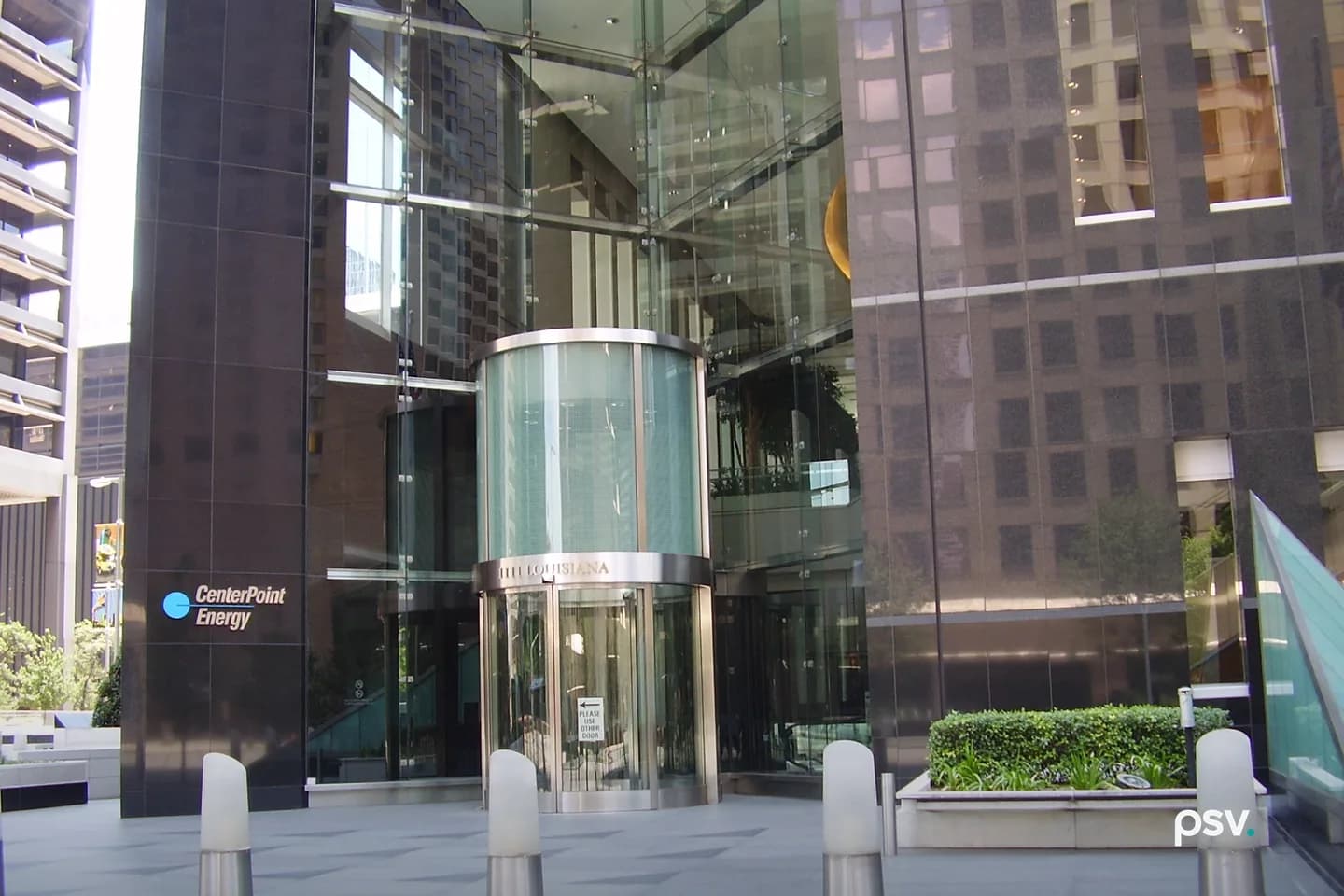
- WhisperToMe, “CenterPoint Energy headquarters, Houston,” Wikimedia Commons, public domain (lead photograph source)
Topics
Related PSV analysis
CRE POLICY NEWS
Wisconsin Made Its 100 Megawatt Customers Sign for the Power
WEC Energy Group filed a Form 8-K on September 4 attaching the investor deck that finally puts numbers on Wisconsin’s Very Large Customer tariff. The Public Service Commission approved it in docket 6630-TE-113 and made it mandatory for any customer with 100 megawatts or more of annual demand. WEC now forecasts 3.9 gigawatts of new electric demand through 2030, and two data center campuses are all of it.
CRE POLICY NEWS
APS Has Not Committed to Serve a New Large Load Since 2024
Closing briefs in the Arizona Public Service rate case were docketed on August 27, and they carry a fact no site selection memo in metro Phoenix can ignore. Microsoft, an intervenor, told the Arizona Corporation Commission that APS has been unable to commit to serve any new large load customer since January 1, 2024. APS’s own brief describes a large queue of uncommitted customers. PSV read the briefs.
CRE POLICY NEWS
PJM’s Firm Power Exemption Is a 10 Year Commitment
PJM told this desk’s readers in July what its Board had directed. The filings themselves are now at the Federal Energy Regulatory Commission, in dockets ER26-3380-000 and ER26-3515-000, and the comment window closed on September 3. They contain terms the Board letter never stated, and the most consequential one is what a site has to promise to keep firm power.
Related guides
Cornerstone PSV guides on the workflows in this article.
Claude for Real Estate Developers
The ground-up developer field guide: site selection through IC memo, built on a real development deal.
Read the guideAI for Commercial Real Estate Lenders
Screening at volume, credit memos drafted from the borrower package, every figure traced to the page it came from, and the book watched after close.
Read the guideWhat is CRE AI?
The definitional guide to commercial real estate AI: the core workflows, how it differs from a chatbot, and how to learn it.
Read the guideby PSVLiveYou read the operator view. Now learn to run the workflow.
The AI MBA for commercial real estate: the workflows these briefs describe, taught end to end on real deal files, with live builds and a community of CRE operators.