CRE AI NEWS
General Catalyst and Koch Put $2 Billion Into Flex’s Data Center Power Spin-Off at a $37.5 Billion Value
Flex filed a Form 8-K on October 5 for an agreement signed October 2: investors led by General Catalyst will buy $2.0 billion of convertible preferred stock in Axiom, the data center power and cooling business Flex plans to spin off in early 2027. Flex’s release puts Axiom’s initial enterprise value at $37.5 billion. The money helps pay for EPC Power.
Direct answer
Direct answer to Flex Axiom General Catalyst investment
The companies that make switchgear, power conversion and liquid cooling for data centers are now raising equity on their own. For an owner or developer, that makes the equipment vendor a counterparty to diligence. Know which legal entity holds your purchase orders, deposits and warranties, and whether those survive Axiom’s separation from Flex. Nothing has closed: the investment, the EPC Power purchase and the spin-off are all pending.
What Flex filed on October 5
Flex Ltd. filed a Form 8-K on October 5, 2026 reporting an earliest event date of October 2. Under Item 1.01, the filing says Flex, its wholly owned subsidiary Axiom Solutions International, Inc., a Texas corporation, a General Catalyst fund named GC Venture XIII (ASI), L.P., and other investors signed a Series A Convertible Preferred Stock Investment Agreement on October 2. The investors agreed to buy 200,000 shares of Axiom convertible preferred stock at $10,000 a share, for $2.0 billion in total, in a private placement. Closing is subject to the Hart-Scott-Rodino waiting period, another required regulatory approval and customary conditions. Item 1.01 names only the General Catalyst fund and “other investors.” The press release attached as Exhibit 99.1, datelined Austin on October 5, says the buyers are funds affiliated with General Catalyst, Koch Equity Development and co-investors. Axiom is the name for Flex’s Cloud and Power Infrastructure segment, which Flex says it intends to separate into an independent public company in the first quarter of calendar 2027. The 8-K says Axiom filed its Form 10 registration statement on September 15.
The release says the investment is at an initial enterprise value for Axiom of $37.5 billion. The filed agreement is more specific: the conversion price is the lower of a price that implies a $37.5 billion enterprise value and 120 percent of Axiom’s average share price over the 30 trading days after the spin-off, with a second test six months later. So $37.5 billion works as a ceiling on the conversion valuation, not a floor. The preferred pays a 10.0 percent annual cash dividend before the separation, which computes to $200 million a year on $2.0 billion. After the separation the rate is 6.0 percent in cash or 7.0 percent paid in kind, and it rises after the fifth anniversary. If the spin-off is not completed on or before December 31, 2027, Axiom must redeem the stock at 115 percent of the purchase price in cash or 125 percent in Flex shares, less cash dividends already paid, and Flex guarantees that obligation. Those percentages compute to $2.3 billion and $2.5 billion before the deduction. The release says net proceeds will fund part of the pending EPC Power purchase, repay any bridge financing, pay dividends on the preferred, or go to general corporate purposes, and that Flex has separately secured committed term loan financing for the balance. PSV covered the $4.4 billion EPC Power agreement on September 5. Against that price, $2.0 billion computes to about 45 percent. General Catalyst will have the right to nominate one Axiom director after the separation.
Why a vendor’s capital raise matters to a data center owner
The investment agreement defines the business being separated, and the list reads like the equipment schedule of a data center. It has two parts. The cloud solutions business covers liquid cooling, including Flex’s JetCool business and third-party sourced liquid cooling, advanced thermal solutions, data center IT hardware systems and rack-scale integration. The power infrastructure business covers critical power, where the agreement names Anord Mardix, Crown Technical Systems, Electrical Power Products and, once that purchase closes, EPC Power, and embedded power, meaning power modules and custom power solutions. An owner or developer does not buy from “Flex” in the abstract. The purchase order, the deposit, the warranty and the service agreement each sit with a specific legal entity, and every entity on that list is scheduled to move under a new public parent within about six months.
The terms also show how much of this depends on the calendar. Axiom pays 10.0 percent in cash on $2.0 billion until it separates, and Flex owes a premium if the separation slips past the end of 2027. That gives both companies a strong reason to finish the spin-off on schedule. It also means a vendor that takes customer deposits for long-lead equipment is carrying a new fixed cash cost while it closes a $4.4 billion acquisition and stands up as a public company. None of that is a statement about Axiom’s ability to perform. PSV has no information on its backlog, its deposits or its delivery record, and the release describes the investment as giving Axiom a strong balance sheet, which is a company statement. The plain point for real estate is that equipment delivery decides when a powered shell can be turned over, and the supplier’s corporate timeline now belongs in the same schedule review as the utility’s.
The workflow PSV would run: a vendor counterparty file
On September 5 this desk described a supply chain register: one row per asset per critical system, naming the manufacturer and the contract counterparty. This filing adds a second sheet to it, about the vendor’s corporate status. The inputs are public and specific. The Form 8-K and its exhibits give the parties, the dollar amounts, the closing conditions and the dates. The Axiom Form 10 on EDGAR describes the business being separated and will be amended before the spin-off. Your own files hold the purchase orders, deposit receipts, warranties and service agreements. The output is one row per open order or active contract: the legal entity that signed it; whether that entity is inside the separated business as the agreement defines it; the deposit paid and what secures it; whether a Flex parent guarantee exists and whether it survives the separation; the assignment and change of control language; the promised delivery date; and the filing and page each fact came from.
The reviewer is the development or construction lead for open orders and the asset manager for operating contracts. Counsel reads any assignment, guarantee or change of control clause, because that is a legal interpretation. The approval gate is that no deposit is released, no order is re-papered to a new entity and no consent to assignment is signed until a named person has approved the row. An assistant can do the volume work: pull the filings, extract the dates and conditions, match vendor names in the agreement’s business definition against names in a folder of contracts, and flag every contract that is silent on assignment. It should not decide whether a guarantee survives, should not treat a release’s description of a balance sheet as a credit opinion, and should not infer delivery risk from a financing term. PSV ran no model and tested no product for this brief, and promises no cost, schedule or performance outcome.
What stays with a person, and what the record leaves open
The operator read
Finish with the judgment call.
The reported facts are above. Enter your email for PSV's operator conclusion and a year of access to every newsroom brief.
Free. No card. Privacy policy. Unsubscribe anytime.
 by PSVLive
Build the workflow behind this analysis. Train with the operators doing it.
Real deal files, live builds, and production-ready CRE AI workflows inside the CRE AI Institute.









Clear answers
Common questions about Flex Axiom General Catalyst investment
How much are General Catalyst and Koch investing in Flex’s Axiom?
$2.0 billion. Flex’s Form 8-K filed October 5, 2026 says investors agreed on October 2 to buy 200,000 shares of Axiom Series A convertible preferred stock at $10,000 a share. Item 1.01 names a General Catalyst fund, GC Venture XIII (ASI), L.P., and other investors. The attached press release says the buyers are funds affiliated with General Catalyst, Koch Equity Development and co-investors, and puts Axiom’s initial enterprise value at $37.5 billion. The filing does not say how the $2.0 billion divides among them. The investment has not closed. It is subject to the Hart-Scott-Rodino waiting period, another regulatory approval and customary conditions.
What is Axiom Solutions International?
It is the company Flex plans to spin off, holding Flex’s Cloud and Power Infrastructure segment. The investment agreement filed with the 8-K defines that business in two parts. Cloud solutions covers liquid cooling, including Flex’s JetCool business, advanced thermal solutions, data center IT hardware systems and rack-scale integration. Power infrastructure covers critical power, where the agreement names Anord Mardix, Crown Technical Systems, Electrical Power Products and EPC Power once that purchase closes, and embedded power. Axiom is a Texas corporation and currently a wholly owned Flex subsidiary. Flex says it intends to complete the separation in the first quarter of calendar 2027, and the 8-K says Axiom filed its Form 10 on September 15, 2026. A Flex shareholder vote is still required.
What should a data center owner check when an equipment vendor is being spun off?
Start with the legal entity on each purchase order, warranty and service agreement, and whether that entity is inside the business being separated. Then check what secures any deposit paid on long-lead equipment, whether a parent guarantee exists and whether it survives the separation, and what the contract says about assignment and change of control. Counsel should read those clauses, because whether a contract assigns is a legal interpretation. In Flex’s case the filed terms add a date to watch: if the spin-off is not completed on or before December 31, 2027, Axiom must redeem the new preferred stock at 115 percent of the purchase price in cash or 125 percent in Flex shares, and Flex guarantees that. PSV has no information on Axiom’s backlog or delivery record and draws no conclusion about its ability to perform.
Primary source record
These records support the reported facts in this brief. PSV’s CRE workflow interpretation and test plan are original analysis.
- Flex Ltd., Form 8-K, filed October 5, 2026 for an event dated October 2, 2026 (Items 1.01, 2.03, 3.02 and 8.01; source of the parties, the 200,000 shares at $10,000, the $2.0 billion total, the December 31, 2027 redemption trigger at 115 or 125 percent, the Flex guarantee, the closing conditions and the September 15 Form 10 filing)
- Flex Ltd., Form 8-K Exhibit 99.1, “Flex Announces $2.0 Billion Convertible Preferred Investment into Axiom Led by General Catalyst with Koch Equity Development,” October 5, 2026 (source of the investor names, the $37.5 billion initial enterprise value, the dividend rates, the use of proceeds, the term loan statement and the board nomination right)
- Flex Ltd., Form 8-K Exhibit 10.1, Series A Convertible Preferred Stock Investment Agreement dated as of October 2, 2026, with the form of Certificate of Designations (source of the definition of the Cloud and Power Infrastructure Business, the conversion price formula, the dividend rate definition and the board rights section)
- Flex Ltd., Form 8-K, filed September 4, 2026 for an event dated September 3, 2026 (source of the $4.4 billion cash price for EPC Power and its expected fourth quarter 2026 closing, covered in PSV’s September 5 brief)
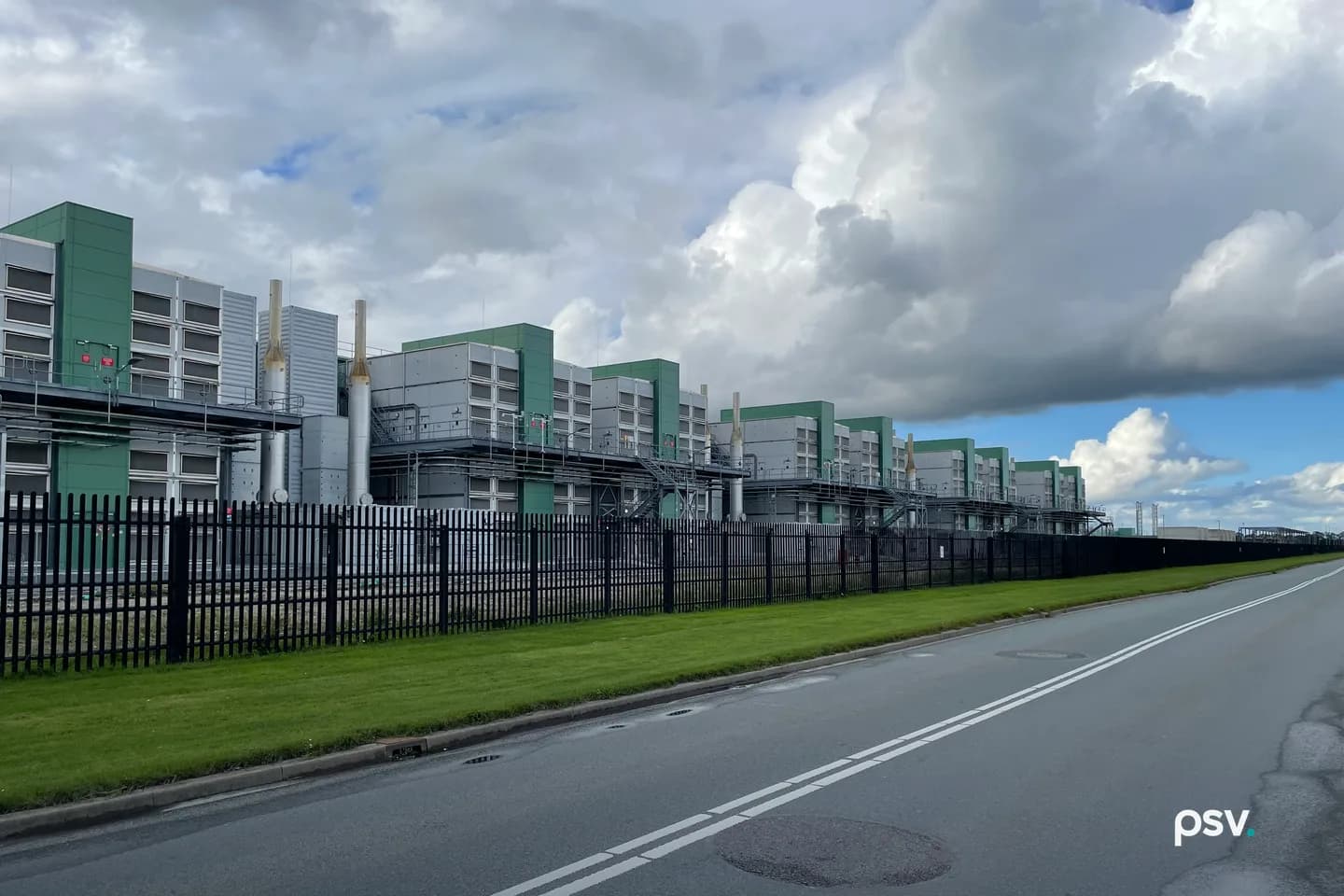
- Hay Kranen, “Microsoft Data Center Middenmeer, the Netherlands - 2,” Wikimedia Commons, CC BY 4.0 (lead photograph source)
Topics
Related PSV analysis
CRE AI NEWS
Flex Agreed to Pay $4.4 Billion for the 800 Volt Power Stack
Flex filed a Form 8-K on September 4 disclosing a Stock Purchase Agreement signed the day before: $4.4 billion in cash for EPC Power, a California maker of power conversion systems engineered for 800 volt DC data center architectures. The buyer says the platform consolidates functions traditionally provided by UPS systems and AC power distribution. That is a change to the electrical room, not only to a supplier list.
CRE CAPITAL NEWS
Vertiv Agreed to Pay $1.45 Billion for the Power Blueprint
Vertiv Holdings Co filed an 8-K on Wednesday disclosing that its Vertiv Corporation subsidiary agreed on September 1 to acquire Utility Innovation Holdings, Inc., which operates as UtilityInnovation Group, for approximately $1.45 billion in cash at closing plus up to $1.15 billion more if earnout targets are met. UIG designs microgrids and behind-the-meter power architecture for data centers. Vertiv says the point is time to power. PSV read the filing and the merger agreement behind it.
CRE AI NEWS
SLB Agreed to Pay $4.1 Billion for the Cooling Loop
SLB furnished an 8-K on Monday morning announcing an agreement to buy Kelvion, a German thermal management and heat exchange manufacturer, for approximately $3.4 billion in cash plus roughly $0.7 billion of assumed debt. Apollo, the seller, headlines the same deal at $4.1 billion. An oilfield services company is buying the heat rejection layer of the AI buildout. PSV read both records.
Related guides
Cornerstone PSV guides on the workflows in this article.
AI for Real Estate Investing
How commercial real estate investors use AI across the deal lifecycle: sourcing, underwriting, due diligence, and asset management, grounded in real documents.
Read the guideBest AI Tools for Commercial Real Estate
The pillar guide to choosing CRE AI tools by workflow fit and control, not vendor hype.
Read the guideEnterprise AI for Institutional CRE
PSV trains your whole firm on Claude and ChatGPT, builds your agents live inside your own environment, and stays on as your embedded AI team. What we build for you is yours.
Read the guideby PSVLiveYou read the operator view. Now learn to run the workflow.
The AI MBA for commercial real estate: the workflows these briefs describe, taught end to end on real deal files, with live builds and a community of CRE operators.