CRE AI NEWS
Flex Agreed to Pay $4.4 Billion for the 800 Volt Power Stack
Flex filed a Form 8-K on September 4 disclosing a Stock Purchase Agreement signed the day before: $4.4 billion in cash for EPC Power, a California maker of power conversion systems engineered for 800 volt DC data center architectures. The buyer says the platform consolidates functions traditionally provided by UPS systems and AC power distribution. That is a change to the electrical room, not only to a supplier list.
Direct answer
Direct answer to Flex EPC Power acquisition
This is the third acquisition in the AI data center power and cooling chain this desk has covered in six days, and the largest. The number an operator should carry out of it is not the price, it is the architecture. If 800 volt DC distribution consolidates the UPS room, the transformers and the protective devices into one integrated system, the electrical footprint inside the building changes. Nothing has closed and nothing is ruled on.
What Flex filed on September 4
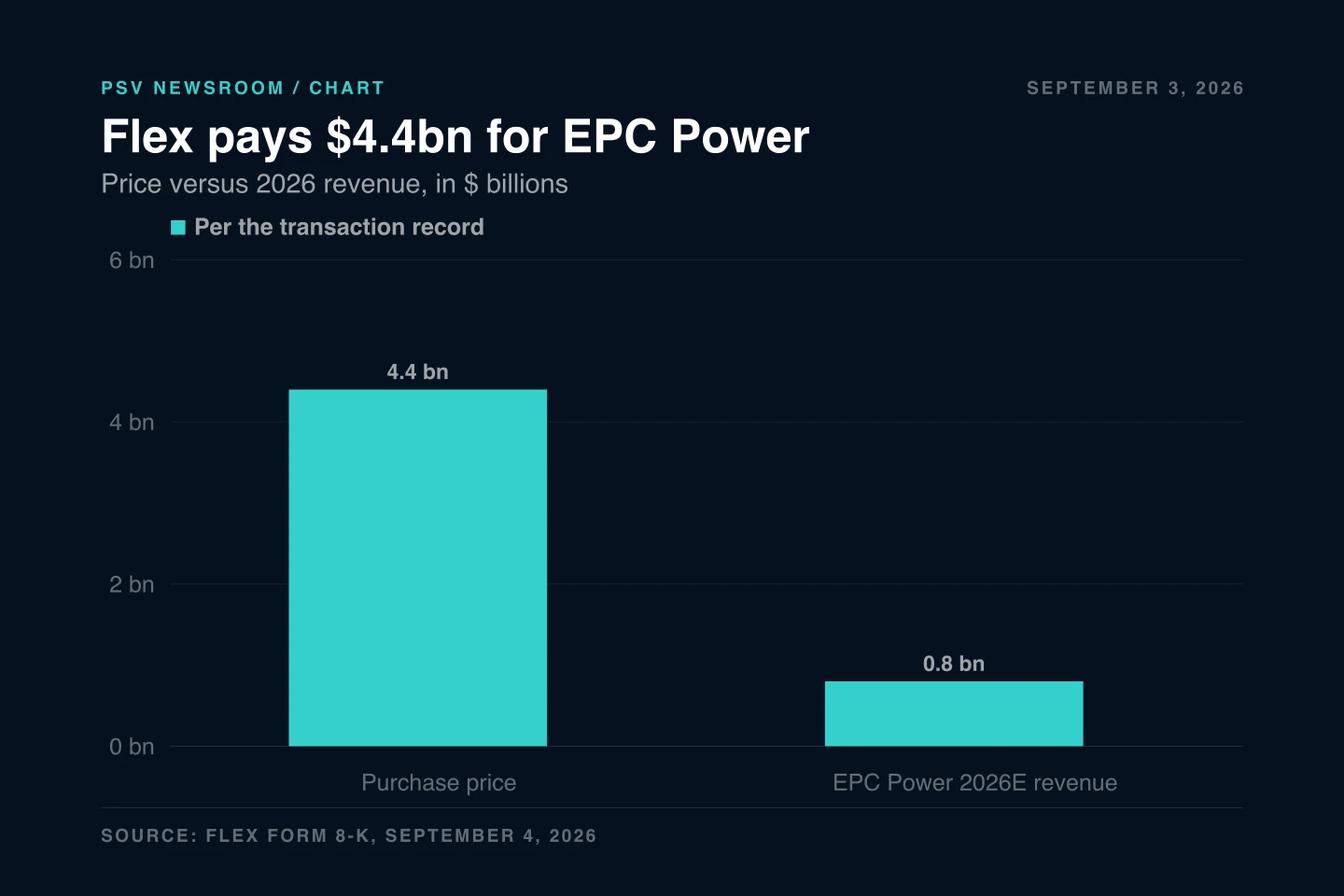
Flex Ltd., a company organized under the laws of Singapore with principal executive offices at 12515-8 Research Boulevard in Austin, Texas, filed a Form 8-K on September 4, 2026 reporting an earliest event date of September 3. Under Item 1.01 the filing states that Flex, ACS Acquisitions, Inc., a Delaware corporation and wholly owned subsidiary, EPC Power Corp., a Delaware corporation, and Charge Parent, LLC, the seller, entered into a Stock Purchase Agreement under which the purchaser will acquire all of the equity interests of EPC Power. The consideration is stated as aggregate cash of $4.4 billion payable at closing, subject to customary adjustments. Flex is a party to the agreement solely to guarantee the purchaser’s obligations. The agreement uses a locked box mechanism in which EPC Power’s enterprise value has been fixed as of June 30, 2026, with customary protections against leakage of value between that date and closing. The transaction is expected to close in the fourth quarter of calendar 2026 subject to the Hart-Scott-Rodino waiting period and other customary conditions, and either side may terminate if it has not closed by December 31, 2026, subject to two automatic three-month extensions. The same item discloses a Senior Unsecured 364-Day Bridge Facility Commitment Letter with Citigroup Global Markets Inc., Bank of America, N.A. and BofA Securities, Inc. providing up to $4.4 billion of bridge financing, which Flex says it intends to replace with a combination of debt and equity.
The Exhibit 99.1 press release, datelined Austin on September 3, describes EPC Power as founded in 2010, headquartered in California, and a provider of intelligent power conversion solutions for data center and grid applications built on internally developed hardware, software and controls with United States engineering and manufacturing. The release says the platform is engineered for next generation 800 volt data center power architectures with capabilities across rectifiers and DC to DC conversion and a planned development of solid-state transformers, that EPC Power has more than 15 gigawatts deployed across 62 countries, and that annual United States manufacturing capacity will surpass 30 gigawatts in 2027. On the financials it says EPC Power is expected to generate approximately $800 million of revenue in calendar 2026, with organic revenue growth of approximately 40 percent expected in 2027 and EBITDA margin expanding by double-digit percentage points to approximately 30 percent in 2027. Against the $4.4 billion price, the stated 2026 revenue computes to a multiple of roughly 5.5 times, which is PSV arithmetic on two figures in the same filing rather than a multiple either company disclosed. Two records disagree on one number and it is worth flagging: Flex’s release puts annual United States manufacturing capacity above 30 gigawatts in 2027, while EPC Power’s own website states annual capacity of more than 40 gigawatts across facilities in California and South Carolina. Both put deployed capacity at more than 15 gigawatts. The seller’s controlling shareholders are named in the release as Goldman Sachs Alternatives and Cleanhill Partners. Everything in this paragraph is a company statement, not a PSV finding, and none of it is audited.
Why an 800 volt power stack is a building question
The sentence in the investor presentation that matters most to a commercial real estate operator is not about price. Flex writes that the platform is designed to simplify next generation data center deployments by directly connecting 800 volt DC loads to grid voltages and consolidating functions traditionally provided by equipment such as UPS systems and AC power distribution. Elsewhere the same deck says the platform simplifies the power architecture by combining transformers, backup power and UPS, protective devices and 800 volt DC power conversion into one integrated system, in modules that scale to 6 megawatts each with redundancy. Read that as a floor plan rather than a product sheet. The UPS room, the battery room, the transformer yard and the low voltage switchgear lineup are not abstractions in a data center; they are square footage, floor loading, fire separation, maintenance clearance and a service corridor, and they are among the reasons a data hall shell is not an ordinary industrial box. If the functions in those rooms consolidate into fewer and denser assemblies, the ratio of white space to support space in a new build moves, and so does the answer to whether an existing shell can be re-fitted for a next generation deployment or has to be rebuilt. Flex is claiming that consolidation as a design intent for equipment it is buying, not demonstrating it in a delivered building, and PSV has verified no engineering claim in this paragraph.
The second thread runs into the regulatory record this desk has been covering all summer. The presentation says EPC Power provides grid support with advanced grid-forming capabilities, load smoothing and compliance with new and emerging grid codes for data centers larger than 75 megawatts, and that grid-forming capability responds in milliseconds to absorb AI load swings. That 75 megawatt line is the same threshold the State of Arizona used in its closing brief last week when it asked the Arizona Corporation Commission to make large load customers above 75 megawatts fund transmission up front, and the same one the Kansas State Corporation Commission used in Evergy’s Large Load Power Service tariff. The pattern is that utilities and regulators are writing rules about how a large load behaves on the grid, and equipment vendors are now selling compliance with those rules as a feature of the box. It is also the third consolidation in this chain in six days. On August 31 SLB agreed to pay approximately $4.1 billion of total transaction value for thermal manufacturer Kelvion. On September 2 Vertiv disclosed an agreement to pay approximately $1.45 billion in cash plus up to $1.15 billion in earnouts for UtilityInnovation Group. Now Flex has agreed to $4.4 billion for EPC Power, and says the combined portfolio will expand content per megawatt as AI infrastructure shifts to integrated architectures. Three buyers making the same bet in one week is a signal about where these firms think margin sits. It is not a prediction that any of them are right.
The workflow PSV would run on a supply chain consolidating under you
Most owners find out that a critical vendor changed hands when a service call goes unanswered. The workflow this argues for is a standing supply chain register for every asset whose value depends on specialized equipment, which for a data center means power, cooling and controls, and for most other property types means at least the plant. The inputs are public. An acquirer of a public company files a Form 8-K under Item 1.01 within four business days and usually attaches the purchase agreement and a press release, which together name the parties, the price, the conditions to closing and the outside date. The seller’s and target’s own websites carry the equipment lines and the plant locations, and they sometimes disagree with the buyer’s release, which is itself a finding worth recording. Your own asset files carry the nameplates, the service agreements, the warranty terms and the spare parts arrangements. The output is one row per asset per critical system with columns that decide an action: the equipment line and nameplate manufacturer; the current legal counterparty on the service contract; whether an announced transaction covers that line and what the filing says the acquired business includes; the expected closing quarter and the outside date; whether your service agreement, warranty or parts arrangement assigns on a change of control, and whether it survives a subsequent spin-off, which matters here because Flex says EPC Power will join a Cloud and Power Infrastructure segment that Flex intends to separate into an independent public company in the first quarter of 2027; and a citation to the filing and page every cell was read from.
The reviewer is the asset manager for the contract and nameplate rows and the development or engineering lead for anything touching architecture and capacity, with counsel on any assignment or change of control question, because that is a contract interpretation and not a summary. The approval gate is that no capital plan changes, no reserve moves and no vendor is replaced until a named person signs the row. An assistant carries most of the volume here and carries it well: pulling the 8-K and its exhibits, extracting the parties, price, conditions and outside date into cells, reading a target’s website against the buyer’s release and flagging where the two disagree, and sweeping a folder of service agreements for change of control language. Three things it should not do. It should not treat a buyer’s announcement-day description of a target’s capabilities as a verified fact about equipment in your building, because that description is marketing filed as an exhibit. It should not conclude that a contract assigns or does not assign, because that is a legal reading. And it should not convert a stated design intent, such as consolidating UPS and AC distribution functions, into a revised space program, because no delivered building in the record demonstrates it yet. PSV ran no model, tested no product and verified no engineering claim here, and promises no cost, schedule or performance outcome.
What stays with a person, and what the record does not settle
The operator read
Finish with the judgment call.
The reported facts are above. Enter your email for PSV's operator conclusion and a year of access to every newsroom brief.
Free. No card. Privacy policy. Unsubscribe anytime.
 by PSVLive
Build the workflow behind this analysis. Train with the operators doing it.
Real deal files, live builds, and production-ready CRE AI workflows inside the CRE AI Institute.











Clear answers
Common questions about Flex EPC Power acquisition
How much is Flex paying for EPC Power?
$4.4 billion in cash at closing, subject to customary adjustments. Flex Ltd. filed a Form 8-K on September 4, 2026 reporting an earliest event date of September 3, 2026, and stating under Item 1.01 that Flex, its wholly owned Delaware subsidiary ACS Acquisitions, Inc., EPC Power Corp. and the seller Charge Parent, LLC entered into a Stock Purchase Agreement under which the purchaser will acquire all of the equity interests of EPC Power for aggregate cash consideration of $4.4 billion. Flex is a party solely to guarantee the purchaser’s obligations. The agreement uses a locked box mechanism fixing EPC Power’s enterprise value as of June 30, 2026, with customary protections against leakage of value before closing. The same item discloses a Senior Unsecured 364-Day Bridge Facility Commitment Letter with Citigroup Global Markets Inc., Bank of America, N.A. and BofA Securities, Inc. for up to $4.4 billion, which Flex says it intends to replace with a combination of debt and equity. Exhibit 99.1 states that EPC Power is expected to generate approximately $800 million of revenue in calendar 2026, so the price computes to roughly 5.5 times revenue, which is PSV arithmetic on two figures in the same filing rather than a multiple either company disclosed. The transaction is expected to close in the fourth quarter of calendar 2026 subject to the Hart-Scott-Rodino waiting period, with an outside date of December 31, 2026 and two automatic three-month extensions available.
What is an 800 volt DC data center power architecture?
It is a way of moving power to a rack at a higher DC voltage and with fewer conversion stages, and Flex’s own investor presentation describes what that does to the equipment. The presentation states that EPC Power’s platform is designed to simplify next generation data center deployments by directly connecting 800 volt DC loads to grid voltages and consolidating functions traditionally provided by equipment such as UPS systems and AC power distribution, and separately that it simplifies the power architecture by combining transformers, backup power and UPS, protective devices and 800 volt DC power conversion into one integrated system, in modules that scale to 6 megawatts each with redundancy. It describes silicon carbide based inverters and active digital rectifiers today with a defined roadmap toward solid-state transformers. For a commercial real estate operator the consequence is spatial rather than electrical: the UPS room, the battery room, the transformer yard and the low voltage switchgear lineup are square footage, floor loading, fire separation and maintenance clearance, so consolidating their functions changes the ratio of white space to support space in a new build and changes whether an existing shell can be re-fitted rather than rebuilt. Those are Flex’s stated design intentions for equipment it has agreed to buy, not a delivered building, and PSV has verified no engineering claim.
Why do data center power vendors keep getting acquired in 2026?
Three of them changed hands in six days, and the buyers all describe the same thesis. On August 31, 2026 SLB agreed to pay approximately $4.1 billion of total transaction value for thermal manufacturer Kelvion. On September 2, 2026 Vertiv disclosed an agreement to acquire UtilityInnovation Group for approximately $1.45 billion in cash plus up to $1.15 billion in earnouts, extending it to the grid interconnect. On September 3, 2026 Flex agreed to pay $4.4 billion for EPC Power and told investors the combination creates an end-to-end power, compute and cooling portfolio that expands content per megawatt as AI infrastructure shifts to integrated architectures. A second thread runs through the regulatory record: Flex’s presentation says the EPC Power platform provides grid support with advanced grid-forming capabilities, load smoothing and compliance with new and emerging grid codes for data centers larger than 75 megawatts, which is the same threshold the State of Arizona used in its August 27, 2026 closing brief asking the Arizona Corporation Commission to make large load customers above 75 megawatts fund transmission up front, and the same threshold in Evergy’s Large Load Power Service tariff in Kansas. Utilities and regulators are writing rules about how a large load must behave on the grid, and equipment vendors are now selling compliance with those rules as a product feature. Three buyers making the same bet in one week is a signal about where these firms believe margin sits. It is not evidence that they are right, and none of the three transactions has closed.
Primary source record
These records support the reported facts in this brief. PSV’s CRE workflow interpretation and test plan are original analysis.
- Flex Ltd., Form 8-K, filed September 4, 2026 for an event dated September 3, 2026 (Items 1.01 and 8.01; source of the Stock Purchase Agreement parties, the $4.4 billion cash consideration, the June 30, 2026 locked box date, the Hart-Scott-Rodino condition, the December 31, 2026 outside date and the $4.4 billion bridge facility commitment)
- Flex Ltd., Form 8-K Exhibit 99.1, “Flex to Acquire EPC Power, Adding Leading Power Conversion Capabilities for AI Data Centers and Grid Applications,” September 3, 2026 (source of EPC Power’s founding year, California headquarters, the 15 gigawatts deployed across 62 countries, the 30 gigawatt 2027 manufacturing capacity figure, the $800 million 2026 revenue estimate, the 40 percent growth and 30 percent margin expectations, and the Goldman Sachs Alternatives and Cleanhill Partners ownership)
- Flex Ltd., Form 8-K Exhibit 99.2, investor presentation “Flex to acquire EPC Power,” September 3, 2026 (source of the 800 volt DC consolidation language, the UPS and AC distribution statement, the 6 megawatt module scale, the grid-forming millisecond response claim, the 75 megawatt grid code statement and the content per megawatt language)
- Flex Ltd. investor newsroom, “Flex to Acquire EPC Power, Adding Leading Power Conversion Capabilities for AI Data Centers and Grid Applications,” September 3, 2026 (the company’s own publication of the release, independent of the EDGAR exhibit)
- Flex Ltd. investor newsroom, “Flex Announces Intention to Spin Off its Cloud and Power Infrastructure Segment into a New Independent Publicly Traded Company,” May 5, 2026 (source of the spin-off plan, the first quarter 2027 target and the intended tax-free treatment)
- EPC Power Corp. company website, accessed September 5, 2026 (source of the stated annual capacity of more than 40 gigawatts and the California and South Carolina manufacturing locations, which differ from the figure in Flex’s release)
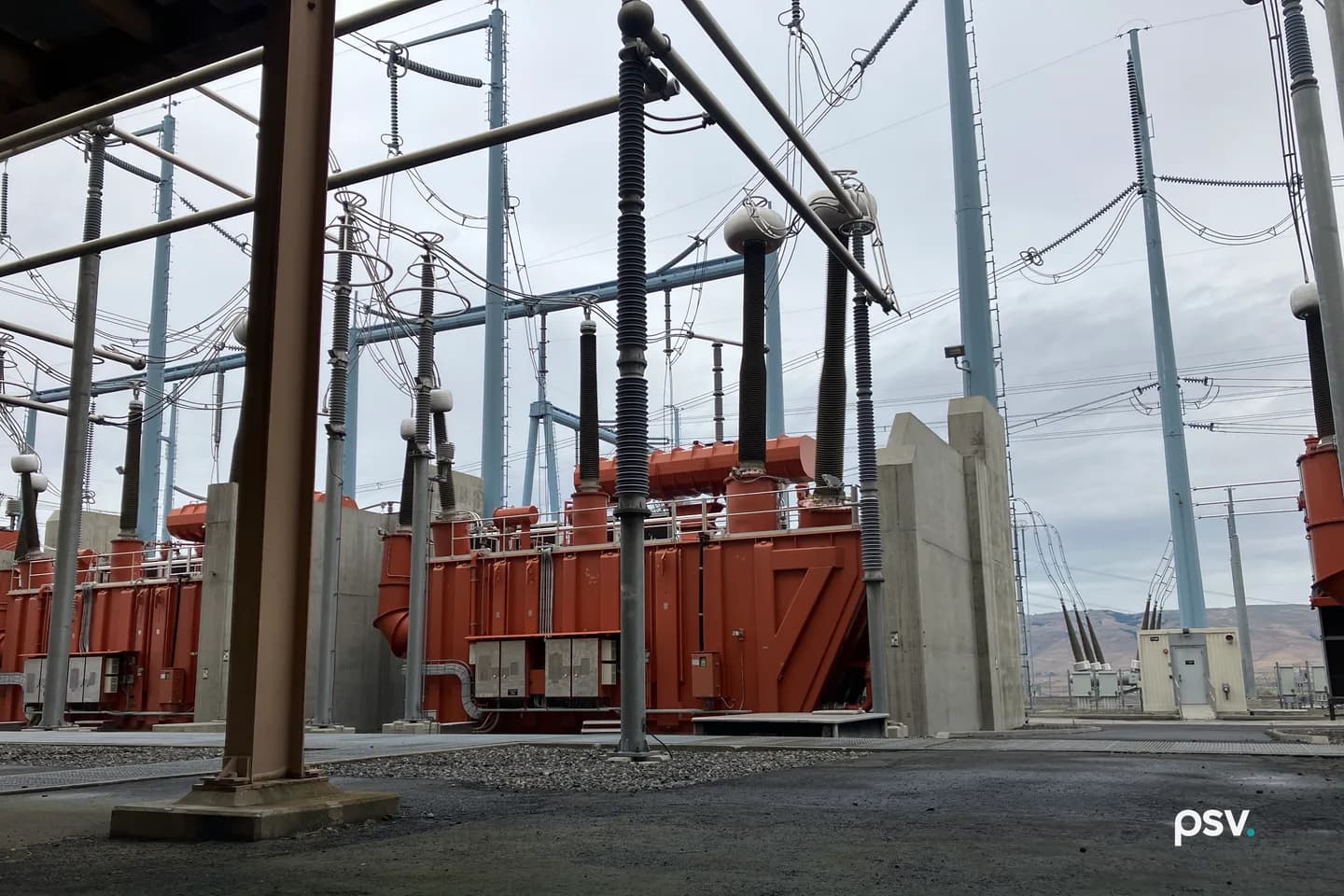
- Buddymoench, “Electrical transformer at Celilo Converter Station (2026),” Wikimedia Commons, CC BY-SA 4.0 (lead photograph source)
Topics
Related PSV analysis
CRE CAPITAL NEWS
Vertiv Agreed to Pay $1.45 Billion for the Power Blueprint
Vertiv Holdings Co filed an 8-K on Wednesday disclosing that its Vertiv Corporation subsidiary agreed on September 1 to acquire Utility Innovation Holdings, Inc., which operates as UtilityInnovation Group, for approximately $1.45 billion in cash at closing plus up to $1.15 billion more if earnout targets are met. UIG designs microgrids and behind-the-meter power architecture for data centers. Vertiv says the point is time to power. PSV read the filing and the merger agreement behind it.
CRE AI NEWS
SLB Agreed to Pay $4.1 Billion for the Cooling Loop
SLB furnished an 8-K on Monday morning announcing an agreement to buy Kelvion, a German thermal management and heat exchange manufacturer, for approximately $3.4 billion in cash plus roughly $0.7 billion of assumed debt. Apollo, the seller, headlines the same deal at $4.1 billion. An oilfield services company is buying the heat rejection layer of the AI buildout. PSV read both records.
CRE POLICY NEWS
APS Has Not Committed to Serve a New Large Load Since 2024
Closing briefs in the Arizona Public Service rate case were docketed on August 27, and they carry a fact no site selection memo in metro Phoenix can ignore. Microsoft, an intervenor, told the Arizona Corporation Commission that APS has been unable to commit to serve any new large load customer since January 1, 2024. APS’s own brief describes a large queue of uncommitted customers. PSV read the briefs.
Related guides
Cornerstone PSV guides on the workflows in this article.
Best AI Tools for Commercial Real Estate
The pillar guide to choosing CRE AI tools by workflow fit and control, not vendor hype.
Read the guideCommercial Real Estate Underwriting Software
A buyer's guide to CRE underwriting software: the three categories, what to require of any tool, and why a grounded AI workflow you own often beats a black box you rent.
Read the guideAI for Real Estate Investing
How commercial real estate investors use AI across the deal lifecycle: sourcing, underwriting, due diligence, and asset management, grounded in real documents.
Read the guideby PSVLiveYou read the operator view. Now learn to run the workflow.
The AI MBA for commercial real estate: the workflows these briefs describe, taught end to end on real deal files, with live builds and a community of CRE operators.