CRE CAPITAL NEWS
Vertiv Agreed to Pay $1.45 Billion for the Power Blueprint
Vertiv Holdings Co filed an 8-K on Wednesday disclosing that its Vertiv Corporation subsidiary agreed on September 1 to acquire Utility Innovation Holdings, Inc., which operates as UtilityInnovation Group, for approximately $1.45 billion in cash at closing plus up to $1.15 billion more if earnout targets are met. UIG designs microgrids and behind-the-meter power architecture for data centers. Vertiv says the point is time to power. PSV read the filing and the merger agreement behind it.
Direct answer
Direct answer to Vertiv UtilityInnovation Group acquisition
Vertiv is buying its way upstream to the grid interconnect. The merger agreement sets a base purchase price of $1,450,000,000 and a maximum earnout of $1,150,000,000, payable in two tranches of $575 million each against Adjusted EBITDA targets the filing does not disclose. For a commercial real estate operator the signal is not the price, it is where power architecture now sits in the sequence: at site selection, before the equipment is chosen and before the building is designed.
What Vertiv filed, and what the merger agreement adds
Vertiv Holdings Co filed a Form 8-K with the Securities and Exchange Commission on September 2, 2026, signed by Chief Financial Officer Craig Chamberlin, reporting an earliest event date of September 1, 2026. Under Item 1.01, Entry Into a Material Definitive Agreement, the filing states that Vertiv Corporation, an Ohio corporation, and Vultra Merger Sub, Inc., a Delaware corporation and each an indirect wholly owned subsidiary of the registrant, entered into an agreement and plan of merger dated September 1, 2026, under which Merger Sub will merge into Utility Innovation Holdings, Inc., with the target surviving as a wholly owned subsidiary of the buyer. The 8-K puts aggregate consideration at approximately $1.45 billion in upfront cash at closing, subject to customary adjustments for working capital, indebtedness and transaction expenses, plus additional potential cash of up to $1.15 billion payable in two tranches if earned against certain EBITDA targets. Closing is conditioned on customary conditions including expiration or termination of the waiting period under the Hart-Scott-Rodino Antitrust Improvements Act, the company expects to close in the fourth quarter of 2026, and it says it expects to fund the acquisition from existing resources. The accompanying Exhibit 99.1 press release, dated September 2, 2026 and datelined Columbus, Ohio, describes the target as operating under the name UtilityInnovation Group, a company it calls a leader in microgrid solutions, advanced power controls and behind-the-meter power architecture design for data centers. The release states that at the approximately $1.45 billion purchase price the acquisition represents approximately 13 times expected UIG 2027 EBITDA, that the multiple is anticipated to be significantly lower if the full earnout is paid, and that Vertiv expects the transaction to be accretive to adjusted earnings per share in the first year following completion. Those are company statements, not PSV findings.
The merger agreement filed as Exhibit 2.1 carries the structure the press release only gestures at, and the difference is worth reading. The agreement defines a Base Purchase Price of $1,450,000,000 and a Maximum Earnout Amount of $1,150,000,000, split into two separate $575,000,000 tranches. Each tranche pays on a straight ratio rather than a pass or fail test: the 2027 Earnout Amount equals $575,000,000 multiplied by the fraction of 2027 Earnout Period Adjusted EBITDA over the 2027 EBITDA Target, capped at $575,000,000, and reduced to nil if Adjusted EBITDA comes in below 50 percent of the target, with the 2028 tranche built identically. The measurement windows are the detail that does not survive the press release’s summary. Both periods commence at 12:01 a.m. Eastern time on October 1, 2026. The 2027 Earnout Period ends September 30, 2027 and the 2028 Earnout Period ends September 30, 2028, and the agreement states for the avoidance of doubt that 2028 Earnout Period Adjusted EBITDA is inclusive of all Adjusted EBITDA for both periods, which makes the second tranche a cumulative two-year measurement rather than a second single year. Two things follow that the release does not say. The earnout clock starts October 1, 2026, which is before the fourth-quarter close the company expects, so the measurement period can begin running before Vertiv owns the business. And the EBITDA targets themselves live on Schedule 2.09(a), which was omitted from the filing under Item 601(a)(5) of Regulation S-K, so no reader can test whether the targets are demanding. The agreement also fixes an Outside Date at the 120th calendar day after signing, which computes to December 30, 2026, automatically extended to the 210th day, March 30, 2027, if the only conditions outstanding are the antitrust ones. That extension sits past the fourth quarter of 2026 the company points to.
Why a power controls acquisition is a commercial real estate story
Strip the equipment vocabulary and this is a transaction about sequence. Vertiv already sells the power and cooling train inside a data center. What it is buying is the layer that sits before that train exists: microgrid controls, onsite generation and energy storage orchestration, microgrid switchgear, and what its release calls behind-the-meter power architecture design that engages customers at the earliest planning stages, before equipment is selected. Chief Executive Officer Gio Albertazzi framed the rationale in the release as speed rather than product, saying that for AI data center operators competitive advantage increasingly depends on how quickly they can move from site selection to first token, and that the combination is intended to extend the portfolio upstream to the utility interconnect and onsite power sources without tying customers to a single generation technology or supplier. UIG’s founder and chief executive Sidney Hinton described the company as built around flexible, technology-agnostic architectures. The company was founded in 2020, is headquartered in Raleigh, North Carolina with a European headquarters in Dublin, and manufactures in North Carolina and New Jersey. Every characterization in this paragraph reaches the reader through Vertiv’s own release rather than through any independent verification, and Vertiv states the expected benefits as anticipations rather than results.
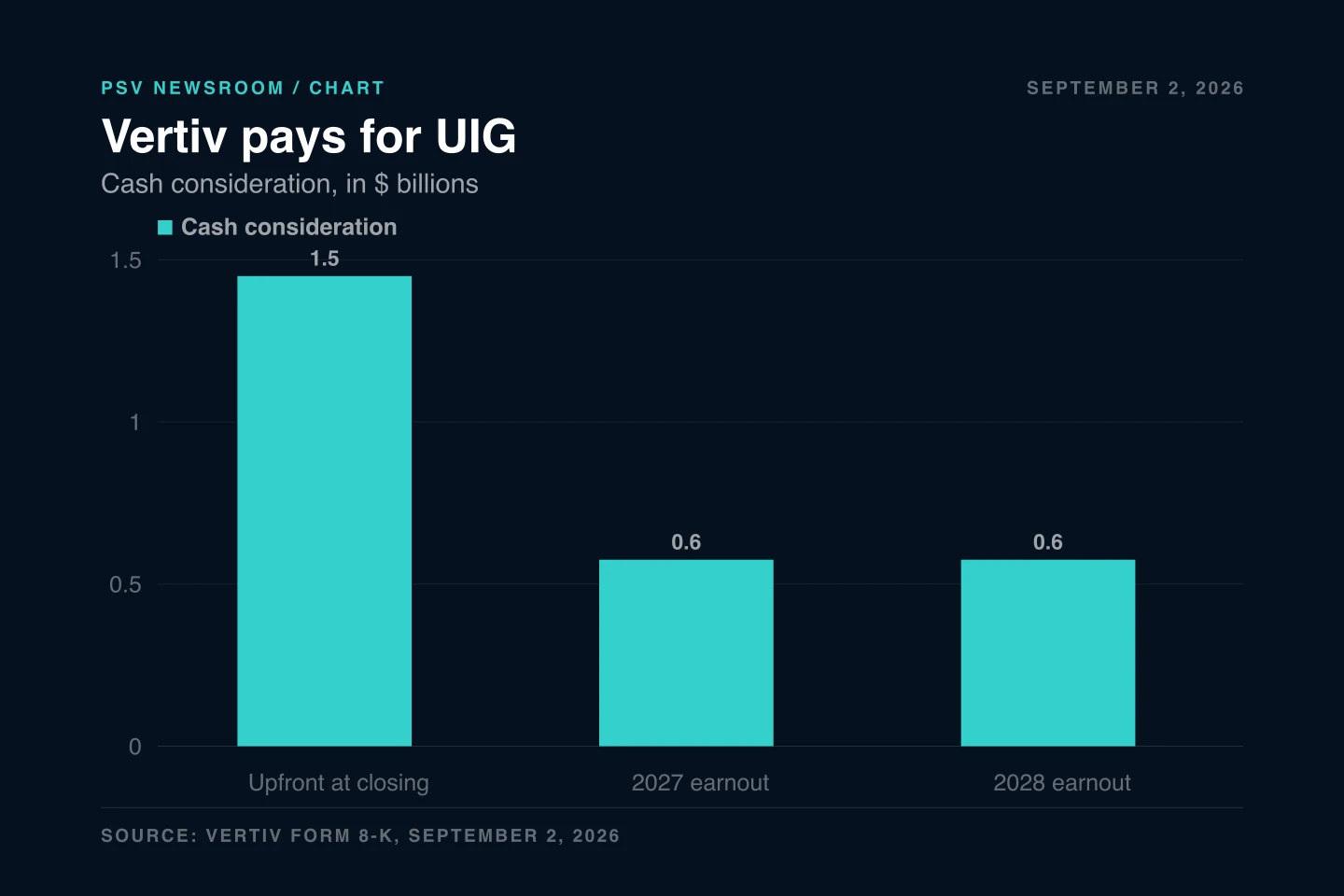
The real estate consequence is the one this desk has been tracking from the grid side all summer. When ERCOT paused its Batch Zero study and left seventeen large loads representing 6,608 megawatts finished with every process except approval to energize, the binding constraint on a data center site stopped being land or capital and became a queue position. A behind-the-meter or islanded architecture is one of the few answers to that constraint that a developer controls, and the price Vertiv is willing to pay is a market signal about how scarce that answer is. The chart above uses only figures the records give: $1.45 billion of cash at closing, then two $575 million tranches. Do the arithmetic on the company’s own multiple and the implication is visible. Approximately $1.45 billion at approximately 13 times expected 2027 EBITDA computes to roughly $111.5 million of expected EBITDA for a six-year-old company. Total possible consideration of $2.6 billion divided by 13 computes to $200 million, so for the multiple on full consideration to land below 13 times, as the company says it anticipates, the measured Adjusted EBITDA would have to come in near or above roughly 1.8 times the level implied at the base price. That is PSV arithmetic on Vertiv’s own stated multiple and the agreement’s stated dollar amounts, not a company projection, and because the targets are omitted from the filing it cannot be checked against them. It is offered as a way to read what the buyer appears to expect, not as a forecast.
The workflow PSV would run on a power-architecture diligence file
If power architecture is moving to the front of the development sequence, the diligence file needs a row for it, and the workflow this argues for is a power-path table for every site under consideration or under management. The inputs already exist and are mostly obtainable: the interconnection queue position report and study status from the regional transmission organization or utility; the utility’s large load tariff or special contract terms and any pending rate case filing; the local zoning ordinance and any air permit thresholds that govern onsite generation, which decide whether a microgrid is even permittable on that parcel; the site’s single-line diagram and equipment schedules where they exist; the vendor contracts behind any controls platform, switchgear or storage already installed, read specifically for assignment and change of control clauses; and the SEC filings of the counterparties, because transactions of this size are disclosed under Item 1.01 with the agreement attached. The output is one row per site with columns that decide the schedule: the served architecture, meaning grid-connected, bridge-to-grid or islanded; the queue position and the date it was last confirmed; whether onsite generation is permittable under the current ordinance and air rules and what the record says; the megawatts the grid alone can deliver against the megawatts the site plan requires; who authored the power design and whether that design and its controls are owned, licensed or vendor-locked; and a citation to the document and page every cell was read from. One derived column carries the finding: the gap in months between the earliest grid-served energization date and the earliest onsite-served date.
The reviewer is the development lead for the entitlement and permitting rows and the asset manager for the operating rows, working with the power engineer on the architecture column, and the approval gate is that no schedule, reserve or offering assumption changes until a named person signs the table. An assistant can assemble and maintain this file, read a merger agreement or a tariff and pull the terms into cells, and flag when a vendor contract contains a change of control clause. Three things it should not do. It should not conclude that a microgrid is permittable on a given parcel, because that is a regulatory determination against facts the public record often does not contain. It should not convert a company’s expected closing quarter into a schedule assumption, because the agreement in this deal sets an outside date that runs past it. And it should not treat an announced acquisition as a completed one, because this transaction is conditioned on an antitrust waiting period that has not run. PSV has tested no Vertiv or UIG product, has verified no engineering or performance claim, and is describing a records review built on filings anyone can pull. No cost, schedule, return or availability outcome is promised.
What stays with a person, and what the record does not settle
The operator read
Finish with the judgment call.
The reported facts are above. Enter your email for PSV's operator conclusion and a year of access to every newsroom brief.
Free. No card. Privacy policy. Unsubscribe anytime.
 by PSVLive
Build the workflow behind this analysis. Train with the operators doing it.
Real deal files, live builds, and production-ready CRE AI workflows inside the CRE AI Institute.










Clear answers
Common questions about Vertiv UtilityInnovation Group acquisition
How much is Vertiv paying for UtilityInnovation Group?
Approximately $1.45 billion in cash at closing, plus up to $1.15 billion more if earnout targets are met, for a maximum of $2.6 billion. Vertiv Holdings Co filed a Form 8-K on September 2, 2026 under Item 1.01 stating that Vertiv Corporation and Vultra Merger Sub, Inc., each an indirect wholly owned subsidiary, entered into an agreement and plan of merger dated September 1, 2026 to acquire Utility Innovation Holdings, Inc., which operates as UtilityInnovation Group. The upfront cash is subject to customary adjustments for working capital, indebtedness and transaction expenses. The merger agreement filed as Exhibit 2.1 defines a Base Purchase Price of $1,450,000,000 and a Maximum Earnout Amount of $1,150,000,000, structured as two separate tranches of $575,000,000 each. Each tranche pays $575,000,000 multiplied by the ratio of Adjusted EBITDA to the applicable EBITDA target, capped at $575,000,000 and reduced to nil if Adjusted EBITDA falls below 50 percent of that target. Vertiv’s Exhibit 99.1 press release states that at approximately $1.45 billion the deal represents approximately 13 times expected UIG 2027 EBITDA, and that the multiple is anticipated to be significantly lower if the full earnout is paid. Vertiv says it expects to fund the acquisition from existing resources and to close in the fourth quarter of 2026, subject to the Hart-Scott-Rodino waiting period.
What does UtilityInnovation Group do?
It designs behind-the-meter power for data centers. Vertiv’s September 2, 2026 press release describes UIG as a leader in microgrid solutions, advanced power controls and behind-the-meter power architecture design for data centers, and says the acquisition adds microgrid controls, onsite generation and energy storage orchestration, microgrid-specific switchgear and behind-the-meter power architecture to Vertiv’s portfolio. Per that release, UIG was founded in 2020, is headquartered in Raleigh, North Carolina with a European headquarters in Dublin, Ireland, and has manufacturing operations in North Carolina and New Jersey. It supplies a proprietary controls platform and pre-engineered microgrid switchgear that orchestrate multiple power sources in real time, along with pre-validated reference designs for grid-connected, bridge-to-grid and islanded sites, and its designs are described as generation-agnostic. Founder and Chief Executive Officer Sidney Hinton is quoted saying the company was founded to solve power challenges through flexible, technology-agnostic architectures. The merger agreement scopes the acquired Included Business as the design, sale, delivery, installation, operation and maintenance of products or services for power system load and frequency balancing, including behind-the-meter systems and utility grids. All of these are descriptions from the buyer’s own records rather than independent findings, and neither record discloses UIG’s revenue, backlog or delivered megawatts.
What does the Vertiv UIG deal mean for data center development?
It moves power architecture to the front of the development sequence. Vertiv’s release states that as power availability becomes a more critical factor in data center development, architecture decisions are moving earlier in the planning process, and that behind-the-meter power architecture design engages customers at the earliest planning stages, before equipment is selected. Chief Executive Officer Gio Albertazzi framed the rationale as speed, saying competitive advantage increasingly depends on how quickly an operator can move from site selection to first token, and that the combination extends the portfolio upstream to the utility interconnect without tying customers to a single generation technology or supplier. The expected operator benefits Vertiv lists are faster access to power with less dependence on utility interconnection timelines, the ability to scale site capacity beyond what the grid alone can provide, and a single accountable relationship from grid interconnect through rack-level infrastructure. Those are the acquirer’s anticipations published on announcement day, not demonstrated results. The practical consequence for a developer is that the power engineer belongs in the site selection meeting, and that the question of whether a parcel can host permittable onsite generation now sits alongside price and entitlement in a screening decision. It also continues a consolidation: two days earlier SLB agreed to pay approximately $4.1 billion of total transaction value for thermal manufacturer Kelvion.
Primary source record
These records support the reported facts in this brief. PSV’s CRE workflow interpretation and test plan are original analysis.
- Vertiv Holdings Co, Form 8-K filed September 2, 2026 (Item 1.01, Entry Into a Material Definitive Agreement; Item 7.01; Item 9.01), reporting a September 1, 2026 agreement and plan of merger to acquire Utility Innovation Holdings, Inc. (chart source)
- Vertiv Holdings Co, Form 8-K Exhibit 2.1, Agreement and Plan of Merger dated September 1, 2026 among Vertiv Corporation, Vultra Merger Sub, Inc. and Utility Innovation Holdings, Inc. (source of the base purchase price, the two $575 million earnout tranches, the earnout periods and the outside date; chart source)
- Vertiv Holdings Co, Form 8-K Exhibit 99.1, “Vertiv Announces Agreement to Acquire UtilityInnovation Group to Accelerate Time to Power for AI Data Centers,” September 2, 2026
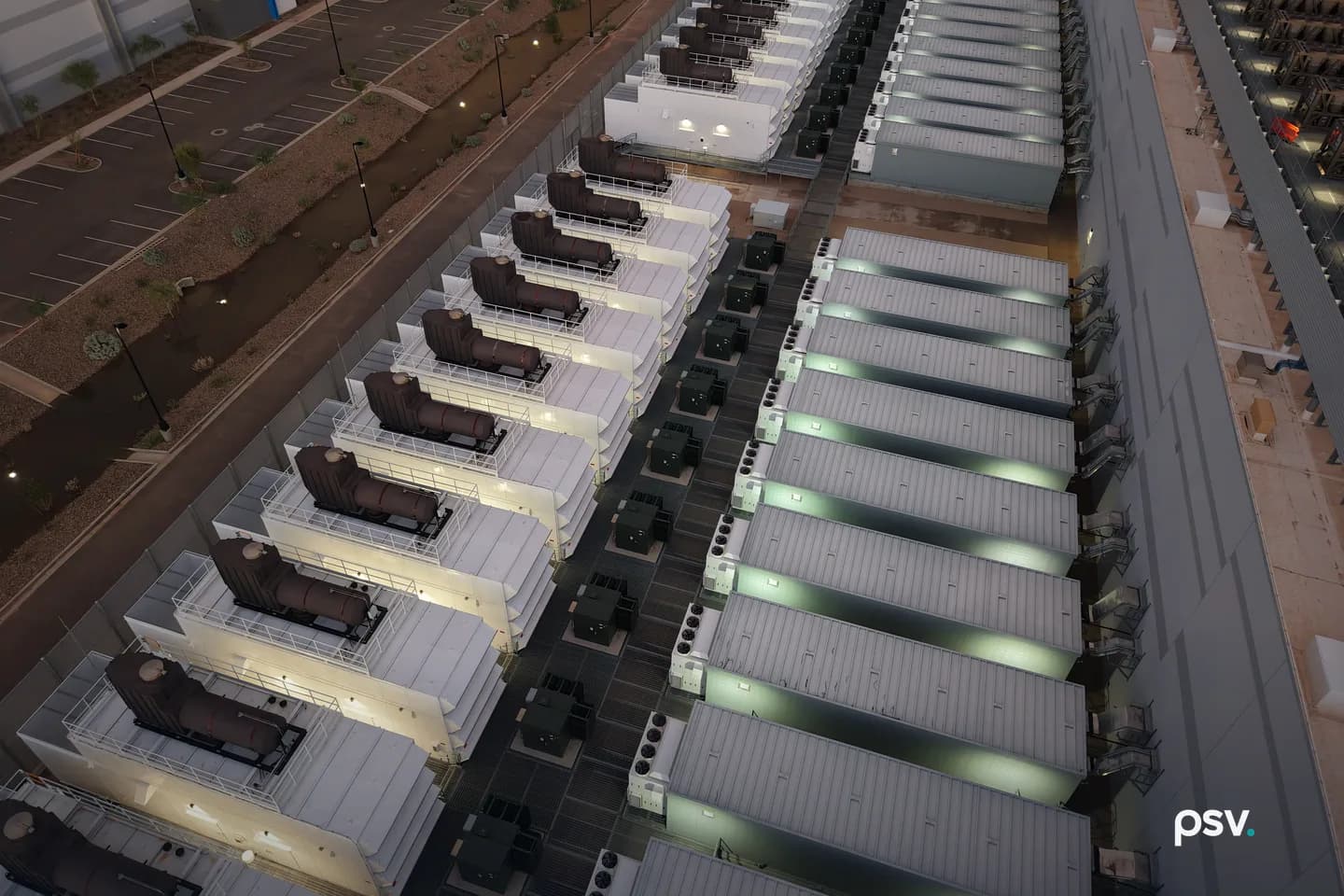
- Rsparks3, “Data center backup generators” (Wikimedia Commons, CC0 1.0 public domain dedication; lead photograph source)
Topics
Related PSV analysis
CRE AI NEWS
SLB Agreed to Pay $4.1 Billion for the Cooling Loop
SLB furnished an 8-K on Monday morning announcing an agreement to buy Kelvion, a German thermal management and heat exchange manufacturer, for approximately $3.4 billion in cash plus roughly $0.7 billion of assumed debt. Apollo, the seller, headlines the same deal at $4.1 billion. An oilfield services company is buying the heat rejection layer of the AI buildout. PSV read both records.
CRE POLICY NEWS
Texas Paused the Data Center Grid Queue, and the Gate Is Paperwork
Governor Greg Abbott directed a verification and audit of every data center advancing through ERCOT’s interconnection process on August 3. The Public Utility Commission of Texas made it operative on August 20, granting ERCOT good cause exceptions that suspend Batch Zero classification deadlines. ERCOT then told the market it intends to issue conditional classifications by August 31. PSV read the letter, the order and ERCOT’s filed presentation.
CRE CAPITAL NEWS
Google Signed for 396 Megawatts Before It Named a Building
Fervo Energy filed an 8-K on Tuesday morning disclosing that a wholly owned subsidiary signed a 15-year power purchase agreement with Google Energy for 396 megawatts of enhanced geothermal capacity at Cape Station in Beaver County, Utah, plus an option that would take the total to roughly 950 megawatts. Fervo calls the power a building block for a potential Utah data center. No building has been announced. PSV read the filing and the statute behind it.
Related guides
Cornerstone PSV guides on the workflows in this article.
Claude for Real Estate Developers
The ground-up developer field guide: site selection through IC memo, built on a real development deal.
Read the guideAI for Real Estate Investing
How commercial real estate investors use AI across the deal lifecycle: sourcing, underwriting, due diligence, and asset management, grounded in real documents.
Read the guideWhat is CRE AI?
The definitional guide to commercial real estate AI: the core workflows, how it differs from a chatbot, and how to learn it.
Read the guideby PSVLiveYou read the operator view. Now learn to run the workflow.
The AI MBA for commercial real estate: the workflows these briefs describe, taught end to end on real deal files, with live builds and a community of CRE operators.