CRE AI NEWS
SLB Agreed to Pay $4.1 Billion for the Cooling Loop
SLB furnished an 8-K on Monday morning announcing an agreement to buy Kelvion, a German thermal management and heat exchange manufacturer, for approximately $3.4 billion in cash plus roughly $0.7 billion of assumed debt. Apollo, the seller, headlines the same deal at $4.1 billion. An oilfield services company is buying the heat rejection layer of the AI buildout. PSV read both records.
Direct answer
Direct answer to SLB Kelvion acquisition
A 100-year-old oilfield services company is paying roughly $4.1 billion for a heat exchanger manufacturer because AI data centers cannot reject heat fast enough. For a commercial real estate operator the consequence is procurement rather than technology: the thermal package that sits on a data center roof is being folded into an integrated modular offering sold by one counterparty, and the list of independent cooling suppliers a developer can bid just got shorter by one.
What SLB furnished, and the two headline numbers
SLB N.V. furnished a Form 8-K to the Securities and Exchange Commission on August 31, 2026, accepted at 6:58 a.m. Eastern time, under Item 7.01, Regulation FD Disclosure, and Item 9.01. The Exhibit 99 press release attached to it announces that SLB has signed an agreement to acquire Kelvion, which it describes as a global provider of thermal management and heat exchange technologies, and states the terms: SLB will acquire Kelvion from Apollo-managed funds, the majority owner, and funds advised by Triton, which holds a minority interest, for approximately $3.4 billion in cash, and will assume approximately $0.7 billion of debt. SLB puts the resulting total transaction value at approximately 11 times estimated 2026 EBITDA before synergies, or approximately 8.5 times including expected annual run-rate synergies, and expects approximately $120 million in annual EBITDA synergies within three years. The transaction is subject to customary closing conditions and regulatory approvals and is expected to close in the first half of 2027. Because the disclosure came in under Item 7.01, it is furnished rather than filed, which is a distinction worth keeping straight when citing it.
The seller published its own record the same morning, eight minutes earlier. Apollo Global Management issued a release at 6:50 a.m. Eastern titled to say that Apollo funds agree to sell Kelvion to SLB for $4.1 billion. The two records do not disagree on the structure. Apollo’s body text carries the identical terms, approximately $3.4 billion in cash and approximately $0.7 billion of assumed debt, and the $4.1 billion in its headline is simply the sum of the two, which computes. What the Apollo release adds is the holding period and the arithmetic behind the multiple. Apollo states that its funds’ investment in Kelvion completed in January 2026, which means the sale was agreed roughly eight months into ownership. On the multiple, approximately $4.1 billion at approximately 11 times computes to roughly $373 million of 2026 EBITDA, which sits inside the $350 million to $400 million range SLB states for Kelvion, and the 8.5 times figure computes to roughly $482 million, which is close to the midpoint of that range plus the stated $120 million of synergies. Guggenheim Securities acted as lead financial advisor to the Apollo funds and Kelvion, with UBS AG London Branch also serving as financial advisor, Sidley Austin as legal counsel and Paul, Weiss, Rifkind, Wharton as regulatory counsel. Kelvion is headquartered in Herne, Germany, and its chief executive is Andy Blandford.
Why a heat exchanger deal is a real estate story
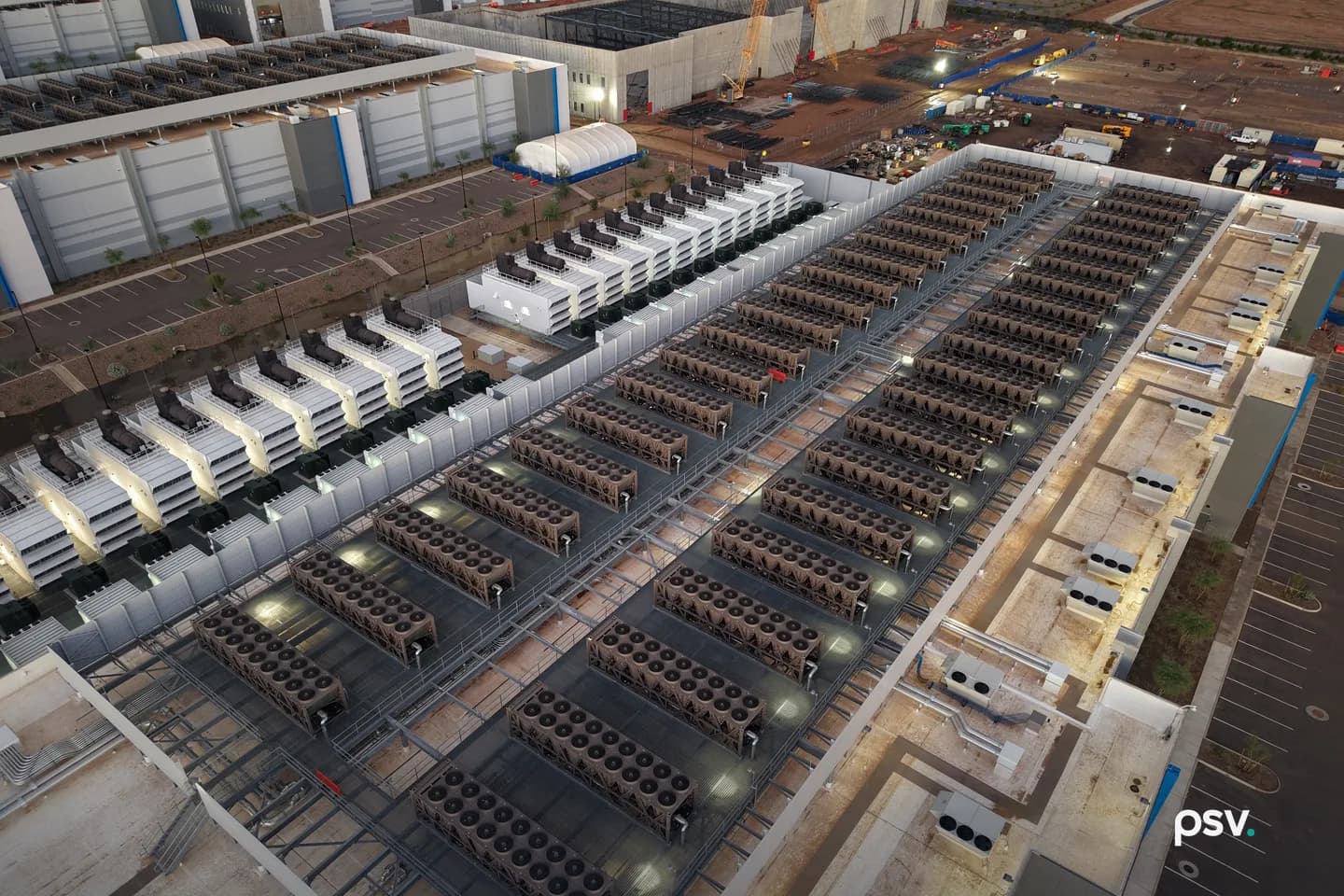
Heat rejection is a building problem before it is an engineering one. Every watt a data center draws comes back out as heat, and the equipment that moves that heat to the outside air is a physical structure with real estate consequences: it occupies roof area or a yard, it imposes structural load, it needs clearances and access routes, it draws water in some configurations, it makes noise at the property line, and it shows up in the height, setback and screening conditions a jurisdiction writes into an approval. PSV covered the litigation end of that on August 26, when five federal class actions filed since April alleged data center noise, and the grid end of it on August 29, when ERCOT paused approvals to energize large loads in Texas. This deal is the supply end of the same constraint. The equipment in the photograph above, rows of heat rejection units racked across a data center roof with another hall still under construction behind them, is the category SLB just paid roughly $4.1 billion to own a manufacturer of.
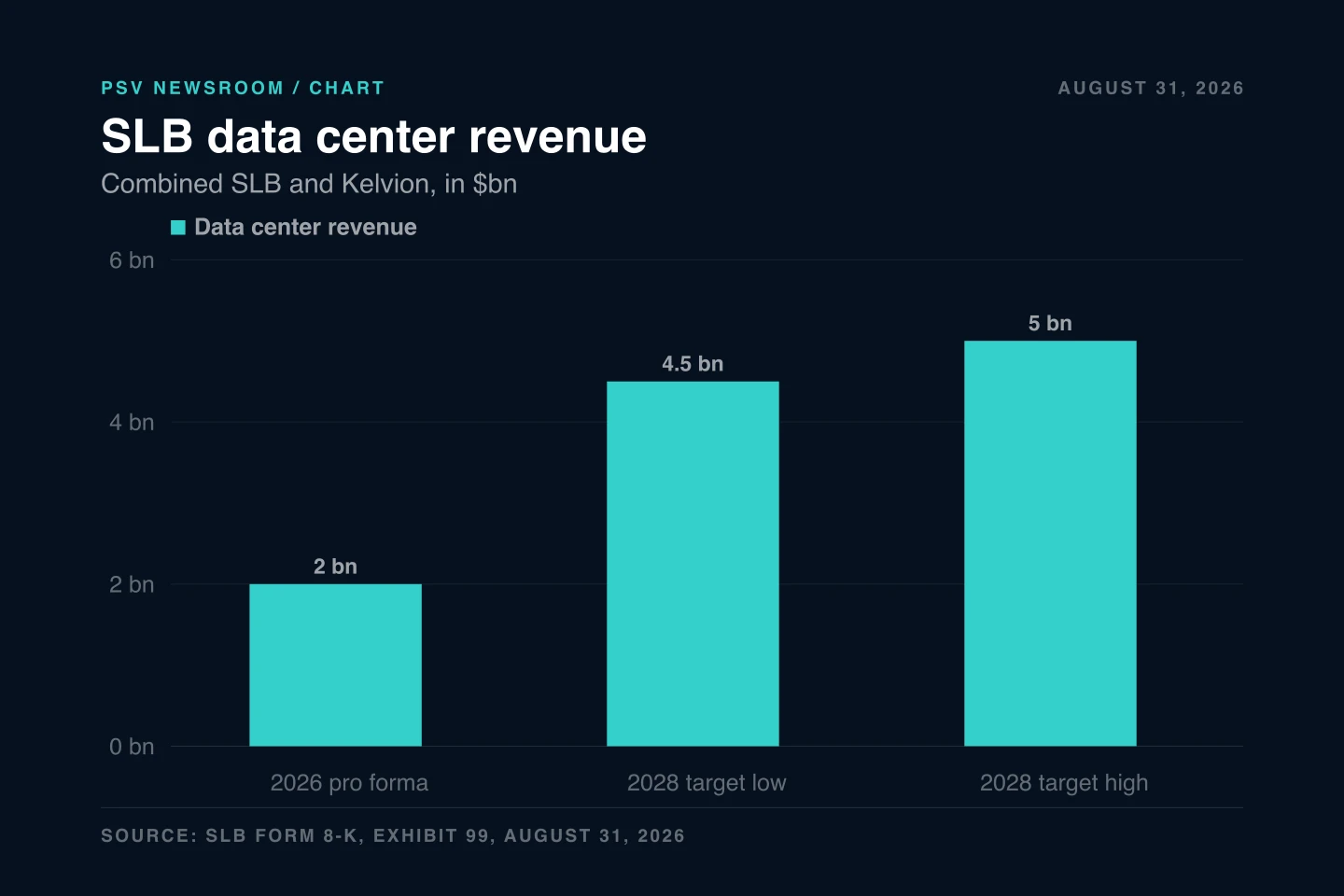
The scale disclosures in the release explain why a company known for oilfield services is buying it. SLB states that its Data Center Solutions business has grown at a compound annual growth rate exceeding 90 percent between 2024 and 2026, and that delivered capacity is expected to surpass 2 gigawatts cumulatively by the end of the year. Kelvion is expected to generate revenue of approximately $2.3 billion to $2.4 billion in 2026 with adjusted EBITDA of approximately $350 million to $400 million, and data centers are its largest and fastest-growing end market at an expected $1.2 billion to $1.3 billion, which computes to roughly 53 percent of Kelvion’s expected revenue at the midpoints of both ranges. Combined, SLB expects more than $2 billion of data center revenue and approximately $300 million of adjusted EBITDA on a pro forma basis for 2026, which computes to roughly a 15 percent margin, and it is targeting $4.5 billion to $5 billion of revenue and $700 million to $800 million of adjusted EBITDA for the combined data center business in 2028. Subtracting Kelvion’s contribution from the combined 2026 figure leaves roughly $0.7 billion to $0.8 billion as SLB’s own current data center revenue. Chief Executive Officer Olivier Le Peuch said AI is driving the most significant infrastructure investment cycle in our lifetime, and that the transaction expands SLB’s addressable market by more than doubling its revenue opportunity per gigawatt of delivered capacity. Gavin Rennick, president of SLB’s New Energy and Industrial business, framed the operating logic as customers wanting partners that can optimize how critical systems work together across the facility and bring new capacity online faster. SLB separately states that its modular approach, combining offsite construction, engineering and digital capabilities, can reduce onsite construction complexity and accelerate time to operation by up to 40 percent. Every figure and characterization in this paragraph is the company’s own claim about its own business, not a PSV finding, and the 40 percent schedule figure in particular is unbenchmarked and carries no stated baseline.
The workflow PSV would run on a mechanical procurement package
The workflow this deal argues for is a vendor concentration review across the long-lead mechanical scope, and it runs on documents a developer or owner already holds. The inputs are the mechanical equipment schedules from the design set; the basis of design and the approved submittals; the bid tabs and the awarded subcontracts for the thermal and electrical packages; the purchase orders and quoted delivery dates for long-lead items; the service and maintenance agreements on anything already operating; and the warranty certificates with their assignment language. The output is one table with a row per long-lead package: the package name, the specified manufacturer and any named alternates, the manufacturer’s current corporate parent, the quoted lead time and the date it was quoted, the contract value, whether the package has a qualified second source that has actually bid, and a citation to the document and page every field was read from. Two columns carry the finding. One flags any package where only a single manufacturer is specified with no alternate that has bid. The other flags any manufacturer whose ownership has changed, or is under agreement to change, within the last twenty-four months. Kelvion would light up both columns on a lot of projects right now.
The reviewer is the project’s mechanical lead or the owner’s construction manager, working with whoever holds the procurement schedule, and the approval gate is that no package moves to award on a single-source specification until a named person signs that the concentration is accepted. Three things an assistant should not decide here. It should not judge whether a proposed alternate is technically equivalent, because equivalence on a thermal package is an engineering determination against the actual load, the site’s design conditions and the redundancy standard. It should not read change of control language in a service agreement and conclude the contract does or does not assign, because that is a legal opinion and the language is negotiated. And it should not convert a vendor’s quoted lead time into a schedule commitment, because the quote is a marketing input and the commitment is the thing a lender and a tenant hold you to. PSV has not tested any SLB or Kelvion product, has run no benchmark against the 40 percent claim, and is describing a review it would run on documents an owner already has. No time or cost result is promised.
What stays with a person, and what the record does not settle
The operator read
Finish with the judgment call.
The reported facts are above. Enter your email for PSV's operator conclusion and a year of access to every newsroom brief.
Free. No card. Privacy policy. Unsubscribe anytime.
 by PSVLive
Build the workflow behind this analysis. Train with the operators doing it.
Real deal files, live builds, and production-ready CRE AI workflows inside the CRE AI Institute.










Clear answers
Common questions about SLB Kelvion acquisition
How much is SLB paying for Kelvion?
Approximately $3.4 billion in cash, plus the assumption of approximately $0.7 billion of debt, which sums to a total transaction value of approximately $4.1 billion. SLB furnished the terms in a Form 8-K on August 31, 2026 under Item 7.01, Regulation FD Disclosure, with the announcement attached as Exhibit 99. Apollo Global Management, whose managed funds are the majority seller, published its own release the same morning headlining the deal at $4.1 billion, and its body text carries the identical structure, so the two records describe the same consideration in different terms rather than disagreeing. SLB states the price represents approximately 11 times estimated 2026 EBITDA before synergies, or approximately 8.5 times including expected annual run-rate synergies, and that it expects approximately $120 million of annual EBITDA synergies within three years. At approximately $4.1 billion, 11 times computes to roughly $373 million of EBITDA, which sits inside the $350 million to $400 million range SLB states for Kelvion in 2026. Funds advised by Triton hold a minority interest that SLB is also acquiring. The transaction is subject to customary closing conditions and regulatory approvals and is expected to close in the first half of 2027.
What does the SLB Kelvion deal mean for data center development?
It consolidates the thermal package. Kelvion manufactures thermal management and heat exchange equipment, and data centers are its largest and fastest-growing end market, expected to produce $1.2 billion to $1.3 billion of its approximately $2.3 billion to $2.4 billion of 2026 revenue, which computes to roughly 53 percent at the midpoints. SLB is folding that into a Data Center Solutions business it says has grown at a compound annual growth rate exceeding 90 percent between 2024 and 2026, with delivered capacity expected to surpass 2 gigawatts cumulatively by the end of the year. SLB states that combining cooling with its engineering, modular manufacturing, offsite construction and digital capabilities can reduce onsite construction complexity and accelerate time to operation by up to 40 percent, a company claim with no stated baseline and no independent benchmark. The practical consequence for a developer is procurement rather than technology: one fewer independent thermal manufacturer to bid, and a growing option to buy the thermal scope inside an integrated modular package from a single counterparty instead of tendering it separately.
Why is an oilfield services company buying data center cooling?
Because heat rejection is the constraint the AI buildout runs into, and SLB says so directly. Chief Executive Officer Olivier Le Peuch stated that AI is driving the most significant infrastructure investment cycle in our lifetime, that the transaction accelerates SLB’s ambition to become an industrial technology partner to the data center industry, and that Kelvion more than doubles its revenue opportunity per gigawatt of delivered capacity. Gavin Rennick, president of SLB’s New Energy and Industrial business, framed it as customers wanting partners that can optimize how critical systems work together across a facility and bring capacity online faster. The economics SLB discloses: combined SLB and Kelvion data center revenue of more than $2 billion on a pro forma basis for 2026 with approximately $300 million of adjusted EBITDA, which computes to roughly a 15 percent margin, against a 2028 target of $4.5 billion to $5 billion of revenue and $700 million to $800 million of adjusted EBITDA. Subtracting Kelvion’s expected contribution leaves roughly $0.7 billion to $0.8 billion as SLB’s own current data center revenue. These are the company’s projections about its own business, not independent findings.
Primary source record
These records support the reported facts in this brief. PSV’s CRE workflow interpretation and test plan are original analysis.
- SLB N.V., Form 8-K furnished August 31, 2026 (Item 7.01, Regulation FD Disclosure; Item 9.01)
- SLB N.V., Form 8-K Exhibit 99, “SLB to Acquire Kelvion, Expanding its Role Across Data Center Infrastructure,” August 31, 2026 (chart source)
- Apollo Global Management, Inc., “Apollo Funds Agree to Sell Kelvion, a Global Leader in Cooling Solutions for Data Centers and Diversified Industrials, to SLB for $4.1 billion,” August 31, 2026
- Rsparks3, “Data center roof” (Wikimedia Commons, CC0 1.0 public domain dedication; lead photograph source)
Topics
Related PSV analysis
CRE CAPITAL NEWS
IREN Wrote Off $638.8M to Turn Mining Halls Into AI Data Centers
IREN Limited reported FY26 results on August 27 and filed its annual report the same day. Revenue rose to $707.0 million and the company still booked a $702.6 million net loss, because $638.8 million of impairment came out of retrofitting air-cooled mining halls into liquid-cooled AI capacity. PSV read both records. The conversion cost, and the spread on who signs the contract, are the real estate story.
CRE POLICY NEWS
Six Federal Cases Are Testing Where a Data Center Can Sit
Five federal class actions filed since April accuse data center operators of pushing unreasonable noise onto neighboring homes, and a sixth case runs the other direction: a developer suing Nashville over a permit moratorium. PSV read all six dockets. Two of the five have already ended, neither of them on the merits, and the pattern is not the one the trade press is describing.
CRE POLICY NEWS
Texas Paused the Data Center Grid Queue, and the Gate Is Paperwork
Governor Greg Abbott directed a verification and audit of every data center advancing through ERCOT’s interconnection process on August 3. The Public Utility Commission of Texas made it operative on August 20, granting ERCOT good cause exceptions that suspend Batch Zero classification deadlines. ERCOT then told the market it intends to issue conditional classifications by August 31. PSV read the letter, the order and ERCOT’s filed presentation.
Related guides
Cornerstone PSV guides on the workflows in this article.
AI for Real Estate Investing
How commercial real estate investors use AI across the deal lifecycle: sourcing, underwriting, due diligence, and asset management, grounded in real documents.
Read the guideWhat is CRE AI?
The definitional guide to commercial real estate AI: the core workflows, how it differs from a chatbot, and how to learn it.
Read the guideClaude Engineering Partner for CRE
What it means to run Claude with an engineering partner: the operating model, the controls, and who owns what.
Read the guideby PSVLiveYou read the operator view. Now learn to run the workflow.
The AI MBA for commercial real estate: the workflows these briefs describe, taught end to end on real deal files, with live builds and a community of CRE operators.