CRE CAPITAL NEWS
IREN Wrote Off $638.8M to Turn Mining Halls Into AI Data Centers
IREN Limited reported FY26 results on August 27 and filed its annual report the same day. Revenue rose to $707.0 million and the company still booked a $702.6 million net loss, because $638.8 million of impairment came out of retrofitting air-cooled mining halls into liquid-cooled AI capacity. PSV read both records. The conversion cost, and the spread on who signs the contract, are the real estate story.
Direct answer
Direct answer to IREN FY26 results data center
The write-off is the accounting record of a change of use. IREN impaired $638.8 million, primarily Bitcoin mining hardware plus IT, electrical and data center infrastructure displaced when Childress and British Columbia halls were retrofitted for AI Cloud. Against that, the company reports contracted pricing above $20 million of revenue per megawatt. And the same category of equipment financed at 6.0 percent behind Microsoft costs 9.0 percent behind a non-investment-grade customer.
What IREN filed, and the number underneath the headline
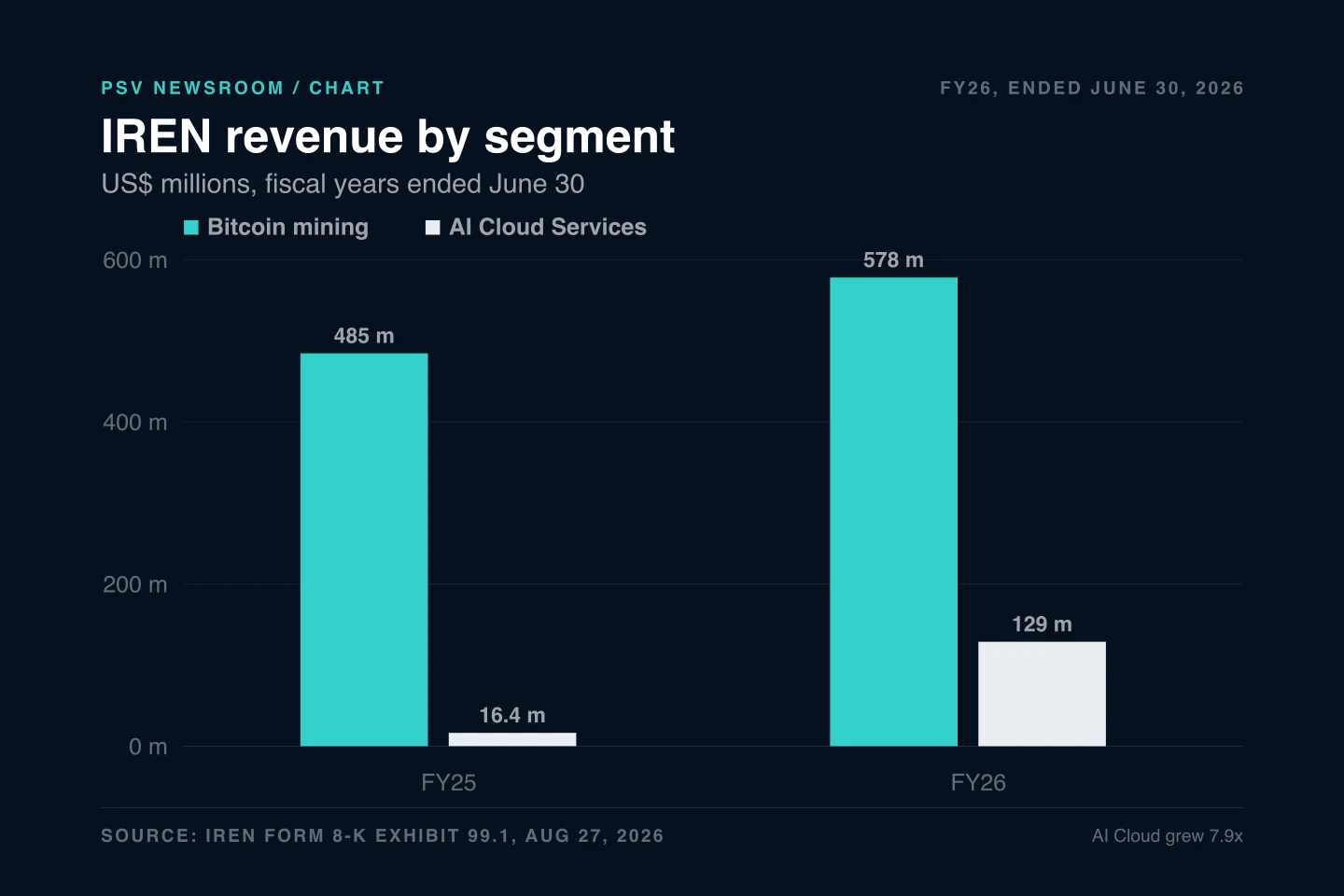
On August 27, 2026 IREN Limited (NASDAQ: IREN) filed its Form 10-K for the fiscal year ended June 30, 2026 and, the same day, furnished its FY26 results as Exhibit 99.1 to a Form 8-K. Total revenue was $707.0 million against $501.0 million in FY25. Net income (loss) was $(702.6) million against net income of $86.9 million a year earlier. Adjusted EBITDA, a non-GAAP measure the company reconciles in the release, was $245.7 million against $269.7 million, so profitability fell while revenue rose by more than $200 million. AI Cloud Services revenue was $128.8 million against $16.4 million, growth the company describes as approximately 8x and which computes to 7.9x. Bitcoin mining revenue was $578.2 million against $484.6 million. Those are IREN’s figures as filed, not PSV findings.
One line explains most of the distance between the revenue and the loss. Impairment of assets was $638.8 million in FY26 against $7.2 million in FY25, an increase of $631.6 million, and it accounts for roughly 91 percent of the year’s net loss. The quarter tells the same story more plainly. Q4 FY26 total revenue was $137.2 million, down from $144.8 million in Q3, even though AI Cloud Services revenue more than doubled inside the quarter from $33.6 million to $70.5 million, because Bitcoin mining revenue fell from $111.2 million to $66.7 million. That computes to $36.9 million added on one side against $44.5 million lost on the other. Q4 carried $(450.4) million of the year’s impairment and a $(684.0) million net loss, and adjusted EBITDA fell to $19.2 million from $59.5 million, which the company attributes to increased employee related costs and broader platform investment ahead of the AI Cloud Services revenue ramp.
Why a $638.8 million write-off is a real estate number
The 10-K states the reason for the impairment directly, and the wording is what makes this a property story rather than a hardware story. The charges relate primarily to Bitcoin mining hardware as well as certain IT and electrical equipment and data center infrastructure impaired as part of the group’s plan to retrofit its air-cooled data centers in Childress and British Columbia, and to develop additional direct-to-chip liquid and air cooling data centers at the Childress campus, identified in the filing as Horizons 5 and 6. The company describes these as assets displaced from its data centers as part of its strategic focus on expanding AI Cloud Services. Read plainly, that is the cost of a change of use. An air-cooled hall purpose-built for one workload does not become a liquid-cooled hall for another without stranding the mechanical and electrical fit-out inside it, and the write-off is where that shows up. Any operator who has repositioned a building will recognize the shape: the demolition line arrives before the new rent does.
The second half of the filing is the one PSV would carry into an unrelated underwrite. IREN reports $3.6 billion of investment grade GPU financing for the Microsoft contract at 6.0 percent, which its footnote defines as a weighted average across a U.S. private placement and a delayed draw term loan, excluding fees, and which together with customer prepayments funds 96 percent of the associated GPU capital expenditure. Separately it reports $2.8 billion of new GPU financings supporting non-investment-grade customer deployments, including $2.4 billion led by Blue Owl and Pacific Investment Management Company LLC, as adviser to certain investors, at a 9.0 percent fixed rate for the Mackenzie air-cooled expansion, funding 90 percent of the associated GPU capital expenditure. Comparable equipment, 300 basis points apart, and the variable that moves is who signed the contract. That is credit tenancy priced out loud, which is exactly the mechanism behind a net lease cap rate, and it is the most portable fact in the filing for anyone underwriting a single-tenant build-to-suit in any asset class.
| Measure | FY26 | FY25 | Change |
|---|---|---|---|
| Total revenue | $707.0m | $501.0m | up $206.0m |
| AI Cloud Services revenue | $128.8m | $16.4m | up 7.9x |
| Bitcoin mining revenue | $578.2m | $484.6m | up $93.6m |
| Impairment of assets | $638.8m | $7.2m | up $631.6m |
| Adjusted EBITDA | $245.7m | $269.7m | down $24.0m |
| Net income (loss) | $(702.6)m | $86.9m | swing of $789.5m |
The workflow PSV would run on a conversion
The artifact worth building from this filing is not a summary of IREN, it is a conversion ledger kept per building for any asset changing use, whether that is mining to AI, office to residential, or big-box to last-mile. The inputs are documents an owner already holds: the fixed asset register with in-service dates and remaining book value by component, the mechanical and electrical drawings for the existing fit-out, the design basis for the intended use, the construction budget separated into demolition, base building and new fit-out, the power interconnect capacity and any utility agreement, and the contracts or leases that will carry the new use with their counterparty and term. Add two things most ledgers omit: which specific components the retrofit strands rather than reuses, and the financing quote or indicative term sheet behind each counterparty.
The output is one row per building with four columns: book value at risk of write-off, retrofit cost to reach the new use, contracted revenue supporting it, and the cost of capital that the named counterparty actually attracts. That last column is the discipline the IREN filing supplies, because a 300 basis point difference on the same equipment is large enough to change a decision on its own. An assistant can assemble and maintain this ledger, cite the drawing, invoice, filing or term sheet behind every cell, and flag when a component moves between the reuse and strand columns. It should never estimate an impairment: that is an accounting determination made under the applicable standard. The reviewer is the asset manager together with the controller and the project engineer, and the approval gate is that no impairment is booked and no retrofit budget is released on a machine-assembled number. PSV takes no position on IREN as a security and has not audited any figure in its filings.
What stays with a person, and what the filings do not settle
The operator read
Finish with the judgment call.
The reported facts are above. Enter your email for PSV's operator conclusion and a year of access to every newsroom brief.
Free. No card. Privacy policy. Unsubscribe anytime.
 by PSVLive
Build the workflow behind this analysis. Train with the operators doing it.
Real deal files, live builds, and production-ready CRE AI workflows inside the CRE AI Institute.











Clear answers
Common questions about IREN FY26 results data center
Why did IREN report a loss in FY26 when revenue went up?
Because of a single non-cash line. IREN Limited reported total revenue of $707.0 million for the fiscal year ended June 30, 2026, up from $501.0 million in FY25, and a net loss of $(702.6) million against net income of $86.9 million a year earlier. Impairment of assets was $638.8 million in FY26 against $7.2 million in FY25, an increase of $631.6 million, which accounts for roughly 91 percent of the year’s loss. The Form 10-K states the charges relate primarily to Bitcoin mining hardware as well as certain IT and electrical equipment and data center infrastructure impaired as part of the group’s plan to retrofit its air-cooled data centers in Childress, Texas and British Columbia, and to develop additional direct-to-chip liquid and air cooling data centers at the Childress campus identified as Horizons 5 and 6. The company describes these as assets displaced from its data centers as part of its strategic focus on expanding AI Cloud Services. Adjusted EBITDA, a non-GAAP measure, was $245.7 million against $269.7 million.
What does it cost to convert a Bitcoin mining data center to AI?
IREN’s FY26 filings are the clearest public number so far, though they measure one company’s conversion rather than an industry rate. The $638.8 million impairment recorded in the year ended June 30, 2026 covers Bitcoin mining hardware plus IT and electrical equipment and data center infrastructure stranded by the retrofit of air-cooled halls at Childress and in British Columbia. The transition also shows up in operating results while it is underway: Q4 FY26 total revenue was $137.2 million, down from $144.8 million in Q3, because AI Cloud Services revenue rose from $33.6 million to $70.5 million while Bitcoin mining revenue fell from $111.2 million to $66.7 million, which computes to $36.9 million gained against $44.5 million lost. Q4 adjusted EBITDA fell to $19.2 million from $59.5 million, which the company attributes to increased employee related costs and broader platform investment ahead of the AI Cloud revenue ramp. None of these figures are a general benchmark, and the mix of stranded equipment differs by site.
Does a data center tenant's credit rating change the financing rate?
IREN’s FY26 release discloses a 300 basis point difference tied to counterparty credit. The company reports $3.6 billion of investment grade GPU financing for its Microsoft contract at 6.0 percent, defined in its footnote as a weighted average across a U.S. private placement and a delayed draw term loan and excluding fees, which together with customer prepayments funds 96 percent of the associated GPU capital expenditure. Separately it reports $2.8 billion of new GPU financings for non-investment-grade customer deployments, including $2.4 billion led by Blue Owl and Pacific Investment Management Company LLC, as adviser to certain investors, at a 9.0 percent fixed rate for the Mackenzie air-cooled expansion, funding 90 percent of the associated GPU capital expenditure. The equipment is comparable and the counterparty is the variable that moves, which is the same mechanism that separates a credit-tenant net lease cap rate from a non-credit one. Both figures are IREN’s own disclosures rather than an independent finding.
Primary source record
These records support the reported facts in this brief. PSV’s CRE workflow interpretation and test plan are original analysis.
Topics
Related PSV analysis
CRE CAPITAL NEWS
IREN Signed $2.8B in AI Contracts. The CRE Read on a New Data Center Capital Stack
IREN Limited said on July 20 it signed $2.8 billion in new multi-year cloud contracts with leading AI developers, raising its 2026 AI Cloud run-rate revenue target above $4 billion. The detail that matters for real estate is how it is funded: customer prepayments covering roughly 45 percent of the associated GPU capital, on top of equipment-backed financing. The AI data center is being underwritten on contracted cash flow, not speculation.
CRE CAPITAL NEWS
Microsoft Says Its Data Centers Last 25 Years: The CRE Read
On its July 29 earnings call, Microsoft told investors it is extending the estimated useful lives of its datacenters and office buildings from 15 years to 25 years, effective with fiscal 2027, and that more of its future datacenter leases will therefore shift from finance leases to operating leases. The reported capital expenditure number falls to about $175 billion. The commitment behind it does not.
CRE CAPITAL NEWS
Riot’s $573M Bridge Matures Before the Rent Starts
Riot Platforms filed a Form 8-K on August 14 reporting that a project subsidiary closed a senior secured delayed-draw term loan of up to $573.0 million, with Morgan Stanley Senior Funding as administrative agent, to buy long-lead equipment for the 191 critical IT megawatt data center at its Rockdale campus. The loans mature December 31, 2026. The first megawatts are not due to energize until December 2027.
Related guides
Cornerstone PSV guides on the workflows in this article.
by PSVLiveYou read the operator view. Now learn to run the workflow.
The AI MBA for commercial real estate: the workflows these briefs describe, taught end to end on real deal files, with live builds and a community of CRE operators.