CRE POLICY NEWS
Loudoun Votes to Pause New Data Center Applications
Loudoun County’s Board of Supervisors voted 7-1-1 on September 15 to direct staff to draft a resolution pausing new data center applications for up to 12 months while it rewrites its data center zoning rules, over a staff recommendation to take no action. A final vote is reported for October. The Planning Commission is not expected to take up the new rules until February 2027.
Direct answer
Direct answer to Loudoun County data center pause
Nothing is paused yet. The board ordered a resolution, and the only draft language the county has published would pause legislative applications for data centers and substations, narrower than the July motion that also reached administrative applications and site plans. In the county that hosts the largest concentration of data centers in the world, the operative fact for owners and lenders is a clock on new entitlements, not on operating or already-approved sites.
What the Loudoun board voted, and what the record shows
The item was 14.l on the Loudoun County Board of Supervisors’ September 15, 2026 business meeting agenda in Leesburg: “Response to Board Motion to Cease Processing Data Center Applications,” with County Attorney Leo P. Rogers and Dan Galindo of Planning and Zoning as staff contacts. The staff report sets out the history. At its July 22, 2026 business meeting, the board voted 6-1-2, with Supervisor Kristen Umstattd opposed and Supervisors Kershner and Letourneau absent, to have staff prepare an item for September 15 to cease processing data center applications, administrative or legislative, data center site plans and any substation application until the county completes the Phase 2 Data Center Standards and Locations amendments to its Zoning Ordinance and Comprehensive Plan, and to research whether other Virginia jurisdictions had paused data center applications. The County Attorney’s office answered with an attorney-client privileged memorandum, which is not in the public packet. The recommendation that is public is short: staff recommends that the board take no action. The report lists two other alternatives and one draft motion, marked as not recommended by staff, to direct staff to prepare a resolution to pause consideration of legislative applications for data centers and substations while the board considers the Phase 2 amendments.
The board went the other way. NBC4 Washington and WJLA both report that supervisors voted 7-1-1 to direct staff to draft a resolution pausing new data center applications for up to 12 months, with Umstattd voting no and Kershner abstaining. NBC4 reports that each application would be paused for one year from its submission, and that Chair Phyllis Randall said the measure is not a ban or a moratorium but a way to give the county time to write new rules. WJLA reports that the pause applies only to new applications, that a final board vote is expected in October, and that Umstattd opposed it because she believes the board lacks the legal authority and the pause could draw lawsuits. As of this morning the county had not posted the adopted motion or an action summary, so the vote count, the 12-month term and the October date are reported facts, not yet a county record, and whether the adopted motion follows the staff draft’s limit to legislative applications is not established. One date needs a flag: WJLA dates the vote Tuesday, September 16, but the county’s agenda sets the meeting on Tuesday, September 15, and PSV uses the county’s date.
Why the scope line matters more than the vote count
Loudoun’s own fact sheet explains why a pause here moves more real estate than one anywhere else. The county describes itself as home to one of the largest concentrations of data centers in the world, and its record traces how that happened: its zoning administrator classified data centers as similar to offices, buildable by right anywhere offices were allowed. In March 2025, Phase 1 of the Data Center Standards and Locations project ended by-right development of most data centers, so new ones need a legislative approval with public input, while a grandfathering resolution let certain pending applications continue through the by-right process. The fact sheet says the adopted fiscal 2027 budget projects $1.3 billion of data center revenue, 40 percent of the total budget. WJLA reports county leaders put the share at more than half; PSV uses the county’s published figure. The county’s August 24 release says Phase 2 covers noise, on-site energy generation, battery energy storage systems, substations, and data center design and siting, holds open houses on September 28 in Ashburn and September 30 in Leesburg, and expects the project before the Planning Commission in February 2027.
Read those together and the scope question is the whole story. The July motion reached administrative applications and site plans, which is where the grandfathered pipeline lives. The staff draft reaches legislative applications, which since March 2025 is where nearly every new data center project goes. A legislative-only pause leaves approved, grandfathered and in-review projects on their current path and puts land whose value depends on a future special exception behind a clock. Virginia Business reported on August 21 that Supervisors Juli Briskman and Laura TeKrony proposed ending the grandfathering resolution, a change it said would affect more than 20 administrative applications; that proposal was not on the September 15 agenda, and PSV did not find its outcome in the county record. The same agenda shows the county’s other lever at work. Under Zoning Ordinance Section 10.09.C.2.a.1 the Planning Commission has 60 days to act on a Commission Permit or the application is considered approved, and the Administrative Items Report asked the board to extend that clock by 365 days for the Fractus-Lenticular substations on 16.06 acres in Broad Run, the Thayer Road substation on about 9.82 acres in Sterling, and the Berwick Energy Storage facility on about 5.5 acres. The Fractus-Lenticular permits had already been deemed approved on June 29 when the 60-day clock ran out, and the board overruled and remanded them 7-0-2 on July 22. Power, not land, is the binding input for a data center, and a substation is where it enters the site.
The workflow PSV would run on a county pause
The useful artifact is an entitlement status register, one row per Loudoun parcel a firm owns, lends against or is bidding, built from public records. Inputs: the county’s land management system records for each application; the September 15 agenda package; the resolution, once staff drafts it and the board adopts it; the March 2025 grandfathering resolution; the Phase 2 drafts as they post; and the county’s map of existing and proposed data centers. Output: columns that decide something. Application type, whether administrative, legislative, site plan or Commission Permit. Acceptance date, the statutory clock and every extension on record. Grandfathered or not. Whether the project depends on a new substation, and that substation’s own application and clock. Which version of the pause would catch it: the July motion, the staff draft, or the adopted text, with the last column left blank until the text exists. And the Phase 2 topics that touch the site, since noise, on-site generation, battery storage and siting standards can change a project that clears the pause. Every populated cell cites a page of a county record.
The reviewer is the development lead, with land use counsel on the pause and the grandfathering columns, and the approval gate is narrow: no valuation, bid or loan sizing uses an entitlement date for a Loudoun data center site until counsel has checked it against the adopted resolution. An assistant does the volume work well. This brief came out of a 1,987-page agenda package, and the useful facts were an item on page 1,974 and three one-page permit extensions buried in an administrative report. Pulling those out, tracking 60-day and 365-day clocks, and diffing a July motion against a September draft is exactly the work to hand off. What it should not do is decide whether the pause is lawful under Virginia law, predict the October vote, or treat reporting on the motion as if it were the motion. PSV ran no model on this record, tested no product, and promises no cost, schedule or entitlement outcome.
What stays with a person, and what the county has not said
The operator read
Finish with the judgment call.
The reported facts are above. Enter your email for PSV's operator conclusion and a year of access to every newsroom brief.
Free. No card. Privacy policy. Unsubscribe anytime.
 by PSVLive
Build the workflow behind this analysis. Train with the operators doing it.
Real deal files, live builds, and production-ready CRE AI workflows inside the CRE AI Institute.











Clear answers
Common questions about Loudoun County data center pause
Did Loudoun County pass a data center moratorium?
Not yet, and the county avoids that word. NBC4 Washington and WJLA report that on September 15, 2026 the Loudoun County Board of Supervisors voted 7-1-1, with Supervisor Kristen Umstattd opposed and Supervisor Caleb Kershner abstaining, to direct staff to draft a resolution pausing new data center applications for up to 12 months, and that Chair Phyllis Randall said the measure is not a ban or a moratorium. WJLA reports a final vote is expected in October. The county’s own staff report for the item, 14.l, recommended that the board take no action. As of September 16 the county had not posted the adopted motion or an action summary, so the resolution’s text and exact scope are not yet public.
What would the Loudoun data center pause cover?
That depends on the resolution, which does not exist yet. The July 22, 2026 motion that started the process, adopted 6-1-2, asked staff to cease processing data center applications, administrative or legislative, data center site plans and any substation application until the county finishes its Phase 2 Data Center Standards and Locations amendments. The only draft language in the county’s September 15 packet is narrower: a resolution to pause consideration of legislative applications for data centers and substations while the board considers Phase 2. WJLA reports the pause applies only to new applications, and NBC4 reports each application would be paused for one year from submission. Whether the adopted motion reaches administrative applications and site plans is not established in the public record.
Why does a Loudoun data center pause matter for commercial real estate?
Because of how concentrated the market is and how much the county depends on it. Loudoun’s fact sheet calls it home to one of the largest concentrations of data centers in the world and says its adopted fiscal 2027 budget projects $1.3 billion of data center revenue, 40 percent of the total. Since March 2025 most new data centers there need a legislative approval, so a pause on legislative applications reaches nearly every new project, while approved and grandfathered sites are reported to stay on their current path. That splits land values between sites with entitlements in hand and land priced on a future special exception. The Phase 2 rules, covering noise, on-site generation, battery storage, substations and siting, are not expected before the Planning Commission until February 2027.
Primary source record
These records support the reported facts in this brief. PSV’s CRE workflow interpretation and test plan are original analysis.
- Loudoun County Board of Supervisors, Business Meeting Full Agenda Package, September 15, 2026 (source of Item 14.l, “Response to Board Motion to Cease Processing Data Center Applications,” including the July 22, 2026 6-1-2 motion, the staff recommendation of no action and the draft motion to pause legislative applications for data centers and substations; the Administrative Items Report timeline extensions for the Fractus-Lenticular and Thayer Road substations and Berwick Energy Storage; Item 14.j, Tech Park at Dulles Substation; and Item 14.m, Valley North Transmission Line Proposal)
- Loudoun County, “County to Host Open Houses in September on Data Center Policies and Regulations,” news release, August 24, 2026 (source of the Phase 1 and Phase 2 description, the September 28 and 30 open houses, and the expected February 2027 Planning Commission review)
- Loudoun County, Data Center Fact Sheet (source of the by-right history, the March 2025 end of by-right development and grandfathering resolution, and the fiscal 2027 projection of $1.3 billion in data center revenue, 40 percent of the budget)
- Loudoun County, Data Centers in Loudoun County
- NBC4 Washington, “Loudoun County board pauses data center applications,” reporting on the September 15, 2026 vote (source of the reported 7-1-1 tally, the one-year-from-submission mechanics, the Chair’s characterization and the 233 data center count)
- WJLA, “Loudoun County votes to pause new data center applications,” reporting on the vote (source of the reported new-applications-only scope, the expected October final vote and Supervisor Umstattd’s stated reason)
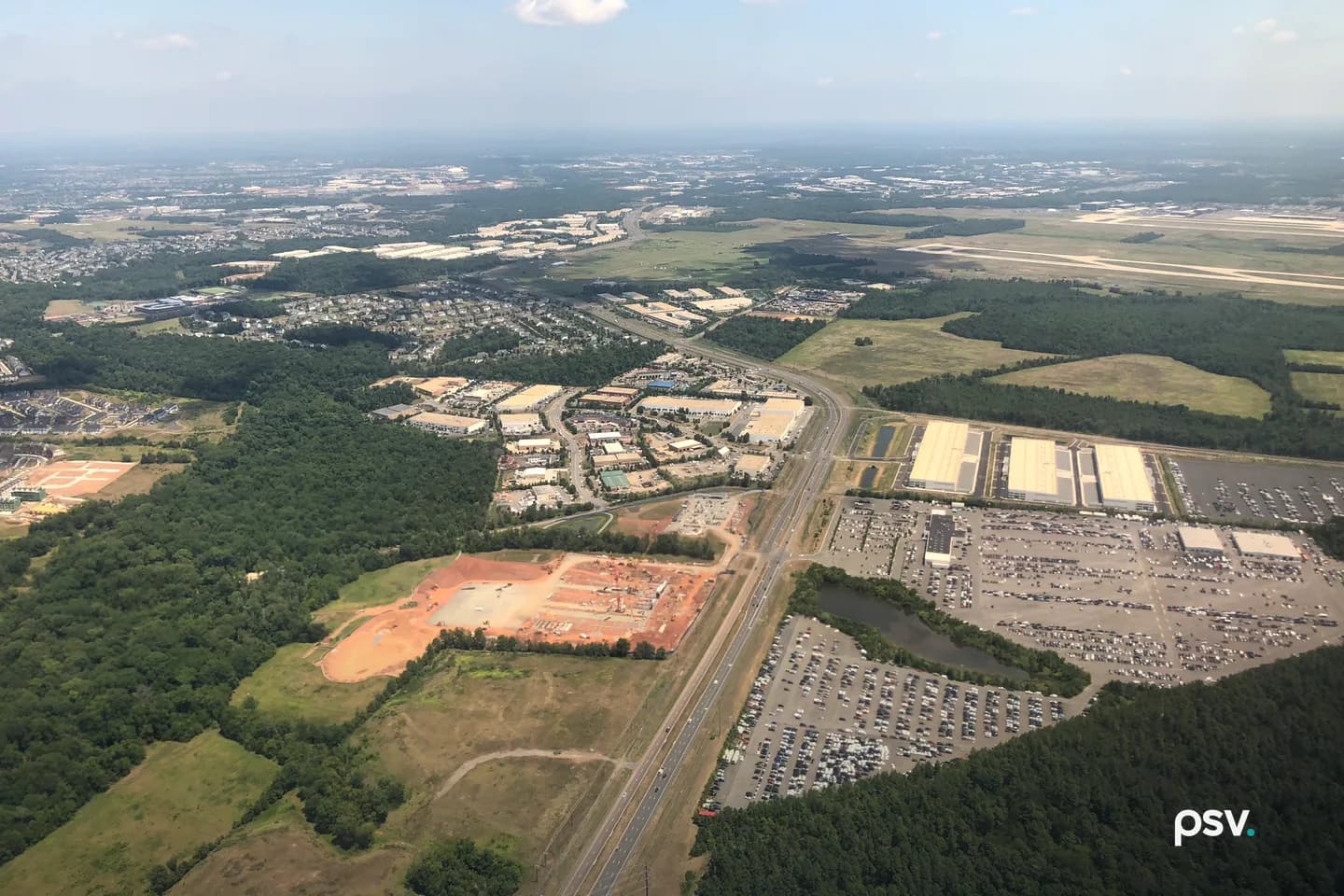
- Famartin, aerial view east along Old Ox Road beside Washington Dulles International Airport, Loudoun County, Virginia, July 19, 2019, Wikimedia Commons, CC BY-SA 4.0 (lead photograph source)
Topics
Related PSV analysis
CRE POLICY NEWS
New York’s Hyperscale Data Center Moratorium: The CRE Read
Governor Kathy Hochul signed Executive Order 62 on July 14, pausing state environmental permits for new hyperscale data centers of 50 megawatts or more for up to one year while New York writes a statewide environmental study and new development standards. It is the first statewide freeze in the country, and it lands on the hottest development pipeline in commercial real estate.
CRE AI NEWS
NAR’s Data Center Report: The Commercial Finding Was the Clear One
The National Association of REALTORS® published its 2026 Data Center Impact Report on September 8, and the coverage led with housing, where its surveyed agents split 25 percent positive against 22 percent negative on nearby home values. The commercial answers were not close. Fifty percent reported increased nearby commercial property values and 42 percent reported increased demand for nearby commercial space, particularly industrial properties and land.
CRE POLICY NEWS
Massachusetts’ Data Center Order Puts a Contract Before the Permit
Governor Maura Healey signed Executive Order No. 658 on September 8, barring MassDEP, the Energy Facilities Siting Board, the MEPA Office and other permitting agencies from issuing any permit to a data center above 25 megawatts of peak demand until it conforms with her June 25 framework and files a community benefits agreement reviewed by the state’s environmental justice office. It also orders a clean energy mandate with a payment alternative.
Related guides
Cornerstone PSV guides on the workflows in this article.
The CRE AI Data & Security Audit
The five-pass audit a CRE firm runs on its own document estate before connecting an assistant: folder access, document provenance, and the approval bands.
Read the guideClaude for Real Estate Developers
The ground-up developer field guide: site selection through IC memo, built on a real development deal.
Read the guideWhat is CRE AI?
The definitional guide to commercial real estate AI: the core workflows, how it differs from a chatbot, and how to learn it.
Read the guideby PSVLiveYou read the operator view. Now learn to run the workflow.
The AI MBA for commercial real estate: the workflows these briefs describe, taught end to end on real deal files, with live builds and a community of CRE operators.