CRE POLICY NEWS
A 22 Million SF Data Center Rezoning Died Over an Ad
The Court of Appeals of Virginia held on March 31, 2026 that Prince William County’s three Digital Gateway rezoning ordinances are void from the beginning, because the county advertised the December 2023 hearing defectively. The county chose not to appeal on April 14, 2026. Compass Datacenters withdrew on April 29, and QTS told the Supreme Court of Virginia on July 2 that it was terminating the project.
Direct answer
Direct answer to Prince William Digital Gateway rezoning void
Three ordinances covering 1,760 acres and 22.2 million square feet of approved data center floor area were declared void from the beginning, not because of what they permitted but because the first of two required newspaper advertisements never ran and the board held the hearing anyway. A supervisor moved to defer until proper notice issued and lost five to three. That motion was the whole case.
What the court record says
On March 31, 2026 the Court of Appeals of Virginia issued a published opinion by Judge Stuart A. Raphael in four consolidated appeals, Record Nos. 1584-25-4, 1590-25-4, 1592-25-4 and 2025-24-4. The holding: “Because the Board violated the advertising rules in Code § 15.2-2204(A) (Supp. 2023) and Prince William County Zoning Ordinance § 32-700.60 (2018), we affirm the trial court’s judgment declaring the Compass, DG South, and DG North rezonings (Ordinances 23-57, 23-58, and 23-59) void ab initio.” Void ab initio means void from the beginning, not cancelled going forward. The trial judgment it affirmed was entered by Judge Kimberly A. Irving of the Prince William County Circuit Court after a bench trial, with the final order made effective September 15, 2025.
The three rezonings were large. Per the opinion, Compass, REZ2022-00036, covered 103 parcels in 11 land bays across 884 acres and would have allowed 11.5 million square feet of gross floor area, with most building heights capped at 85 feet. DG North covered 534 acres and 7 million square feet, DG South 342 acres and 3.7 million square feet. That is 1,760 acres and 22.2 million square feet in total, which is PSV’s arithmetic on the court’s three figures. The opinion states that as many as 37 data centers would have been built in the rezoned areas, operating continuously, with proffers capping noise at 60 decibels by day and 55 at night. The applicants of record are single-purpose entities rather than the familiar brand names: H&H Capital Acquisitions, LLC for Compass, and GW Acquisition Co. I, LLC and GW Acquisition Co., LLC for DG North and DG South.
The defect was an advertisement that never ran
The statute in force required two advertisements, the first no more than 14 days before adoption and at least six days before the second. The county planned for the first to run in The Washington Post on November 28, 2023 and the second on December 5, and the Board’s clerk emailed the paper on November 20 to place it. The first advertisement never ran. Rather than reset the hearing, the Board pressed ahead with December 12 and ran three replacement advertisements, on December 2, December 5 and December 9. The courts held the timing did not satisfy the statute or the county’s own zoning ordinance, and the Board, not the newspaper, was responsible for the failure, which is why the General Assembly’s saving provision for a locality that submitted a correct and timely ad did not rescue it.
What happened at the hearing is the part an operator should read twice. The Planning Commission had recommended denial of all three rezonings on November 8, 2023. The Board opened on December 12 by going into closed session on probable litigation over the rezonings. Supervisor Robert Weir then moved to defer the hearing “until such date as a proper public notice has issued,” saying it would avoid expected litigation; his motion failed five to three. The developers submitted revised proffers in the early hours of December 13 while public comment was still running, and staff told the Board it had not been able to vet them thoroughly. A motion to deny failed four to four. Supervisor Victor Angry’s motion to approve passed four to three with one abstention, and the Board adjourned at 1:14 p.m. on December 13, 27 hours after it convened. Two years later the entitlement was worth nothing.
The workflow PSV would run: a public notice compliance file
The artifact is one file per legislative approval a firm is relying on, built during diligence rather than after a challenge. Inputs: the governing notice statute and the locality’s own zoning ordinance notice section, in the versions in force on the hearing date; the publisher’s affidavits of publication and the actual clippings with their dates; the dates the proposed ordinance text and any revised proffers became available for public review; the agenda, minutes and vote records for the hearing; and the 30 day window in which a notice challenge must be filed. Output: for each approval, the two publication dates with the interval between them, whether the first ran inside the statutory window, whether the text was available when advertised, and whether anyone put a notice objection on the record before the vote.
The reviewer is land use counsel, with the development lead accountable for acting on what the file says. The approval gate: no acquisition of entitled land, and no construction loan closing that relies on the entitlement, until the file is complete and clean, or the price reflects the risk that it is not. An assistant is genuinely useful here, because the work is retrieval and date arithmetic across long records: pulling affidavits, comparing publication dates against the statute, and flagging where a hearing proceeded over a documented objection. It should not opine on whether a defect is curable, and it should not be the reason a firm skips counsel.
What stays with a person, and what the record leaves open
The operator read
Finish with the judgment call.
The reported facts are above. Enter your email for PSV's operator conclusion and a year of access to every newsroom brief.
Free. No card. Privacy policy. Unsubscribe anytime.
 by PSVLive
Build the workflow behind this analysis. Train with the operators doing it.
Real deal files, live builds, and production-ready CRE AI workflows inside the CRE AI Institute.











Clear answers
Common questions about Prince William Digital Gateway rezoning void
Why were the Prince William Digital Gateway rezonings voided?
Because of defective public notice, not because of the data centers. The version of Virginia Code § 15.2-2204(A) then in force required two newspaper advertisements, the first no more than 14 days before adoption and at least six days before the second. The first ad, booked in The Washington Post for November 28, 2023, never ran. The Board held its December 12, 2023 hearing anyway on the strength of replacement ads run December 2, 5 and 9. On March 31, 2026 the Court of Appeals of Virginia affirmed that Ordinances 23-57, 23-58 and 23-59 are void ab initio, meaning void from the beginning.
How large was the Digital Gateway project?
The three rezonings covered 884 acres with 11.5 million square feet of gross floor area (Compass, REZ2022-00036, 103 parcels in 11 land bays), 534 acres with 7 million square feet (DG North) and 342 acres with 3.7 million square feet (DG South). That totals 1,760 acres and 22.2 million square feet, PSV’s arithmetic on the court’s figures. The opinion says as many as 37 data centers would have been built, operating continuously, with proffers capping noise at 60 decibels by day and 55 at night. Widely repeated figures of $100 billion and 3.5 gigawatts appear in no primary record PSV read.
Is the Digital Gateway project dead?
The applicants ended it. Prince William County’s Board of County Supervisors voted unanimously at its April 14, 2026 meeting, Resolution No. 26-231, to direct counsel not to petition the Supreme Court of Virginia. Compass Datacenters said on April 29, 2026 that it could not move forward, citing “recent legal actions and compounding regulatory hurdles.” On July 2, 2026 the GW Acquisition entities, affiliates of QTS, filed notices withdrawing their petitions for appeal, stating that QTS “has made the decision to terminate the Digital Gateway project and withdraw its associated filings.” The land reverts to its prior zoning; nothing prevents a new application.
Primary source record
These records support the reported facts in this brief. PSV’s CRE workflow interpretation and test plan are original analysis.
- Court of Appeals of Virginia, Board of County Supervisors of Prince William County v. Oak Valley Homeowners Association, Inc., published opinion, March 31, 2026 (source of the holding, the void ab initio disposition, the acreage and floor area of each rezoning, the 37 data centers and noise proffers, the advertising timeline and the December 12 and 13, 2023 hearing votes)
- Prince William County Board of County Supervisors, minutes of the April 14, 2026 meeting, Resolution No. 26-231 (source of the unanimous direction to county attorney and outside counsel not to petition the Supreme Court of Virginia, and of the 1:52 a.m. April 15 adjournment)
- Compass Datacenters, “Statement Regarding Digital Gateway Project,” April 29, 2026 (source of the company’s withdrawal and the quoted statement by President AJ Byers)
- GW Acquisition Co., LLC and GW Acquisition Co. I, LLC, Notice of Withdrawal of Petition for Appeal, Supreme Court of Virginia Record No. 260396, July 2, 2026 (source of QTS’s decision to terminate the project and the “tens of billions of dollars in capital investment” characterization; copy posted by the Coalition to Protect Prince William County, not retrieved from the court’s docket)
- Prince William County, Comprehensive Plan Amendment CPA2021-00004, Prince William Digital Gateway staff report (source of the approximately 2,139 acre study area and the 27 million square foot intensity limit that the later rezonings sat inside)
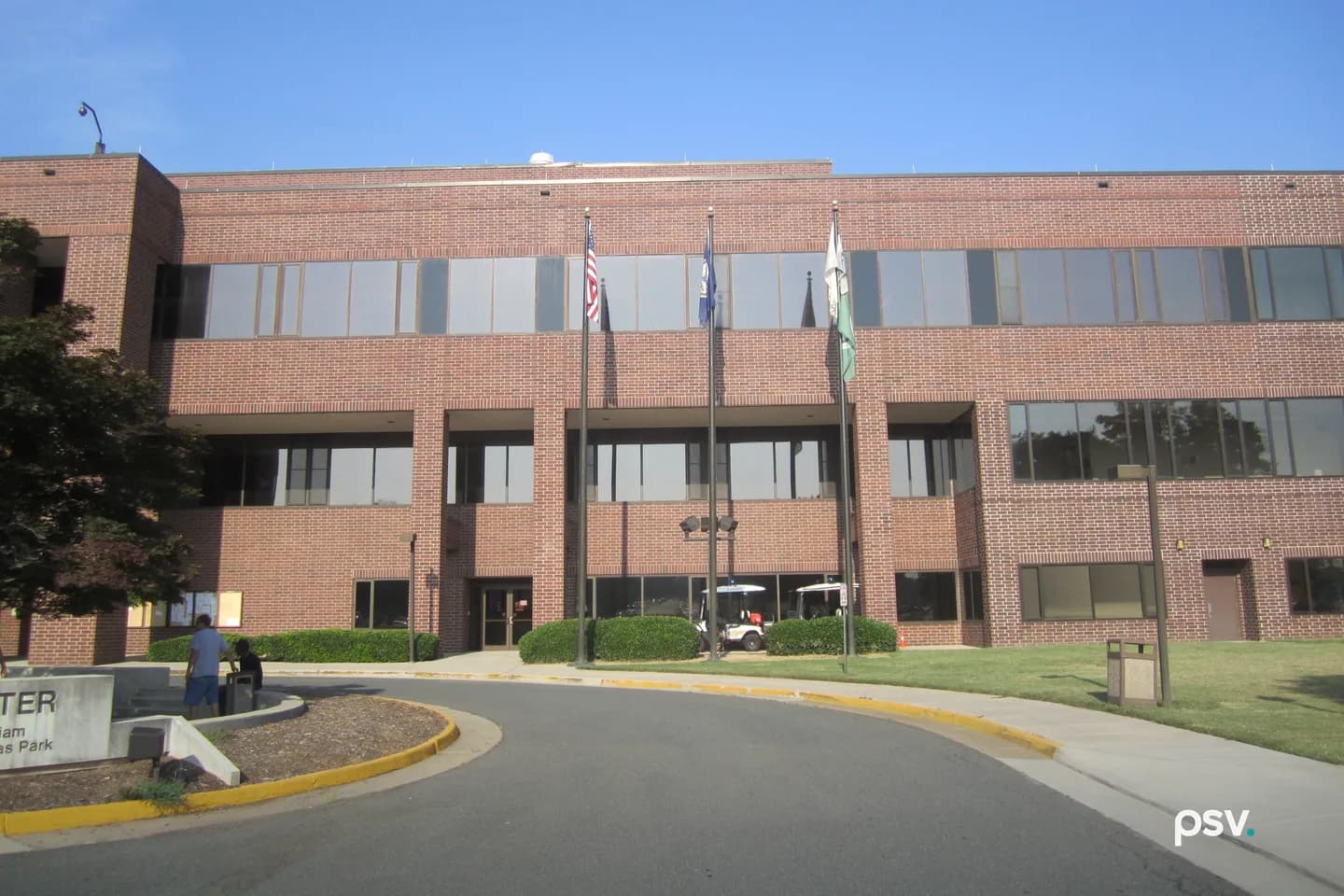
- Billy Hathorn, “Prince William County Courthouse, Manassas, Virginia,” Wikimedia Commons, CC BY-SA 3.0 (lead photograph source)
Topics
Related PSV analysis
CRE POLICY NEWS
Loudoun Votes to Pause New Data Center Applications
Loudoun County’s Board of Supervisors voted 7-1-1 on September 15 to direct staff to draft a resolution pausing new data center applications for up to 12 months while it rewrites its data center zoning rules, over a staff recommendation to take no action. A final vote is reported for October. The Planning Commission is not expected to take up the new rules until February 2027.
CRE POLICY NEWS
Six Federal Cases Are Testing Where a Data Center Can Sit
Five federal class actions filed since April accuse data center operators of pushing unreasonable noise onto neighboring homes, and a sixth case runs the other direction: a developer suing Nashville over a permit moratorium. PSV read all six dockets. Two of the five have already ended, neither of them on the merits, and the pattern is not the one the trade press is describing.
CRE AI NEWS
NAR’s Data Center Report: The Commercial Finding Was the Clear One
The National Association of REALTORS® published its 2026 Data Center Impact Report on September 8, and the coverage led with housing, where its surveyed agents split 25 percent positive against 22 percent negative on nearby home values. The commercial answers were not close. Fifty percent reported increased nearby commercial property values and 42 percent reported increased demand for nearby commercial space, particularly industrial properties and land.
Related guides
Cornerstone PSV guides on the workflows in this article.
by PSVLiveYou read the operator view. Now learn to run the workflow.
The AI MBA for commercial real estate: the workflows these briefs describe, taught end to end on real deal files, with live builds and a community of CRE operators.