CRE POLICY NEWS
California’s Prop 45 Puts CEQA on a Clock. Are Data Centers In?
California votes November 3 on Proposition 45, which would set deadlines on environmental review and lawsuits for projects it calls essential, including housing, office-to-residential conversions and medical office buildings. The text never mentions data centers. Its official proponent says they are out, opponents disagree, and only a court could settle it.
Direct answer
Direct answer to California Proposition 45 commercial real estate
Proposition 45 would give eligible California projects an optional fast track: 365 business days to decide an environmental impact report, 270 days for lawsuits including appeals, and frozen review standards. Housing and commercial-to-residential conversions are clearly named. Data centers are not named or excluded. Treat data center eligibility as unresolved, and treat every result here as conditional until the vote is counted.
What Proposition 45 would do
Proposition 45, on California’s November 3, 2026 ballot, is an initiative statute that would add new procedures to the California Environmental Quality Act for projects it defines as “essential.” The Legislative Analyst’s Office lists the eligible types: housing, water systems except Delta conveyance, clean energy except nuclear, health facilities, clinics and medical office buildings, fire, police and sheriff’s stations, wildfire risk reduction, broadband internet access, education facilities, and transportation except high-speed rail. The new track is optional. The analyst says an eligible applicant may use either the new procedures or the existing ones.
The deadlines are specific. The measure’s text requires a lead agency to decide whether to certify an environmental impact report within 365 days after an application is complete, and it defines “day” in those sections as excluding weekends and state holidays, which computes to roughly 17 months on PSV’s arithmetic. Some published summaries say only 365 days. Lawsuits must be filed within 30 days of the agency’s notice and completed within 270 calendar days, including appeals, with up to 90 more at the court’s discretion. Impacts are judged under the standards in place when the application was submitted, the applicant develops one proposed alternative, and a court can stop only the part of a project that failed review, according to the analyst. The analyst estimates initial state and local costs in the high tens of millions of dollars a year, possibly above $100 million, partly covered by fees, with uncertain long-term effects in either direction.
Why a CRE operator should care
The clearest commercial real estate effect is in housing. The text’s “essential housing project” covers residential-only projects, subdivisions, and “a conversion of an existing commercial building to residential use.” Mixed use qualifies when at least two-thirds of the square footage is residential. It can also qualify at 50 percent residential with at least 500 net new units and no hotel component, and a further path adds demolition or conversion thresholds. Heavy industrial, port and refinery uses cannot count as the nonresidential portion. Standalone office, retail, hotel and warehouse projects do not appear on the analyst’s list. Section 21033 applies the chapter to all pending and future reviews once it takes effect, so projects already in the queue could be affected. Section 21034 lets the Legislature amend it only by a two-thirds vote in each house, and only in ways consistent with its purposes.
The data center dispute turns on one definition. An “essential broadband internet access project” is a project to provide “mass market retail service” to customers with the capability to reach substantially all internet endpoints, “including, but not limited to, any capabilities that are incidental to and enable the operation of the communications service.” Separately, an essential project includes related infrastructure included in the application “to serve” a listed project. The measure expressly excludes high-speed rail, nuclear generation, Delta conveyance and detention facilities, and it does not mention data centers either way. Official proponent Kurt Oneto argues the definition tracks Government Code section 53167 and does not reach them. Brownstein Hyatt reports that a Legislative Counsel opinion, requested by the Yes campaign, reached the same conclusion. Commercial Observer and the Daily Journal report that opponents read the language more broadly and dispute the opinion’s weight. PSV’s read: the argument is not over, because a court, not a campaign, would decide it. A nearer question is power. The clean energy category covers renewable generation, storage, microgrids and associated transmission, and PSV found no limit in that definition based on who buys the electricity. That is PSV’s reading of the text, not a legal opinion.
The workflow PSV would run
Before Tuesday’s result, a California developer can build a pipeline screen that works under either outcome. Inputs: each project’s entitlement file, its use mix by square footage, its CEQA stage and notice dates, and the official measure text. Output: one row per project showing the matching statutory category with the section cited, the square-footage test where mixed use applies, whether the review is pending, the applicable deadline, and any labor requirement the category carries. Broadband, clean energy and education categories each point to Section 21183.5, and counsel should confirm the rest. An extraction tool can draft the row and quote the clause. A land-use attorney reviews it, and the development head approves any change to the schedule.
A second pass belongs in underwriting. For each eligible project, the team should keep the current schedule as the base case and model the new deadlines as a separate scenario, because the deadlines bind the agency and the courts but do not guarantee an approval. Section 21014 says the chapter does not diminish an agency’s authority to approve or disapprove. The other approvals remain too: the analyst notes many projects also need local land use changes and state wildlife or water reviews. Data center projects should stay on their existing California path in any base case. Brownstein reports that Governor Newsom signed seven data center bills this year, including SB 887 on CEQA and AB 2469 on water supply assessments, and those requirements need their own check.
What should remain human-owned
The operator read
Finish with the judgment call.
The reported facts are above. Enter your email for PSV's operator conclusion and a year of access to every newsroom brief.
Free. No card. Privacy policy. Unsubscribe anytime.
 by PSVLive
Build the workflow behind this analysis. Train with the operators doing it.
Real deal files, live builds, and production-ready CRE AI workflows inside the CRE AI Institute.











Clear answers
Common questions about California Proposition 45 commercial real estate
Does California Proposition 45 apply to data centers?
The text does not name data centers or exclude them. The official proponent says the broadband definition does not reach them, and Brownstein Hyatt reports a Legislative Counsel opinion agrees, but opponents read it more broadly. No court has ruled, and PSV has not seen the opinion itself.
What deadlines would Proposition 45 set?
A lead agency would have 365 business days after a complete application to decide whether to certify an environmental impact report. Lawsuits would be filed within 30 days of the notice and completed within 270 calendar days including appeals, with up to 90 more at the court’s discretion.
Would Proposition 45 cover office-to-residential conversions?
The text lists a conversion of an existing commercial building to residential use as an essential housing project. The track is optional, other permits still apply, and labor or other conditions should be checked by counsel. The measure takes effect only if voters approve it on November 3, 2026.
Primary source record
These records support the reported facts in this brief. PSV’s CRE workflow interpretation and test plan are original analysis.
- California Legislative Analyst’s Office, Proposition 45 analysis, November 3, 2026 ballot (procedures, optional election, court changes, fiscal effects)
- California Secretary of State, Official Voter Information Guide, Proposition 45: title and summary, analysis, eligible project list and ballot arguments
- California Secretary of State, complete Official Voter Information Guide, text of proposed laws (Public Resources Code sections 21013 to 21034 as proposed, source of definitions and deadlines)
- Kurt Oneto, official proponent, “Prop 45 Does Not Cover Data Centers: Here’s Why,” National Law Review, October 2, 2026 (advocate’s position)
- Brownstein Hyatt Farber Schreck, client alert on California data center laws, October 27, 2026 (description of the Legislative Counsel opinion and the seven signed bills)
- Commercial Observer, “Is Prop 45 a Quick Fix to California’s Slow Construction Pace?” October 30, 2026 (external reporting on opponents’ reading)
- Daily Journal, “Data centers emerge as flashpoint in Prop 45 CEQA fight” (external reporting; full text not read by PSV)
- CalMatters, Proposition 45 explainer, October 2026 (reports the California Chamber-commissioned study estimate)
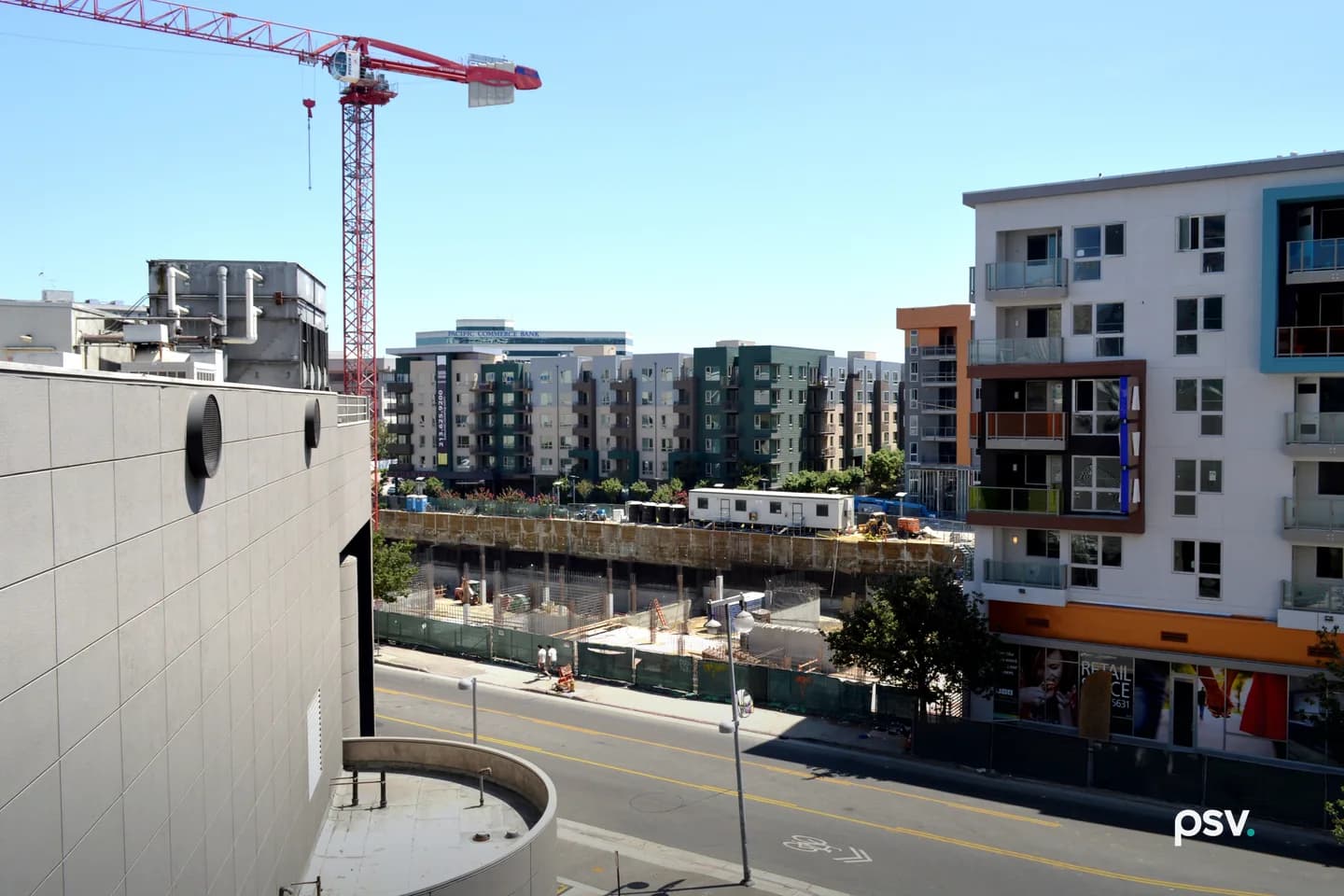
- Wikimedia Commons, “20140622-0256 Little Tokyo,” Nandaro, CC BY-SA 4.0 (lead photograph)
Topics
Related PSV analysis
CRE POLICY NEWS
San Francisco Pauses New Data Centers for 45 Days
San Francisco’s urgency ordinance, File No. 261021, bars the city from issuing any approval for a data center for 45 days, with exceptions for accessory computing and for repair of existing sites. Reporting says the mayor signed it on October 16, 2026, and days later a developer’s plan to convert a shuttered downtown mall surfaced.
CRE POLICY NEWS
Charlotte Extends Its Data Center Pause to October 2027
On October 26, 2026, the Charlotte City Council voted unanimously, according to three local outlets, to extend its moratorium on new data center applications until October 18, 2027. The original 150-day pause, adopted June 8, was due to expire November 5. Projects approved before June 8 and existing facilities are not covered.
CRE POLICY NEWS
Senate Permitting Bill Would Make 20 MW Data Centers Pay
The Bipartisan American Affordability and Jobs Act of 2026, introduced on September 30 by the chairs and ranking members of the Senate’s environment and energy committees, would make data centers and other computing loads of 20 megawatts or more bear the full incremental cost of the power, transmission and distribution built to serve them, and let states auction service.
Related guides
Cornerstone PSV guides on the workflows in this article.
Claude Engineering Partner for CRE
What it means to run Claude with an engineering partner: the operating model, the controls, and who owns what.
Read the guideClaude for Real Estate Developers
The ground-up developer field guide: site selection through IC memo, built on a real development deal.
Read the guideOffice Real Estate AI Underwriting & Acquisitions
Custom AI employees for office real estate underwriting. Distress sourcing, TI/LC modeling, conversion feasibility, and tenant rollover analysis.
Read the guideby PSVLiveYou read the operator view. Now learn to run the workflow.
The AI MBA for commercial real estate: the workflows these briefs describe, taught end to end on real deal files, with live builds and a community of CRE operators.