CRE POLICY NEWS
Senate Permitting Bill Would Make 20 MW Data Centers Pay
The Bipartisan American Affordability and Jobs Act of 2026, introduced on September 30 by the chairs and ranking members of the Senate’s environment and energy committees, would make data centers and other computing loads of 20 megawatts or more bear the full incremental cost of the power, transmission and distribution built to serve them, and let states auction service.
Direct answer
Direct answer to Bipartisan American Affordability and Jobs Act data centers
This is the toughest federal data center cost language yet, and it is still only a bill. Section 2107 sets a 20 megawatt threshold, five times lower than the House-passed Ratepayer Protection Act, bars shifting incremental cost to other customers, keeps billing a load that walks away, and lets states put scarce capacity out to bid. Anyone underwriting a powered site after enactment should price it now.
What the bill text says
On September 30, 2026, Senators Shelley Moore Capito and Sheldon Whitehouse, the chair and ranking member of the Environment and Public Works Committee, and Mike Lee and Martin Heinrich, the chair and ranking member of the Energy and Natural Resources Committee, introduced the Bipartisan American Affordability and Jobs Act of 2026, a 417-page permitting reform bill. Most of it concerns environmental review and energy permitting. The data center language is Section 2107, “Ratepayer protection,” and it works in two ways. Subsection (a) directs the Federal Energy Regulatory Commission, within 270 days of enactment, to revise its 1994 transmission pricing policy statement so that public and transmitting utilities charge transmission customers serving a computational load site both the embedded cost and the incremental cost of that service, with the incremental payments credited back to the utility’s revenue requirement and a lower price for sites that elect non-firm service. A proposed rule follows within 270 days of the revised statement and a final rule within a year after that. A computational load site is one or more buildings at a single location, connected to the bulk power system, that primarily house IT infrastructure for software and services, artificial intelligence training and delivery, cryptocurrency mining or other computing.
Subsection (b) adds a new Section 228 to the Federal Power Act. A covered load is electric load from one or more data centers or high-density computing facilities at a single site, or at multiple sites under common ownership or control, that reaches 20 megawatts, or is reasonably expected to at full buildout if built in phases; computing that is ancillary to some other commercial or industrial use is excluded. No portion of a utility’s incremental cost to serve a covered load may be recovered from any other customer. The rate must keep recovering that cost even if the load terminates its contract or stops buying power first. Before building or upgrading generation, transmission or distribution for a covered load, the utility must require financial assurances or contributions sufficient to cover it. States may charge covered loads more than both embedded average cost and incremental cost and credit the excess to other retail customers, allocate service through an open season or competitive solicitation that favors the greatest present-value benefit to other ratepayers regardless of queue order, require the load to procure new generation, require it to take limited or non-firm transmission, and treat it as a separate, less favored class than other large industrial users. The section applies to covered loads that interconnect on or after enactment; arrangements a state or FERC approved before then remain in effect. Section 2114 separately adds data center load to the Energy Information Administration’s Form 861.
Why a CRE operator should care
The threshold is the headline for real estate. The House-passed Ratepayer Protection Act, H.R. 9340, reaches sites of 100 megawatts or more and only obliges state commissions to consider a standard; this bill sets a binding federal floor at 20 megawatts, counts sites under common ownership together, and counts phased projects at full buildout. By PSV arithmetic that is one fifth of the House threshold, low enough to reach many colocation and enterprise data centers and campus first phases, not only hyperscale builds. The sponsors’ own descriptions frame it the same way: the Energy and Natural Resources fact sheet says the bill requires data centers to pay for all of their associated transmission costs “rather than relying on a voluntary structure.”
The capital consequence is the open season. A state could stop serving large loads in queue order and instead award capacity to whichever covered load offers other ratepayers the most, with each award stating the firm megawatts and the transmission service category. That turns power from a place in line into a priced bid, and it rewards sites that bring their own generation or accept curtailable service. The timing matters too: by PSV arithmetic the FERC steps run at least 270 plus 270 days plus one year, roughly two and a half years after enactment before a final transmission rule, while Section 228’s cost floor applies to loads interconnecting from enactment.
The workflow PSV would run on a 20 MW cost rule
The tool is a covered-load screen across a portfolio or pipeline. Inputs are each site’s expected peak demand at full buildout, the owner and affiliates that could make sites count together under common control, the executed utility service agreement and the date a state commission or FERC approved it, any construction or upgrade cost the utility has quoted, the posted collateral, and the transmission service the site takes. The output is a one-page flag per site: whether it would be a covered load, whether its arrangement predates enactment, what incremental cost and assurance the utility could require, and whether the site could win an open season with on-site generation or non-firm service.
The reviewer is the development or acquisitions lead with utility counsel, and the approval gate is that the screen never changes a pro forma on its own. It moves a power cost line only after counsel confirms the bill has become law in that form and the site’s utility or state commission has a filed tariff or order implementing it. Until then, the screen is a sensitivity case, not an assumption.
What stays with a person, and what the record leaves open
The operator read
Finish with the judgment call.
The reported facts are above. Enter your email for PSV's operator conclusion and a year of access to every newsroom brief.
Free. No card. Privacy policy. Unsubscribe anytime.
 by PSVLive
Build the workflow behind this analysis. Train with the operators doing it.
Real deal files, live builds, and production-ready CRE AI workflows inside the CRE AI Institute.











Clear answers
Common questions about Bipartisan American Affordability and Jobs Act data centers
What does the Bipartisan American Affordability and Jobs Act require of data centers?
Section 2107 adds a new Section 228 to the Federal Power Act. For a covered load, data centers or high-density computing facilities of 20 megawatts or more at one site or at sites under common ownership or control, no part of the utility’s incremental cost to serve it may be charged to other customers, recovery continues if the load terminates its contract or stops buying power, and the utility must collect financial assurances or contributions before building upgrades. It also directs FERC to make transmission customers serving computing sites pay both embedded and incremental transmission cost.
Is the Senate permitting bill law?
No. Senators Capito, Lee, Whitehouse and Heinrich introduced it on September 30, 2026. The posted text leaves the bill number and committee referral blank, PSV found no announced markup as of October 19, 2026, and it must pass both the Senate and the House. Its data center provisions apply only to covered loads that interconnect on or after enactment.
How is the Senate bill different from the Ratepayer Protection Act?
The House-passed Ratepayer Protection Act, H.R. 9340, covers sites of 100 megawatts or more and asks state commissions to consider a cost standard without requiring them to adopt it. The Senate bill sets a binding federal floor at 20 megawatts, counts commonly owned sites and phased buildouts together, and lets states charge above cost, credit the excess to other customers, and award service through an open season instead of queue order.
Primary source record
These records support the reported facts in this brief. PSV’s CRE workflow interpretation and test plan are original analysis.
- Bipartisan American Affordability and Jobs Act of 2026, bill text as posted by the Senate Environment and Public Works Committee (Sections 2107 and 2114; 417 pages)
- Senate Environment and Public Works Committee, “Capito, Lee, Whitehouse, and Heinrich Introduce Bipartisan American Affordability and Jobs Act of 2026,” September 30, 2026
- Senate Energy and Natural Resources Committee (Democrats), “Fact Sheet: Heinrich Outlines How Bipartisan American Affordability & Jobs Act Will Deliver Cheaper Energy, More Jobs, and Responsible Growth,” September 30, 2026
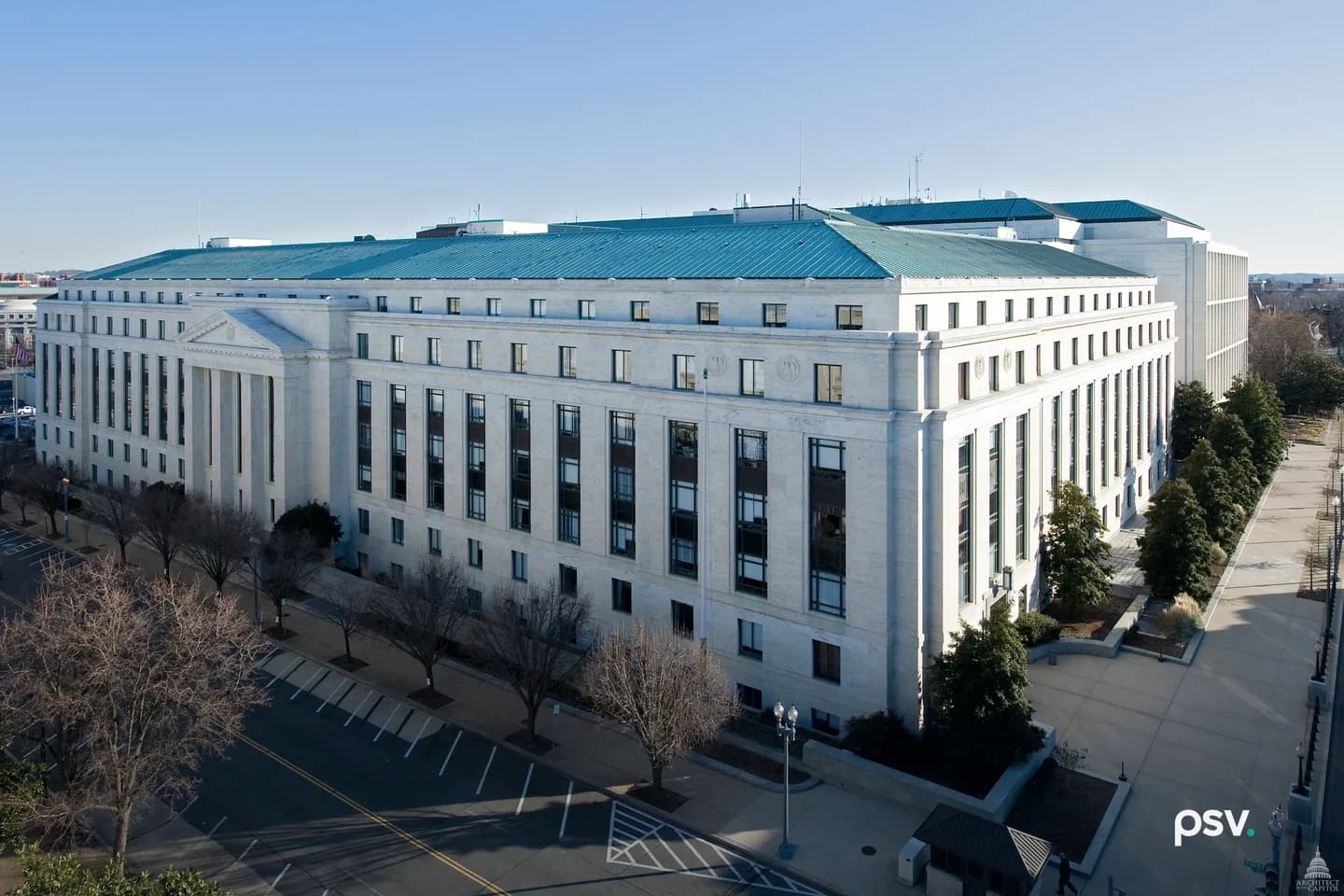
- Architect of the Capitol, “Dirksen Senate Office Building,” Wikimedia Commons, public domain (lead photograph source)
Topics
Related PSV analysis
CRE POLICY NEWS
Ratepayer Protection Act Stalls in Senate
The House passed H.R. 9340, the Ratepayer Protection Act, by 417 to 3 on September 16, 2026. It would add a federal standard to the Public Utility Regulatory Policies Act making data center campuses of 100 megawatts or more pay the full incremental cost of the grid upgrades built for them. On September 17 Senator Martin Heinrich blocked fast passage in the Senate.
CRE POLICY NEWS
FERC Rejects PJM’s Plan to Curtail New Data Centers First
The Federal Energy Regulatory Commission on October 9, 2026 accepted two pieces of PJM’s large load filing, a 50 megawatt definition and a registry, and rejected the rest: the curtailment service, the requirement to bring new capacity and the exemption rules that went with it. The registry took effect October 12.
CRE POLICY NEWS
Wisconsin Made Its 100 Megawatt Customers Sign for the Power
WEC Energy Group filed a Form 8-K on September 4 attaching the investor deck that finally puts numbers on Wisconsin’s Very Large Customer tariff. The Public Service Commission approved it in docket 6630-TE-113 and made it mandatory for any customer with 100 megawatts or more of annual demand. WEC now forecasts 3.9 gigawatts of new electric demand through 2030, and two data center campuses are all of it.
Related guides
Cornerstone PSV guides on the workflows in this article.
Claude MCP for CRE
MCP explained for CRE teams: connect Claude to the files and systems you already run so answers come from your data, with citations.
Read the guideWhat is CRE AI?
The definitional guide to commercial real estate AI: the core workflows, how it differs from a chatbot, and how to learn it.
Read the guideby PSVLiveYou read the operator view. Now learn to run the workflow.
The AI MBA for commercial real estate: the workflows these briefs describe, taught end to end on real deal files, with live builds and a community of CRE operators.