CRE POLICY NEWS
Four Senate Bills Target Data Center Tax Breaks. Each Draws the Line Differently.
Two Democrats and two Republicans on the Senate side have put data center tax benefits in writing: Warner’s bonus depreciation repeal, Wyden’s discussion draft adding a private REIT rule and an excise tax, Hawley’s Opportunity Zone ban and Moreno’s incentive ban. Wyden said November 4 he expects to chair the Finance Committee next Congress.
Direct answer
Direct answer to data center bonus depreciation repeal bill
None of these bills is law, and none has had a committee vote PSV could find. What changed is who may run the committee they sit in: Ron Wyden, whose October 23 draft would end bonus depreciation, Opportunity Zone benefits and some private REIT rent treatment for data centers of 25 megawatts or more, said on November 4 that he expects to chair Senate Finance. The bills define a data center four different ways, and that definition decides which buildings are exposed.
What the four texts say
Sen. Mark Warner, D-Va., introduced S. 5054, the Data Center Tax Accountability and Disclosure Act of 2026, on July 21, 2026, and it was referred to the Committee on Finance. The bill text amends section 168(k) of the Internal Revenue Code so that bonus depreciation does not apply to any property used in an AI data center placed in service after enactment. It defines an AI data center as a structure or group of structures dedicated to housing and operating IT and network equipment, including at least one graphics processing unit, at least 20 percent of which is used for developing or operating artificial intelligence. A facility certified LEED Gold or Platinum is excluded, and the Energy Department and EPA may jointly approve an equivalent standard. A separate section requires every operator of a data center with power demand of 25 megawatts or more to file an initial disclosure, and then an annual report by December 31, covering monthly water withdrawn or consumed and its source, monthly electricity and peak demand, behind-the-meter generation, greenhouse gas emissions, power and water usage effectiveness, power purchase agreements, backup power capacity, fuel stored and hours run, and the setback rules, zoning variances and special use permits that apply to the site. The Tax Foundation estimated in August that the depreciation change would raise $29.9 billion over 2027 to 2036 on a conventional basis. That is the Tax Foundation’s estimate, not an official score.
Senate Finance Committee Ranking Member Ron Wyden, D-Ore., released draft legislative text on October 23, 2026. His committee’s technical summary describes four changes to existing benefits, each limited to data centers of 25 megawatts or more: no bonus depreciation for data center assets placed in service in taxable years beginning after enactment; no Opportunity Zone business status for data center service businesses or property acquired after enactment; and, for a private REIT, defined as one with less than 80 percent of its stock traded on a national exchange, rent from a data center acquired after enactment would not count as qualifying income under either the 75 percent or the 95 percent test. A fourth provision says data center build-out costs cannot be claimed as research credit supplies. The draft also creates a federal excise tax on gross receipts from data center services, with the rate left to be set after revenue estimates. On the Republican side, Sen. Josh Hawley’s S. 5418, introduced September 16, would exclude data centers from qualified Opportunity Zone businesses, and Sen. Bernie Moreno’s S. 5689, the RECLAIM Act, introduced October 15, would bar federal incentives for AI data centers of 100 megawatts or more and impose a 100 percent excise tax on state and local incentives they receive.
Why a CRE operator should care
The tax change most owners will read about is bonus depreciation, but the one that touches real estate structures most directly is the private REIT rule. A large share of data center ownership sits in vehicles that are not exchange-traded: private and non-traded REITs, and joint ventures held through them. Under Wyden’s draft, a private REIT could keep earning qualifying rent from data centers it already owns, but rent from a 25 megawatt or larger data center it acquires after enactment would be bad income for both REIT tests. That changes who can buy a stabilized data center in a REIT wrapper, and it could change the bid. The draft is a discussion text, not an introduced bill, so its wording can still move. That reading is PSV’s, not the committee’s.
The second point is the definitions. The four texts reach different buildings, and the difference is the whole diligence question.
| Bill | Sponsor and date | Which facilities | What changes |
|---|---|---|---|
| S. 5054, Data Center Tax Accountability and Disclosure Act | Warner (D), introduced July 21, 2026 | At least one GPU and at least 20 percent AI use; LEED Gold or Platinum excluded. Disclosure applies at 25 MW or more | No bonus depreciation for property placed in service after enactment; annual water, power, backup and zoning reports |
| Wyden data center tax package (discussion draft) | Wyden (D), released October 23, 2026 | 25 MW or more for the four benefit changes | No bonus depreciation, no Opportunity Zone status, private REIT rent not qualifying income, no research credit; new gross receipts excise tax |
| S. 5418, No Tax Breaks for Data Centers Act | Hawley (R), introduced September 16, 2026 | Data centers (the text PSV read does not set a size) | Not a qualified Opportunity Zone business for interests or property acquired after enactment |
| S. 5689, RECLAIM Act | Moreno (R), introduced October 15, 2026 | 100 MW or more contracted peak demand and at least 50 percent AI accelerator chips | No federal incentives; 100 percent excise tax on state and local incentives received |
The workflow PSV would run
Tax exposure here is a classification problem before it is a tax problem, and classification across a portfolio is where an assistant helps. Inputs: for each data center or powered shell, the contracted and peak megawatts from the utility agreement, the tenant’s stated use and any GPU deployment language in the lease, LEED certification status, the placed-in-service date, the ownership vehicle and whether its shares trade on an exchange, any Opportunity Zone designation for the parcel, and every state or local incentive agreement. Output: one row per asset showing which of the four definitions it meets, which provision would touch it, and the date that decides it, with each cell citing the lease clause, utility letter or certificate it came from. Where the record is silent, such as the share of a tenant’s capacity used for AI, the row says unknown instead of guessing.
The reviewer is the owner’s tax counsel, together with the asset manager who knows the leases. The approval gate is that nothing in that ledger changes a hold, sell, structure or closing date until counsel has read the current bill text and signed the row. Two things to design against. The first is collapsing the thresholds: a 30 megawatt building meets Wyden’s line and Warner’s disclosure line but not Moreno’s, so a single yes or no flag is wrong. The second is treating the Warner disclosure section as a tax item. It is a reporting duty on the operator, which in a leased building may be the tenant, and the setback, variance and special use permit history it asks for usually sits in the landlord’s entitlement files.
What stays human, and what the texts do not settle
The operator read
Finish with the judgment call.
The reported facts are above. Enter your email for PSV's operator conclusion and a year of access to every newsroom brief.
Free. No card. Privacy policy. Unsubscribe anytime.
 by PSVLive
Build the workflow behind this analysis. Train with the operators doing it.
Real deal files, live builds, and production-ready CRE AI workflows inside the CRE AI Institute.











Clear answers
Common questions about data center bonus depreciation repeal bill
Is Congress repealing bonus depreciation for data centers?
Not yet. Sen. Mark Warner’s S. 5054, introduced July 21, 2026, would deny bonus depreciation for property used in an AI data center placed in service after enactment, and Sen. Ron Wyden’s October 23 discussion draft would deny it for data center assets at facilities of 25 megawatts or more. Both sit with the Senate Finance Committee, and PSV found no committee vote. Wyden said on November 4 that he expects to chair that committee in the next Congress.
How would Wyden’s draft affect REITs that own data centers?
Only private REITs, which the draft defines as those with less than 80 percent of their stock traded on a national exchange. Rent from a data center of 25 megawatts or more that the REIT acquires after enactment would not count as qualifying income under the 75 percent or 95 percent REIT tests. Rent from data centers already owned at enactment would still qualify, and listed REITs are not covered by this provision.
Which data centers would lose Opportunity Zone benefits?
Under Sen. Josh Hawley’s S. 5418, a data center could not be a qualified Opportunity Zone business for stock, interests or property acquired after enactment; the text PSV read sets no size. Wyden’s draft would exclude data center service businesses and data centers of 25 megawatts or more, also only for interests and property acquired after enactment. Existing Opportunity Zone investments would not be unwound by either text.
Primary source record
These records support the reported facts in this brief. PSV’s CRE workflow interpretation and test plan are original analysis.
- GovInfo: S. 5054, Data Center Tax Accountability and Disclosure Act of 2026, introduced in Senate (July 21, 2026)
- Senate Finance Committee: “Amid AI Boom, Wyden Unveils Proposals to Ensure Wage Security, Fair Contributions from Data Centers” (October 23, 2026)
- Senate Finance Committee: Wyden data center tax package discussion draft, one-pager and technical summary (October 23, 2026)
- Senate Finance Committee: Wyden data center tax package, draft legislative text (October 23, 2026)
- Senate Finance Committee: “Wyden Statement on Finance Committee Democratic Majority Agenda” (November 4, 2026)
- GovInfo: S. 5418, No Tax Breaks for Data Centers Act, introduced in Senate (September 16, 2026)
- GovInfo: S. 5689, RECLAIM Act, introduced in Senate (October 15, 2026)
- Tax Foundation: congressional data center tax proposals and U.S. AI investment (August 13, 2026; revenue estimate cited)
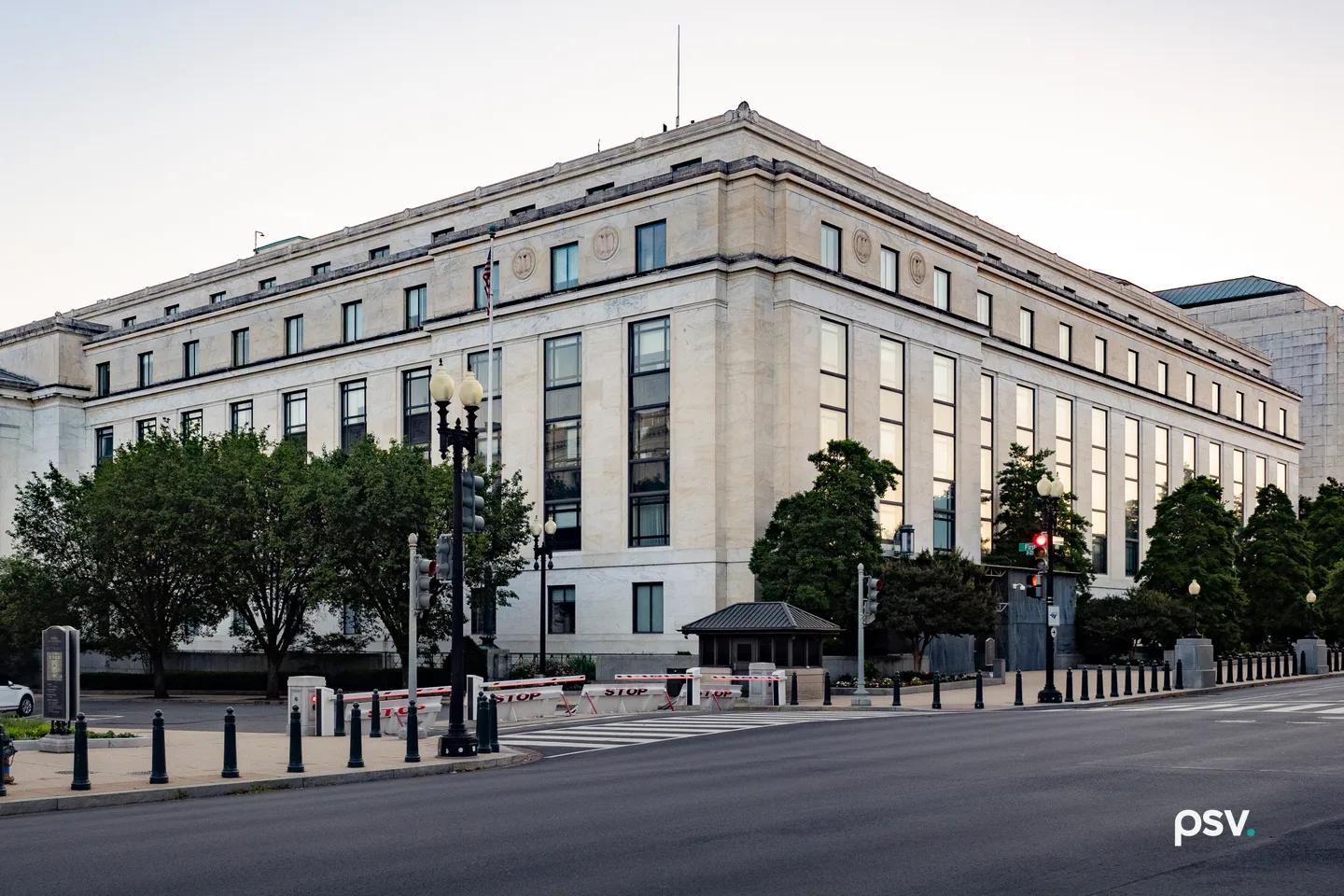
- Wikimedia Commons: Dirksen Senate Office Building (53831703501) (lead image)
Topics
Track every data center moratorium and large-load rule we have reported, with sources: US data center moratorium tracker.
Related PSV analysis
CRE POLICY NEWS
Senate Permitting Bill Would Make 20 MW Data Centers Pay
The Bipartisan American Affordability and Jobs Act of 2026, introduced on September 30 by the chairs and ranking members of the Senate’s environment and energy committees, would make data centers and other computing loads of 20 megawatts or more bear the full incremental cost of the power, transmission and distribution built to serve them, and let states auction service.
CRE POLICY NEWS
Texas Elects a Governor Who Promised a Data Center Moratorium
Democrat Gina Hinojosa won the Texas governor’s race on November 3 after a campaign that called for an immediate moratorium on new data centers until the Legislature passes protections. Governor Greg Abbott’s own audit pause runs until ERCOT reports on December 10. Hinojosa takes office in January, and the moratorium she promised has no published text.
CRE AI NEWS
Amodei’s “Pace the Frontier” and Data Center REITs
On September 12, 2026 Anthropic chief executive Dario Amodei published “We Must Pace the Frontier,” an essay calling on AI companies to slow the rate at which model capabilities improve. Data center landlords sold off in the next session: Digital Realty fell 5.0 percent and Equinix 3.8 percent on September 14. By September 18 both had recovered part of the drop.
Related guides
Cornerstone PSV guides on the workflows in this article.
Enterprise AI for Institutional CRE
PSV trains your whole firm on Claude and ChatGPT, builds your agents live inside your own environment, and stays on as your embedded AI team. What we build for you is yours.
Read the guideWhat is CRE AI?
The definitional guide to commercial real estate AI: the core workflows, how it differs from a chatbot, and how to learn it.
Read the guideby PSVLiveYou read the operator view. Now learn to run the workflow.
The AI MBA for commercial real estate: the workflows these briefs describe, taught end to end on real deal files, with live builds and a community of CRE operators.