CRE AI NEWS
Google Bought Crusoe’s Wyoming Site. The Entitlements Came With It.
Crusoe said on November 6 that Google has acquired its data center site in southeast Wyoming, a day after Google announced a $17 billion first Wyoming data center near Cheyenne. Neither disclosed a price. A Laramie County memo shows how the approvals carried over: the county said in July it would process Google’s revised plan, cut from five buildings to four, administratively.
Direct answer
Direct answer to Google Crusoe Wyoming data center site
The asset that changed hands was not a building. It was a zoned, site-planned parcel with a power plan attached, and the county said it would handle Google’s smaller revision administratively, with a public hearing only on a new office complex. Anyone buying or selling entitled land should price the approvals and know which changes reopen them. The 702 megawatts Google cites is power generation, not disclosed IT capacity.
What Google and Crusoe announced
Google said on November 5, 2026, in a post signed by Steve Walter, its vice president for global infrastructure and energy, that it is building its first data center in Wyoming, in Laramie County, and called it “a long-term, $17 billion investment.” The post names Tallgrass Energy, Black Hills Energy, American Electric Power (AEP) and Related Digital as partners. It says the project is contracted with AEP for a 702 megawatt fuel cell development with carbon capture and storage, using natural gas fuel cells made by Bloom Energy, with captured carbon dioxide stored at Tallgrass’s Eastern Wyoming Sequestration Hub. Google says it is also sourcing power from gas generators run by Tallgrass and Black Hills Energy, that the data center will be air-cooled, that it will pay for all the power it uses, and that it expects “hundreds of millions of dollars in local property taxes for Laramie County and School District 1.” Those are Google’s statements, not PSV findings. The post gives no acreage, building area, IT capacity, start date or completion date, and it does not mention Crusoe.
Crusoe filled in the other half a day later. In a November 6 release from Denver, the company said its site in southeast Wyoming “has been acquired by Google” and that the transaction marks the completion of its pre-development work, which it lists as site selection, governmental approvals and power strategy. Chief executive Chase Lochmiller described that work as “origination, entitlement, and de-risking.” Neither company disclosed a price. A third record dates the handover earlier. In a memo to residents dated July 8, 2026, the Laramie County Board of Commissioners wrote that the project formerly called Project Jade is now Project Tembo, that Crusoe’s submittal had received a zone change to the Switchgrass Industrial Park planned unit development and a commercial site plan approval, that “Crusoe Energy has withdrawn from the project,” and that the county had since held discussions with Google, doing business as Jupiter Star Holdings, LLC, about a re-submittal. The county described a withdrawal in July; Crusoe describes a completed sale in November. The records do not say when the land itself closed.
Why a CRE operator should care
What Crusoe sold was the approval record and the power plan on a piece of land, and the county memo shows how much of that record survived the change of owner. The commissioners wrote that because the updated application is significantly smaller than the approved site plan, the county intends to process the site plan revision administratively. The one public hearing the memo schedules, before the Planning Commission on August 13, 2026, is specific to a new office complex east of the industrial park, which needs a Class B conditional use permit (PZ-26-00057) alongside the overall site plan submittal (PZ-26-00058). PSV did not check the outcome of that hearing. The memo also says Tallgrass holds its own zone change and site plan approvals for a natural gas power hub and that construction phases there are well underway.
The table below sets the county’s figures for the approved plan against the re-submittal. The reduction computes to 945,500 square feet, or about 23.5 percent of the approved building area. Divide Google’s $17 billion by the 3,080,000 square feet in the re-submittal and it computes to roughly $5,500 per square foot of building, but treat that as a ceiling on what the figure could mean, not a construction cost: Google does not define what the $17 billion covers or over what period.
| Item | Approved plan (Crusoe) | Re-submittal (Google) |
|---|---|---|
| Data center buildings | Five | Four |
| Building area | 4,025,500 square feet | 3,080,000 square feet |
| Permanent entrances on US 85 | One | Two |
| Peak construction workforce | 5,000 | 2,500 |
| County review path | Zone change and site plan with public hearings | Site plan revision processed administratively; hearing only for the office complex permit |
The workflow PSV would run
A land or development team on either side of a deal like this should build an approval inheritance schedule before it argues about price. Inputs: the zone change ordinance and planned unit development text, the approved site plan and its conditions, every re-submittal and staff memo, the hearing calendar, the power and offtake agreements with the name of the counterparty on each, and the water and wastewater approvals. Output: one row per approval that states who holds it, whether it runs with the land or with the applicant, what kind of change sends it back to a public hearing, and its status today, with each cell citing the page of the record it came from. An assistant can draft that table from the county’s public notice portal and the contract set and flag every cell where the record is silent.
The reviewer is the team’s land use counsel with the development lead, and the approval gate is that no letter of intent, price or closing date goes out until counsel has confirmed each row against the recorded documents. Power needs the same treatment, because here the public records name different parties. AEP’s quarterly report on Form 10-Q, filed October 28, says an unregulated AEP subsidiary agreed in January 2026 to buy solid oxide fuel cells for approximately $2.65 billion and signed a 20-year offtake arrangement with “a high investment grade third-party customer” for all of the output of a fuel cell facility expected to be located near Cheyenne. The filing does not name the customer or the megawatts. Google’s post names AEP and 702 megawatts. PSV reads the two as the same project, and labels that an inference, not a filed fact.
What stays human, and what the record does not settle
The operator read
Finish with the judgment call.
The reported facts are above. Enter your email for PSV's operator conclusion and a year of access to every newsroom brief.
Free. No card. Privacy policy. Unsubscribe anytime.
 by PSVLive
Build the workflow behind this analysis. Train with the operators doing it.
Real deal files, live builds, and production-ready CRE AI workflows inside the CRE AI Institute.










Clear answers
Common questions about Google Crusoe Wyoming data center site
Did Google buy Crusoe’s Wyoming data center site?
Yes. Crusoe said in a release dated November 6, 2026 that its site in southeast Wyoming has been acquired by Google, and described the sale as the completion of its pre-development work on site selection, governmental approvals and power strategy. Google’s own November 5 post announces a $17 billion first Wyoming data center in Laramie County and does not mention Crusoe. Neither company disclosed a purchase price, the acreage or a closing date.
How big is Google’s Wyoming data center?
Google has not published a size, IT capacity or completion date. A Laramie County Board of Commissioners memo dated July 8, 2026 says the re-submitted Project Tembo plan has four data center buildings totaling 3,080,000 square feet, down from five buildings and 4,025,500 square feet in the plan approved for Crusoe, with a peak construction workforce of 2,500 instead of 5,000. The 702 megawatts in Google’s post is a contracted fuel cell power development, not the data center’s IT load.
Do data center entitlements transfer when a site is sold?
It depends on the jurisdiction and the approval, so confirm it with land use counsel. In this case Laramie County wrote that Crusoe’s submittal had received a zone change and a commercial site plan approval, and that because Google’s revised application is significantly smaller, the county intends to process the site plan revision administratively. Only a new office complex, which needs a Class B conditional use permit, was set for a Planning Commission hearing.
Primary source record
These records support the reported facts in this brief. PSV’s CRE workflow interpretation and test plan are original analysis.
- Google: “Investing in Wyoming’s infrastructure, energy and workforce” (November 5, 2026)
- Crusoe: “Crusoe Announces Wyoming Data Center Campus Update” (November 6, 2026)
- Laramie County Board of Commissioners memo to residents, “Project Tembo Data Center Site Plan and Conditional Use Permit” (July 8, 2026)
- American Electric Power Form 10-Q for the quarter ended September 30, 2026 (filed October 28, 2026; Fuel Cell Agreements)
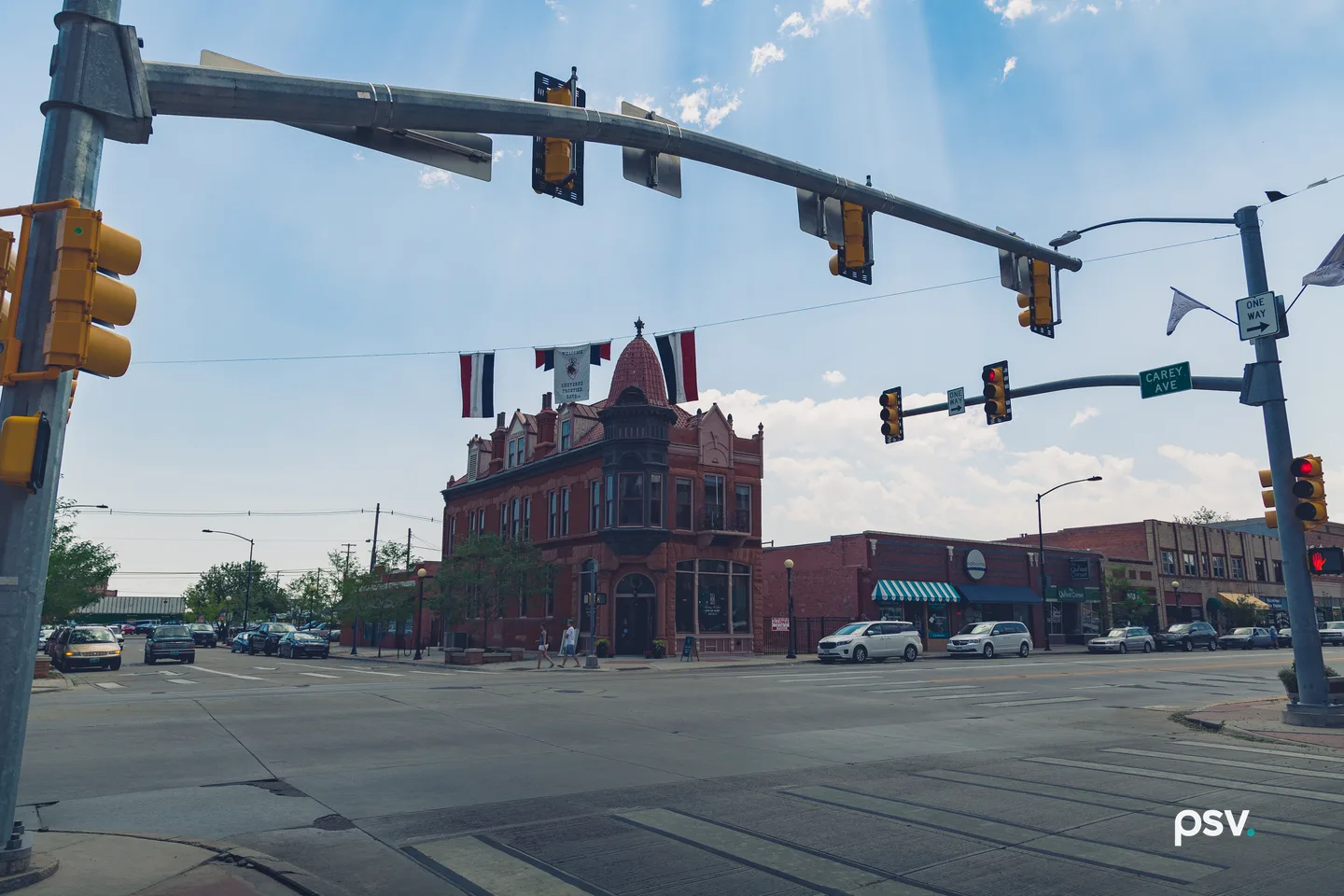
- Lead image: Tony Webster, “Downtown Cheyenne, Wyoming (28169024324),” Wikimedia Commons, CC BY-SA 2.0
Topics
Track every data center moratorium and large-load rule we have reported, with sources: US data center moratorium tracker.
Related PSV analysis
CRE AI NEWS
Google Pays Full Cost for West Memphis Data Center Power
Entergy Arkansas said on October 19, 2026 that Google will fund about $600 million of new infrastructure and a 440 megawatt solar purchase agreement to serve a second phase of its West Memphis data center campus, under a 20-year contract that goes to the Arkansas Public Service Commission for approval.
CRE AI NEWS
Riot Leases All of Corsicana to Anthropic: 910 MW of Powered Land, No Building
Riot Platforms signed a 15-year triple-net powered land lease for its entire 910 critical IT megawatt Corsicana, Texas campus, at $130 per kilowatt a month escalating 3 percent a year. Riot’s release calls the tenant a leading frontier AI lab; its quarterly report on Form 10-Q names Anthropic PBC.
CRE AI NEWS
An Unnamed AI Lab Commits to Lease Cipher’s Barber Lake Data Center From Year 11
Cipher Digital said on September 25, 2026 that a leading AI lab it does not name made a binding commitment to lease its Barber Lake data center in Colorado City, Texas for ten years after Fluidstack’s ten-year lease ends. Cipher puts the added contracted revenue at about $5.2 billion. The same filing moves delivery into phases and sets who pays for cost overruns.
Related guides
Cornerstone PSV guides on the workflows in this article.
Claude Engineering Partner for CRE
What it means to run Claude with an engineering partner: the operating model, the controls, and who owns what.
Read the guideClaude for Real Estate Developers
The ground-up developer field guide: site selection through IC memo, built on a real development deal.
Read the guideIndustrial & Logistics AI Underwriting
Custom AI employees for industrial real estate underwriting. WALT analysis, tenant credit, clear-height and power modeling, and lender packages.
Read the guideby PSVLiveYou read the operator view. Now learn to run the workflow.
The AI MBA for commercial real estate: the workflows these briefs describe, taught end to end on real deal files, with live builds and a community of CRE operators.